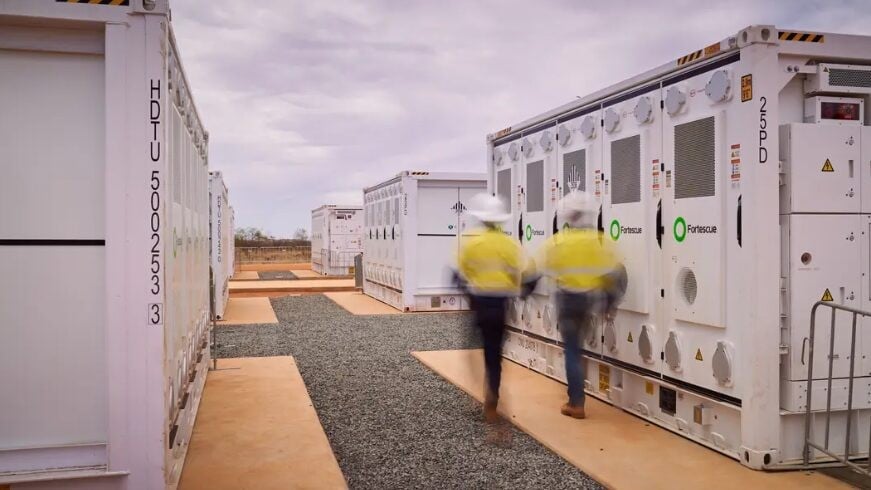
Australian mining giant Fortescue has claimed to have secured large-scale battery energy storage systems (BESS) at pricing levels not previously seen in Australia, according to CEO Dino Otranto during the group’s December 2025 quarterly production report investor call yesterday (22 January).
While declining to disclose specific commercial terms, Otranto said the procurement outcomes would materially support the economics of Fortescue’s decarbonisation programme as the company accelerates deployment of battery storage across its Pilbara operations.
Responding to questions on capital expenditure and battery costs associated with Fortescue’s planned 4–5GWh rollout of energy storage, Otranto said the company was “pretty confident that we’ve secured large-scale BESS at pricing that hasn’t really been seen, certainly in Australia before.”
He added that the pricing would provide “a natural tailwind to the overall project economics,” even as Fortescue continued to manage cost pressures elsewhere across its asset base.
Try Premium for just $1
- Full premium access for the first month at only $1
- Converts to an annual rate after 30 days unless cancelled
- Cancel anytime during the trial period
Premium Benefits
- Expert industry analysis and interviews
- Digital access to PV Tech Power journal
- Exclusive event discounts
Or get the full Premium subscription right away
Or continue reading this article for free
The comments provide further insight into how Fortescue is progressing toward its stated ambition to achieve “real zero” Scope 1 and 2 emissions across its iron ore operations by 2030, without the use of offsets.
Large-scale battery storage is a central component of that strategy, supporting the integration of on-site renewable generation and improving power reliability in the remote Pilbara region, where grid connections are limited and operations have historically relied on gas and diesel generation.
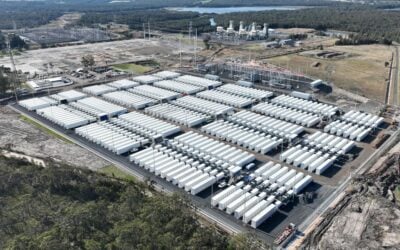
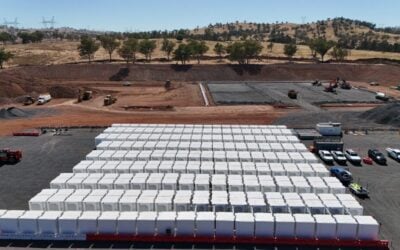
Fortescue has already begun deploying battery systems at scale. During the quarter, the company delivered its first large-scale BESS at North Star Junction, a 50MW/250MWh system that marked the initial phase of the planned multi-gigawatt-hour rollout.
As reported by Energy-Storage.news, the BESS was supplied by Chinese manufacturer BYD. BYD’s Blade Battery technology deployed at North Star Junction forms part of the company’s expanding portfolio of utility-scale storage solutions.
The company launched the 14.5MWh BESS system last year, demonstrating continued advancements in energy density and system integration capabilities that support large-scale industrial applications, such as Fortescue’s mining operations.
Otranto described the operational benefits of battery storage in practical terms, noting that the BESS had already prevented shutdowns during power fluctuations that are common in the Pilbara. He also characterised battery storage installations as relatively simple to deploy compared with conventional power infrastructure, likening them to modular systems that can be replicated at scale.
According to Otranto, the battery storage system has supported higher-than-nameplate performance at Fortescue’s mining and processing facilities by removing power reliability as a limiting factor.
Battery storage deployment is being pursued alongside on-site renewable generation. The North Star Junction project is also home to a 100MW solar PV power plant, which started operations in July 2024.
Located in Pilbara, on the state’s northwestern coast, the solar PV power plant is located close to Fortescue Metal Groups’ Iron Bridge magnetite mine.
Iron Bridge produces a wet concentrate product that is then transported to Port Hedland through a 135km specialist slurry pipeline, where dewatering and materials handling occurs.
Fortescue’s close commercial relationship with Chinese suppliers were highlighted in Otranto’s remarks, something that the organisation has done so several times over past few years.
He noted the procurement of battery storage systems from BYD as part of a broader evolution in Fortescue’s supply chain strategy, which now encompasses solar modules, wind turbines and, in future, hydrogen electrolysers.
Otranto claimed that this relationship has enabled Fortescue to access advanced battery technology at competitive pricing, at a time when global demand for energy storage continues to intensify.
While Fortescue did not break out the share of battery costs within its previously stated US$6.2 billion decarbonisation capital envelope, Otranto’s comments suggest that declining BESS prices are playing a meaningful role in keeping the programme on track.
Earlier this month, Elysia, a battery intelligence data analytics platform owned by Fortescue, acquired a US on-site controls company, Zitara. Managing director of Elysia, Tim Engstrom, spoke exclusively with our colleagues at Solar Power Portal, describing the acquisition as “really connecting battery intelligence to battery action, from cloud to site.” Elysia offers both cloud-based and embedded software to automotive, heavy industry and battery storage sectors.
The Energy Storage Summit Australia 2026 will be returning to Sydney on 18-19 March. It features keynote speeches and panel discussions on topics such as the Capacity Investment Scheme, long-duration energy storage, and BESS revenue streams. ESN Premium subscribers receive an exclusive discount on ticket prices. To secure your tickets and learn more about the event, please visit the official website.