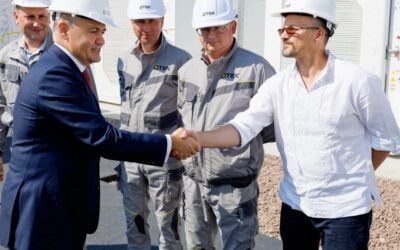
Fluence has deepened its partnership with Ukraine-headquartered energy company DTEK, agreeing to supply a large-scale battery storage project in Poland.
This morning, the Virginia, US-headquartered battery energy storage system (BESS) integrator and technology provider announced the signing of the Polish project deal with DRI, a subsidiary of Ukrainian energy investment group DTEK.
The deal covers DRI’s 133MW Trzebinia BESS project in Chrzanów, southern Poland, about 330km southwest of the capital city, Warsaw.
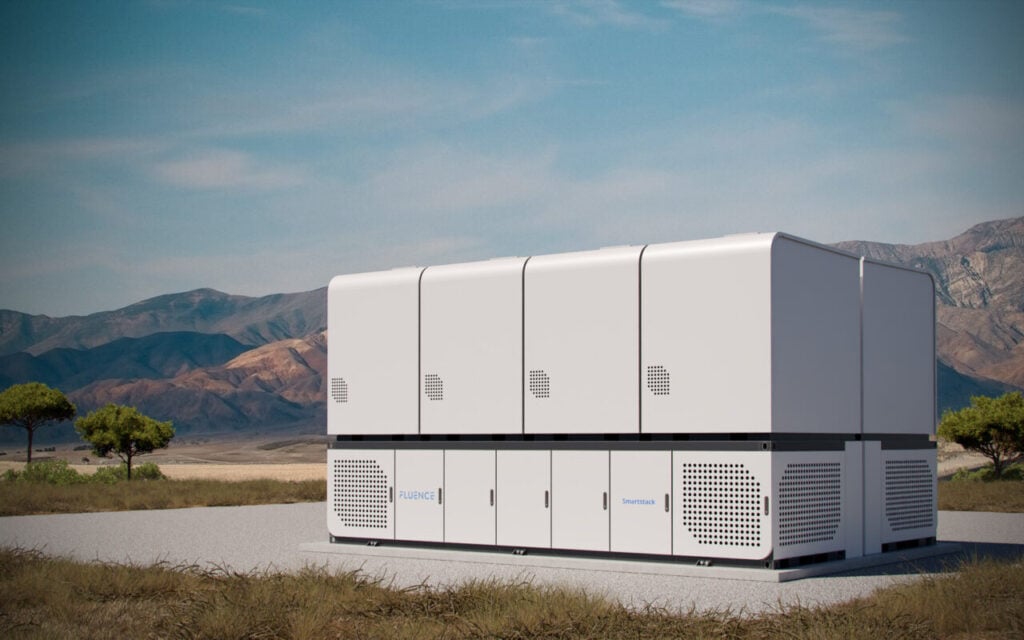
Fluence will provide its newest BESS solution, SmartStack. Launched in February of this year at the Energy Storage Summit EU conference, hosted by our publisher Solar Media, SmartStack is an AC block which integrates power conversion system (PCS) and thermal management into one unit, underneath the battery modules.
Try Premium for just $1
- Full premium access for the first month at only $1
- Converts to an annual rate after 30 days unless cancelled
- Cancel anytime during the trial period
Premium Benefits
- Expert industry analysis and interviews
- Digital access to PV Tech Power journal
- Exclusive event discounts
Or get the full Premium subscription right away
Or continue reading this article for free
The design enables up to 7.5MWh storage capacity per unit using 300Ah cells, in a form factor slightly longer and considerably taller than the standard 20-ft ISO shipping containers that most BESS enclosures on the market use. Fluence’s Battery Pod battery modules and Smart Skid AC skid are transported separately and plugged in on-site.
Fluence recently began the mass production of SmartStack, for delivery to non-US markets, at a factory in Vietnam, which the company is ramping to 35GWh annual production capacity.
Capacity market contracts underpin BESS business case in Poland
DRI secured a capacity market contract in December 2022 for 125MW of the Trzebinia project’s power, making it the largest among the four BESS projects from successful bidders in a reverse auction with a clearing price of PLN 406.35/kW (US$101/kW at that time’s exchange rate).
Along with the other projects from developers Hynfra, OX2, and Energa Wytwarzanie, the Trzebinia BESS’s capacity market delivery obligation starts in 2027. DRI’s win comprised most of the 165MW awarded to battery projects, while other resources, such as gas, were handed 5,379MW of contracts.
Trzebinia’s contract was secured by its then-developer Columbus Energy, which agreed to sell the project to DRI in Spring 2024. At the time, the project’s planned megawatt-hour capacity was planned at 532MWh. A Fluence spokesperson told Energy-Storage.news this morning that the project is now being designed for 622MWh battery capacity.
The following capacity market auction, held in 2023, attracted 16GW worth of pre-registered BESS project bids, resulting in 1.7GW of contract awards to batteries out of a 7GW total, when results were announced in December of that year. The 2023 auction found a lower clearing price than its predecessor at PLN244.90/kW, for capacity market obligations beginning in 2028 and with contract lengths ranging from a year to 17 years.
While other revenue-generating opportunities, such as frequency regulation ancillary services, and wholesale market arbitrage energy trading, are available and likely to be more profitable, the capacity market’s long-term contracts are considered vital for supporting the business case for batteries in Poland.
Poland’s growth of BESS revenue opportunities across the merchant value stack and the bankability of capacity market contracts means that the market has started to see its first waves of third-party asset optimisation deals between project owners and route-to-market providers.
Deal follows COD of ‘historic’ Ukraine projects
DTEK self-describes as the largest private investor in Ukraine’s energy sector, and DRI is the group’s arm for investing in renewable and clean energy projects in European Union (EU) territories.
The Polish project announcement comes just a couple of weeks after DTEK and Fluence announced the start of commercial operation at a 200MW/400MWh, six-project BESS portfolio back in the energy investor’s home country.
Ranging from 20MW to 50MW per project, DTEK has signed ancillary services contracts for the six with Ukraine’s transmission system operator (TSO) Ukrenergo, which represents an investment of around EU125 million.
They form part of a total 500MW BESS buildout that DTEK is aiming for in Ukraine. The company’s CEO Maksym Timchenko said the switching on of the projects was a “historic step” for the country’s energy system. DTEK was the company behind Ukraine’s first-ever megawatt-scale BESS project, which went online in 2022, just a few weeks before the Russian invasion began.
DTEK energy storage lead Vadim Utkin told Energy-Storage.news in an October 2024 interview about the company’s activities in the space, including the ancillary contract wins, he had been impressed with the resilience of his country’s energy network, despite the ongoing assaults from Russia.
National energy minister Svitlana Grinchuk said that “in the context of large-scale attacks on Ukraine’s energy system, the role of energy storage systems has become just as fundamental as energy generation itself.”
Energy-Storage.news publisher Solar Media will host the Energy Storage Summit Central and Eastern Europe 2025 in Warsaw, Poland, this week, 23-24 September.