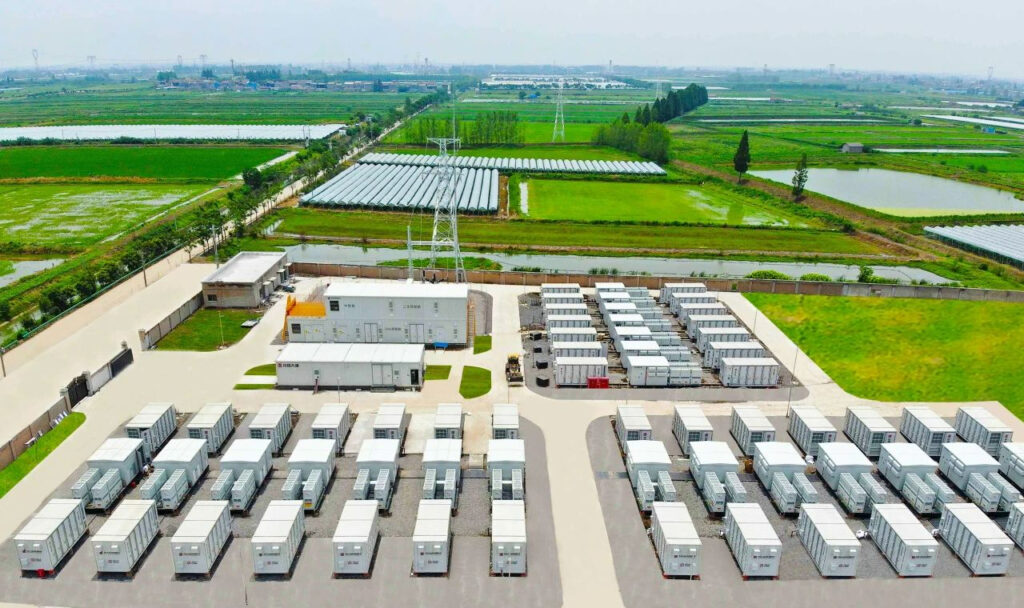
The first phase of the world’s largest sodium-ion battery energy storage system (BESS), in China, has come online.
The first 50MW/100MWh portion of the project in Qianjiang, Hubei province has been completed and put into operation, state-owned media outlet Yicai Global and technology provider HiNa Battery said this week.
Its capacity will eventually be doubled to 100MW/200MWh, but is almost certain to already be the largest sodium-ion project in the world, as claimed in both announcements. It comprises 42 BESS containers containing 185Ah sodium-ion batteries, 21 power conversion system (PCS) units and a 110kV booster station.
As Energy-Storage.news reported when covering the project in January, it is being developed and operated by Datang Hubei Energy Development, part of the state-owned Assets Supervision and Administration Commission of the State Council (SASAC). Its deployment is part of a national-level effort to build large-scale storage projects using non-lithium technologies.
Try Premium for just $1
- Full premium access for the first month at only $1
- Converts to an annual rate after 30 days unless cancelled
- Cancel anytime during the trial period
Premium Benefits
- Expert industry analysis and interviews
- Digital access to PV Tech Power journal
- Exclusive event discounts
Or get the full Premium subscription right away
Or continue reading this article for free
Sodium-ion: high potential but bumpy road to commercialisation
The technology is generally seen as the battery chemistry most well-placed to commercialise at scale and ease supply chain bottlenecks around lithium-ion, the dominant battery chemistry for both electric vehicles (EVs) and BESS applications. Part of this is a similar design making it easier to ‘drop in’ to lithium-ion production lines.
Sodium-ion has a lower energy density and, because of lower scale, generally a higher cost than lithium-ion, although by 2025 it could already be 15-30% cheaper than lithium-ion according to BYD. However, commercialisation and cost reductions have come slower than expected, Yicai Global said.
Technically it also has some advantages according to HiNa Battery. One is a better round-trip efficiency (RTE) and cycle lifetime at extreme temperatures. They also perform much better than general batteries in acupuncture and impact-resistance tests, the project manager said.
Energy-Storage.news has been told anecdotally that one reason China is investing so heavily on sodium-ion technology is because of fears that, long-term, it could start to be cut out of the lithium supply chain. China does dominate the supply chain today, both in terms of battery manufacturing and lithium refining, but HiNa’s announcement pointed out that it only has about 6% of the world’s lithium reserves for mining, whereas it has abundant reserves of the minerals for sodium-ion batteries.
HiNa Battery’s general manager Li Shujun has claimed that the a ‘terawatt-hour’ sodium-ion battery industry will gradually form by 2030, Yicai Global added.