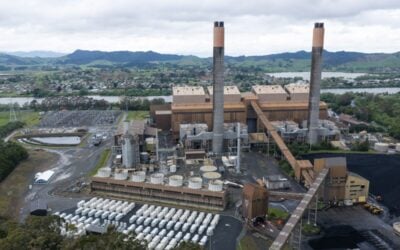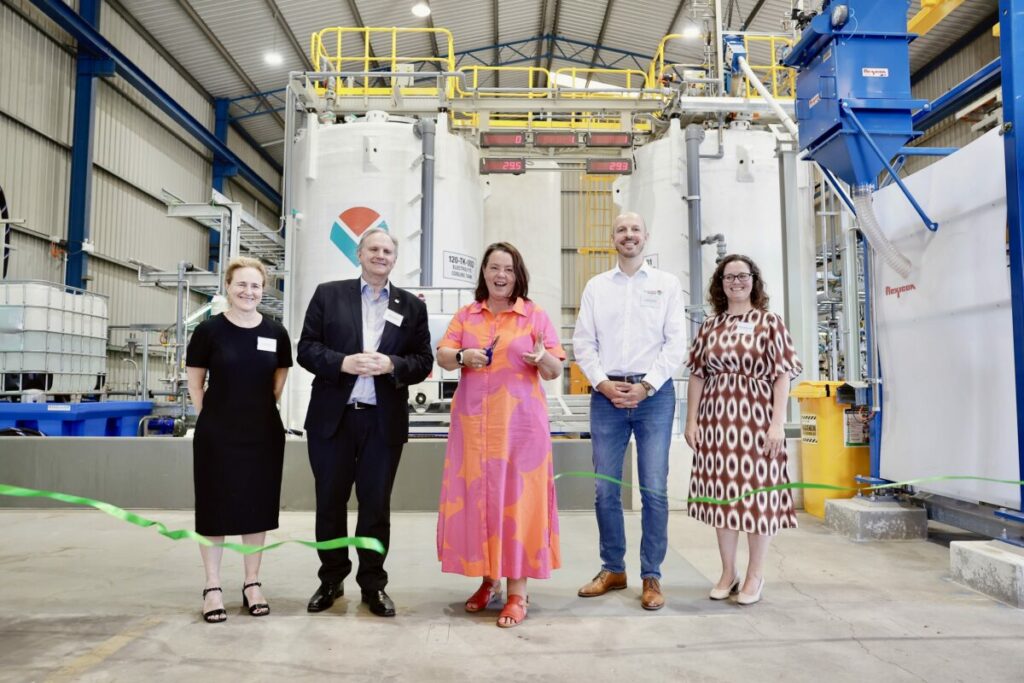
An official opening took place this morning for the new vanadium flow battery electrolyte factory in Western Australia, built by Australian Vanadium (AVL).
Dignitaries including Australian federal resources minister Madeleine King and Western Australia (WA) state politicians, including minister for mines and petroleum David Michael, attended the event today.
The electrolyte is a key material in the making of vanadium redox flow batteries (VRFBs), which store the liquid in tanks separate to the cathode and anode stack of the battery.
That means the energy capacity of a VRFB can be scaled up merely by increasing the size of the tank, as opposed to lithium-ion batteries, where additional stacks are required to create larger capacities. The technology is considered a contender for providing long-duration energy storage (LDES) at scale, and among its advantages are expected long lifetimes through thousands of heavy cycles.
Try Premium for just $1
- Full premium access for the first month at only $1
- Converts to an annual rate after 30 days unless cancelled
- Cancel anytime during the trial period
Premium Benefits
- Expert industry analysis and interviews
- Digital access to PV Tech Power journal
- Exclusive event discounts
Or get the full Premium subscription right away
Or continue reading this article for free
The new electrolyte plant in Wangara, WA, will convert high-purity vanadium pentoxide into vanadium electrolyte. Its initial production capacity has not been revealed, but AVL aims to ramp it up to 33MWh of annual production. The plant’s construction was completed late last year, as reported by Energy-Storage.news in mid-December.
AVL is a vanadium resource company listed on the Australian Securities Exchange (ASX) and is seeking to develop vertically-integrated capabilities along the entire vanadium value chain.
That includes a primary vanadium extraction site that it hopes to open in WA, which could potentially produce a volume of vanadium equivalent to about 5% of today’s entire global supply, as well as a processing plant to turn raw vanadium into the high-purity vanadium pentoxide required for use in batteries.
AVL also has a downstream arm to promote VRFB systems into Australian and overseas markets.
As AVL marketing manager Samantha McGahan wrote in a guest blog for this site last year, access to electrolyte is what will really determine the ability of flow battery companies to scale up and win customer projects. The electrolyte is by far the most expensive component, and shipping it around the world presumably doesn’t make much sense.
AVL is initially buying in its vanadium pentoxide from the Arkansas processing plant of US Vanadium, which in turn has an annual production capacity of four million litres, or about 60MWh of flow batteries.
The company’s new factory was built by engineering firm Primero Group. With vanadium classed as a critical mineral by the Australian government, and with the aim to support domestic manufacturers, AVL received some government funds for the project.
AVL’s plant was developed and built quickly, from the site being selected and secured less than a year ago.
Minister King noted in remarks made this morning that the vanadium flow battery was invented in Australia in the 1980s, and that vanadium “will play a key role in the energy transition”.
Another vanadium electrolyte factory went online in Australia a few months ago. Queensland premier Annastacia Palaszczuk officially opened a plant built by Veeco Group last June, producing liquid electrolyte with an initial production capacity of 175MW annually, which could ramp up to 350MWh.
Energy-Storage.news’ publisher Solar Media will host the 1st Energy Storage Summit Australia, on 21-22 May 2024 in Sydney, NSW. Featuring a packed programme of panels, presentations and fireside chats from industry leaders focusing on accelerating the market for energy storage across the country. For more information, go to the website.