
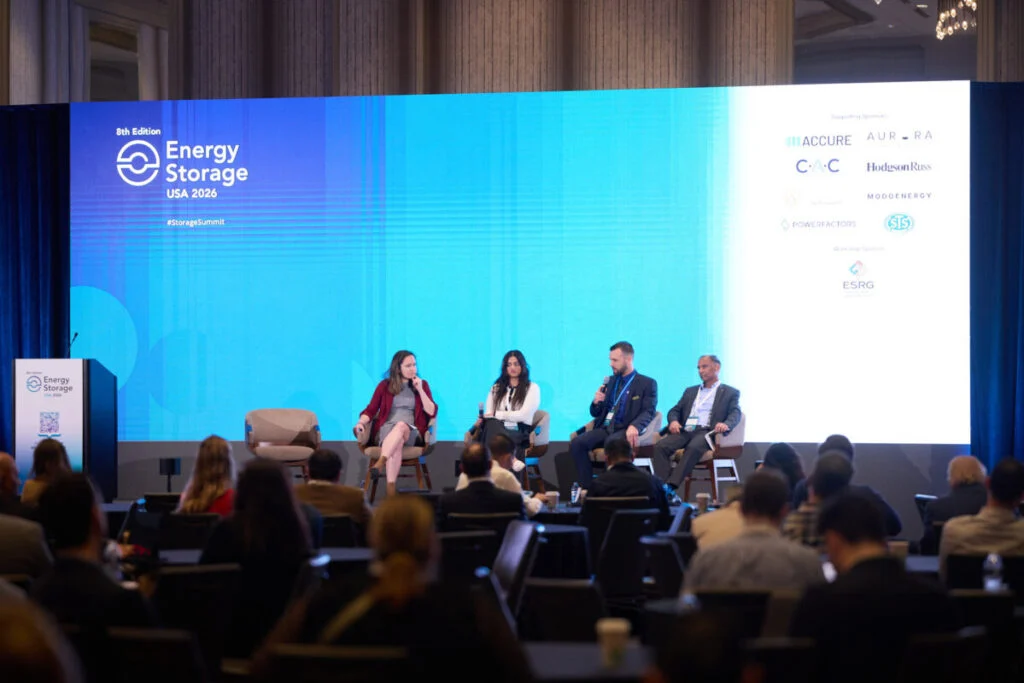
US policy changes are driving developers toward “non-traditional supply chain strategies,” according to a panel at Energy Storage Summit USA 2026.
The panel focused on the evolving landscape of battery energy storage system (BESS) procurement was titled “The EPC and Equipment Squeeze – Navigating Supply Chain Bottlenecks in US Energy Storage.” It took place at the summit in Dallas, Texas, which was hosted last month by our publisher, Solar Media (part of the Informa Group).
It was moderated by Emily Burlinghaus, director of energy storage manufacturing & supply chain at the Solar Energy Industries Association (SEIA) and featured Hugo Leduc, technical advisor, solar and energy storage at STS-Certified, Reddy Tudi, energy storage solutions director at Linxon, and Hema Gupta, supply chain senior director at Onyx Renewables.
SEIA is a non-profit trade association for the US solar and storage industry, STS provides inspections and audits in the PV module and other renewables industries, Linxon is an EPC company, and Onyx is a renewables asset developer.
Try Premium for just $1
- Full premium access for the first month at only $1
- Converts to an annual rate after 30 days unless cancelled
- Cancel anytime during the trial period
Premium Benefits
- Expert industry analysis and interviews
- Digital access to PV Tech Power journal
- Exclusive event discounts
Or get the full Premium subscription right away
Or continue reading this article for free
The shift from EPC to direct developer procurement
Burlinghaus began by questioning whether developers are increasingly taking on direct procurement roles that were traditionally performed by engineering, procurement, and construction (EPC) firms, and what risks this shift might bring.
Gupta provided context on the shift, saying, “The thing is that developers normally like to operate as owners’ reps. The traditional business model is we finance, we fall back, we let the EPCs do all the diligence. We cover ourselves in the contracts. But now, because of the IRS guidance and the Foreign Entity of Concern (FEOC) compliance and the domestic reps and safe harbour reps and begin construction dates, we are now forced to do non-traditional supply chain strategies.”
Energy storage projects that use domestically produced batteries and are likely to meet the FEOC restriction should qualify for a 30% investment tax credit (ITC). Additionally, an extra 10% can be obtained through the domestic content adder. Overall, this could total around a 40% ITC for projects using locally made batteries.
However, the latest interim FEOC guidance from the US Treasury still raises unresolved questions regarding the procurement of the ITC.
Gupta explained the implications: “It’s not that we don’t want to buy them (battery equipment), but normally, in a typical strategy, it works out for us because the risk is not on us, the risk is all on the EPC. But now the way we view products is so different. To have a defensible supply chain, you need proper documentation. It’s not enough for me to now say, ‘Hey, great, you bought this from a third-party distributor. We accept it.’ We need full transparency. We need to know where the stuff is coming from, we need to be able to rep to it.”
Gupta outlined the financial drivers behind this shift, “Because of the new domestic reps and safe harbour, price volatility is a real thing, and we can no longer absorb those margins that EPCs are charging. It’s actually in our best interest to be able to procure properly for a full economic life cycle of a project to come through for us.”
She continued, “In doing that, eliminating the EPC risk, it opens us up for a lot of risks, because now we’re not just buying things. We are the project coordinator. We are the integrators. We are the installers. If something goes wrong, communication, BESS charging, all of that risk now falls on us, so it does make us more vulnerable.”
Leduc stressed the importance of quality control in this new approach, explaining that mitigating risks means ensuring proper technical quality control.
Domestic manufacturing transition
Burlinghaus asked Leduc about the impacts of the shift toward domestic manufacturing and the outlook over the next five years.
Leduc observed, “I would say that the purchase of BESS equipment has shifted from the playground of the CTO to the playground of the CFO. So, there’s obviously understanding the regulation, the changes in supply chain, new factories, new geographies, that have a big impact on the finance part of it now.”
He cautioned about quality concerns with rapid domestic expansion, “We’re talking about assets that are lasting 25 years. If you want to operate these assets for 25 years, you want to make sure you have bankable products that can last and operate throughout that period. It’s going to be hard to build a decade of experience in a year of domestic manufacturing.”
Later in the discussion, Leduc shared that, “Today, there’s about 60GWh of domestic capacity, and there’s a hundred more gigawatt-hours planned. Is that going to be on time? Is it going to be at the quality level? I think we’ve seen in the news a big shift among electric vehicle (EV) manufacturers toward BESS. Usually, you don’t want to be the first one to buy the first model of a car, so you wait for the second year. Imagine if the car switches to a BESS.”
More domestic BESS procurement options are emerging, mainly through various announcements from South Korean battery manufacturers. These companies are either repurposing EV factories or opening facilities specifically for ESS.
Leduc added, “When you look at, for example, fire safety, 20% of the BESS containers we’re inspecting have non-conformities on the fire safety. This is worldwide, not even with new manufacturing. You can imagine a new factory having those risks—that’s crazy. Don’t gamble on your product’s quality.”
Long lead times
Linxon’s Reddy Tudi addressed the challenge of long lead times for critical equipment: “The long lead items in all these projects, either standalone storage or either hybrids or data centre projects, are the high voltage equipment. The breakers today are almost running into two- to three-year lead times. Transformer capacities are the same. The large utilities, the large hyperscalers, they’re locking up a lot of these high voltage products.”
He explained Linxon’s strategy to address this issue, “We, as being 49% owned by Hitachi, we do have some preferential pricing and preferential manufacturing slots. So, we are procuring those long lead items and keeping them in our inventory. And we actually reserve the slots. We were helping out with projects that require faster interconnections with the equipment that we carry.”
When asked at what point in the development cycle developers should be locking in equipment, Tudi responded, “Today, I think when a developer secures land for a site, the first thing is they start doing the interconnection studies. That is the time when the value of that project development really adds, if they actually have the equipment to facilitate the interconnection timing they want.”
Gupta added, “The risks have been so high with delayed lead times and everyone else buying up all the equipment that we’re starting to procure things as early as 30% drawings. And you can understand how challenging that is, because things can definitely change throughout the lifecycle, but it also makes contracting challenging. We’re stepping into the rooms with people and asking them to negotiate pricing and foresee any tariffs, foresee any new FEOC guidance that’s going to come out, up to 12 to 16 months in advance.”
FEOC compliance challenges
The discussion turned to FEOC compliance, which has emerged as one of the industry’s most significant challenges.
Gupta provided commentary on the difficulties, “It has definitely been a challenge. I think I meet 20 vendors every time I go somewhere that are like, ‘We’re FEOC compliant.’ When we ask them to open the books, it’s very challenging. They want to share, but they can only share up to a certain amount, and I understand that this has all been new to everybody. You don’t expect someone to go from completely imported to fully domestic. It’s actually a very unrealistic expectation, to be honest.”
She continued, “Just asking people to open their books, asking to go down to the sub-components, constantly attending webinars, talking to our legal teams, building a defensible supply chain, and being able to diligence all the tax equity requirements has been a very big challenge for us. I’m trying to follow the guidance as much as I can, and they don’t make it easier for the vendors or us.”
Gupta highlighted the confusion even among experts, “I’ve attended webinars where three different legal teams are arguing with each other about their interpretation of what they think is happening. You can just see if legal teams are having a hard time understanding, how are folks like us living in a commercial nightmare going to be able to go through these times?”
Gupta also discussed the frustrating process of procuring ITC insurance:
“I don’t know if any of you deal with ITC insurance to cover a project. That’s a million dollars added on to a project just like that, just in case what they’re repping to is not what they’re repping to, and we’re covered in that way. That’s not making projects bankable. That’s definitely slowing down our timeline. Investors are pulling their money out because they’re getting scared; they don’t want to take that risk of paying the full ITC back, either.”
Tudi added, “To satisfy project finance requirements, the owners are asking the EPC not only to mitigate the tariff risks, but also to prove that we can mitigate the FEOC risks if two years down the line there’s an audit, and if there’s a possibility of the project losing the ITC requirements, who bears that risk? We can say we’re domestically procuring almost everything, but to provide a certificate to say that I am FEOC compliant is very hard. Down the supply chain, we have a big pool of sub-suppliers, everybody to come up with a certificate and say, ‘Yes, I am FEOC compliant,’ it’s a very hard thing to do.”
He contrasted this with tariff risk, “The tariff risk, at least, is a business decision that you can price into a project, but FFEOC is unknown today. The definition is not clearly defined. How do you say, ‘Yes, we are fully FEOC compliant.’?”
