Europe reached 4.5GW of battery storage capacity last year and could hit 95GW by 2050, according to figures from LCP Delta and Aurora Energy Research respectively.
Some 1.9GW of grid-scale battery storage was installed across the continent including the UK last year, LCP Delta said in a separate announcement a few weeks ago.
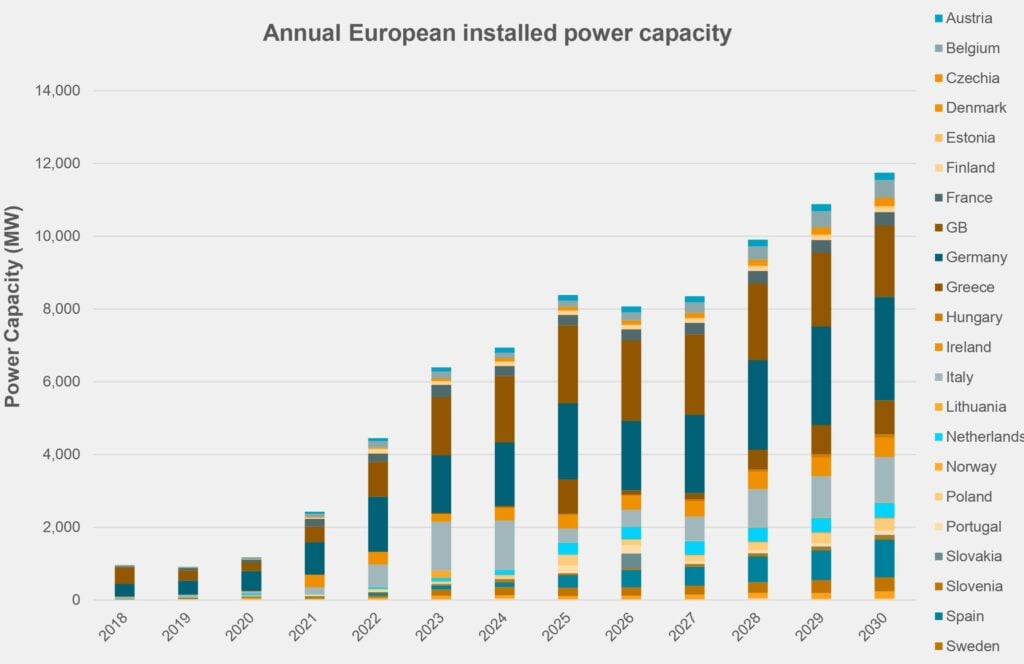
The continent is expected to install at least another 6GW of battery storage in 2023, LCP Delta said in the seventh edition of the European Market Monitor on Energy Storage (EMMES), published in partnership with the European Association for Storage of Energy (EASE).
By 2050, Europe is expected to install at least 95GW of grid-scale battery storage systems, according to separate figures from Aurora Energy Research. It says 5GW of grid-scale storage is online today.
Try Premium for just $1
- Full premium access for the first month at only $1
- Converts to an annual rate after 30 days unless cancelled
- Cancel anytime during the trial period
Premium Benefits
- Expert industry analysis and interviews
- Digital access to PV Tech Power journal
- Exclusive event discounts
Or get the full Premium subscription right away
Or continue reading this article for free
It estimates that four-hour battery storage systems will make up 61% of total installed systems by that year, compared with 22% by 2025. The five most attractive markets for battery storage are Germany, Great Britain, Greece, Ireland and Italy, Aurora said.
Ryan Alexander, Research Lead, European Power Markets, Aurora Energy Research, commented:
“Batteries represent an attractive investment opportunity in Europe’s energy sector—new projects are announced on a near-daily basis as developers seek to capitalise on the need for storage in the energy transition. There will undoubtedly be an early mover advantage for investors: the anticipated surge in demand for batteries over the next decades creates saturation risk, causing revenues to decline as markets become overcrowded.”
The publication of the figures coincides with the European Commission commissioner for energy Kadri Simson describing energy storage as “vital” for the continent’s decarbonisation. Several high-level policy measures to help the energy storage market kick on in Europe have been taking shape over 2023 so far.
In March, the Commission published its proposal for reforming Electricity Market Design (EMD) and energy storage industry figureheads reacted positively to the prominence the technology is being given.
In the same week, the Commission’s Net Zero Industry Act included energy storage as an eligible technology, which was called a “huge victory” by one source.
LCP Delta and EASE showed their forecast for the coming decade in the infographic below.