
The easing of trade frictions through the recent European Union-India agreement could unlock innovation and scale in energy storage, writes Eugene Beh, CEO of Quino Energy.
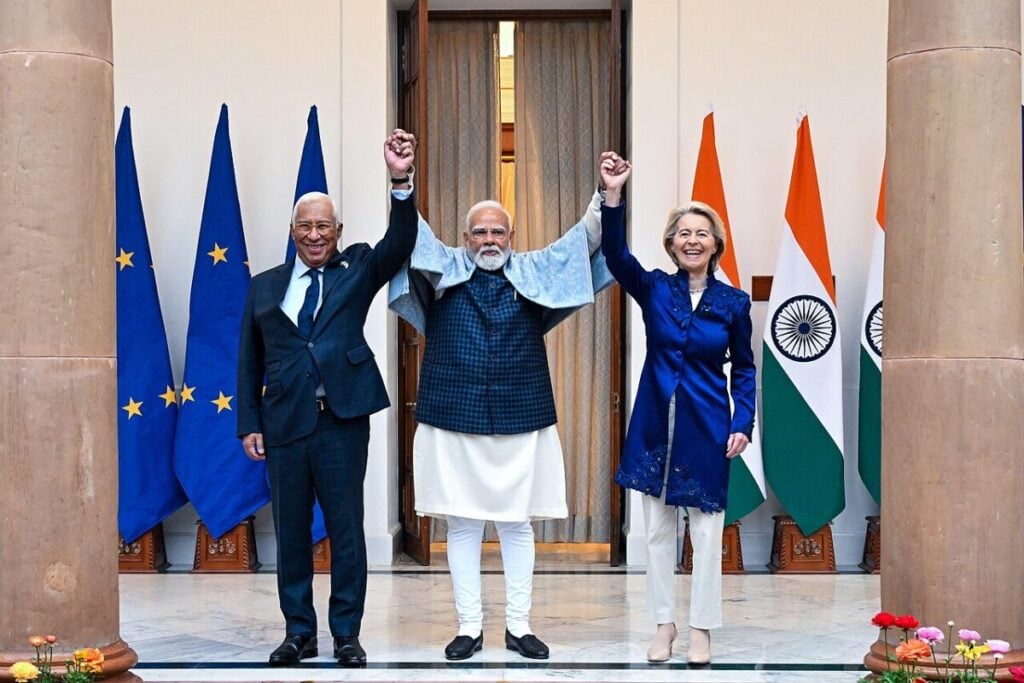
January’s landmark trade agreement between the European Union (EU) and India will not only present significant opportunities for the people of India and Europe, but it will also ease manufacturing processes for those with operations in the negotiating nations.
The deal could double EU exports to India by reducing tariffs by an expected 96.6% and, according to Indian Prime Minister Narendra Modi, it represents 25% of the global GDP and one-third of global trade.
The deal is also expected to benefit the battery energy storage system (BESS) industry and address ongoing barriers to progress due to supply chain challenges and tariff restrictions. Many global energy storage companies are already considering establishing manufacturing operations in India to diversify their supply chains and reduce reliance on Chinese resources.
Try Premium for just $1
- Full premium access for the first month at only $1
- Converts to an annual rate after 30 days unless cancelled
- Cancel anytime during the trial period
Premium Benefits
- Expert industry analysis and interviews
- Digital access to PV Tech Power journal
- Exclusive event discounts
Or get the full Premium subscription right away
Or continue reading this article for free
This new trade agreement could drive energy storage development across Europe by providing developers with increased access to both manufactured goods and upstream raw materials. The EU’s battery storage deployment increased by 45% year-on-year in 2025 to 27.1GWh, largely driven by growth in utility-scale batteries, which demonstrates the desire and need to build out a stronger domestically led manufacturing production effort.
Nearly every battery technology is highly dependent on China in its supply chains, ranging from raw materials and processing to product assembly.
Many companies are expected to use this EU-India trade deal to their advantage to create a battery where the majority of cost components aren’t dependent on China, to ensure continuity of supply through a diversified supply chain. By avoiding Chinese components or keeping their use low, companies can avoid certain penalties or take advantage of lucrative incentives, such as the European Commission’s Made in Europe industrial plan.
The US has similar incentives to strengthen domestically-manufactured content and limit sourcing from foreign entities of concern (FEOC), the most well-known of which is the Renewable Electricity Production Tax Credit (PTC) introduced under the Inflation Reduction Act (IRA) and subsequently modified by the ‘One Big Beautiful Bill Act’ (‘OBBBA’).
Returning to the EU’s plan, this “European Preference” push aims to reduce China’s involvement in European public funding and lessen Beijing’s future investments in the EU. Additionally, the Industrial Accelerator Act (IAA) aims to de-risk clean energy technologies, car manufacturers, and energy-intensive industries such as aluminium, steel and cement, by shifting reliance off China and back to EU manufacturers.
These plans don’t mean that the EU will use zero battery content from China. Instead, companies are partnering with manufacturers in China and India, which will help expand access to overseas markets, as well.
How the EU-India deal will impact BESS manufacturing
The European Climate Law, passed in 2021, formally set several long-term goals proposed by the European Green Deal, including achieving climate neutrality across EU countries and industries by 2050. The law also sets a legally binding target of net-zero greenhouse gas (GHG) emissions by 2050, in line with the Paris Agreement goal.
This trade deal has the potential to catalyse energy storage deployment across Europe by reducing trade and tariff barriers and thereby improving the economics of BESS projects.
European companies that import batteries or battery components can establish partnerships with companies in India to source many of these materials, mitigating supply chain risks. Further, energy storage companies looking to establish or expand production in the EU can similarly procure raw materials required for manufacturing from partners in India.
This effort could drive innovation and adoption for non-lithium energy storage solutions, including flow batteries. For instance, Quino Energy partnered with Indian energy conglomerate Atri Energy Transition to establish a manufacturing line for its organic flow battery electrolyte within India. The trade deal opens up new pathways for scaling the deployment of flow batteries across Europe and worldwide more broadly.
Why the EU prioritises forward-thinking deals to combat tariff uncertainty
The agreement between the EU and India will mean growth for projects and companies in the energy sector as it creates a solid passageway between two significant markets, even in light of larger challenges in global trade. The deal will also help the EU decarbonise its industries while remaining competitive on a global scale, in accordance with last year’s EU Clean Industrial Deal.
Similarly, the EU is passing legislation that will encourage more energy storage deployment and adoption. This includes the REPowerEU initiative to phase out Russian fossil fuel imports, the European Grids Package to lower energy costs by speeding up the modernisation and expansion of the bloc’s energy grid and the EU 2023 Batteries Regulation, to make batteries sustainable throughout their entire life cycle.
Timely progress of the European Parliament finalising and ratifying the EU-India trade agreement would provide much-needed clarity for industry stakeholders. Prolonged uncertainty tends to dampen investment and boost slow decision-making across all industries, including energy storage and batteries. A stable trade environment supports not just commercial growth, but broader national security interests tied to critical technologies and innovation.
About the Author
Eugene Beh is the CEO of Quino Energy, a California-headquartered startup developing and commercialising aqueous flow batteries. Prior to co-founding Quino in 2021, Eugene was a Member of Research Staff at Xerox PARC, where he invented and commercialized a redox flow desalination technology platform, leading him to become PARC’s Most Prolific Inventor in 2020 and 2021.