Pomega is selling the future offtake from its South Carolina ESS gigafactory into a market with “a lot of scepticism about whether US battery cell production is viable”, its VP business development, Louis Caso, told Energy-Storage.news.
The firm, part of Turkish company Kontrolmatik, held a groundbreaking ceremony in February 2023 with land clearing now underway and construction set to conclude in July 2024. The facility will manufacture lithium iron phosphate (LFP) cells and the modules, racks or full containerised battery energy storage system (BESS) solutions, with an initial output of 3GWh, later rising to 6GWh.
It is currently focused on talking to as many players as possible to secure non-binding offtake agreements like the one agreed with Powin last year, Pomega’s Caso said. Speaking to Energy-Storage.news whilst at Energy Storage Summit USA, he said the main challenge the company faces as a new entrant is a lack of existing product that companies can test.
“We have our specifications, we’ve done our testing, the IP for ourselves is very strong. So we own the IP, these are our proprietary cells and we’ve done our own internal testing and we’re very confident that the performance will be up there with the best that are available on the market.”
Try Premium for just $1
- Full premium access for the first month at only $1
- Converts to an annual rate after 30 days unless cancelled
- Cancel anytime during the trial period
Premium Benefits
- Expert industry analysis and interviews
- Digital access to PV Tech Power journal
- Exclusive event discounts
Or get the full Premium subscription right away
Or continue reading this article for free
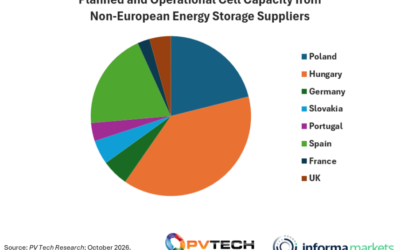
More broadly, the US is quickly catching up to Europe in terms of planned lithium-ion manufacturing capacity but there are still reservations about how successful these projects will be, he said.
“There is still a lot of scepticism in the market about whether US battery cell production is viable. Part of that is just because it hasn’t been done yet. Part of it is due to market factors. Kontrolmatik is committed to the US market and was already working on the factory before the IRA passed. We’re confident we’re going to succeed. Companies are taking a wait-and-see approach with us which is fine and understandable, though it is a challenge.”
Phase one of the gigafactory is a 650,000 square feet site of which 350,000 will be for cell manufacturing with the remainder for ‘value-added’ manufacturing of modules, racks and BESS. Phase two will double its cell manufacturing space.
“That value-added component will be complete before the cell manufacturing portion so we will be able to manufacture and deliver systems using our Turkish cells or our clients’ own cells in advance of the US battery cell production capacity coming online.”
The non-binding offtakes are conditional agreements which can move into purchase agreements once UL certification, bankability assessments and performance testing are complete, Caso said.
“So essentially, it’s allowing companies that are forward-thinking to reserve their capacity from our initial production line, without having to commit any funds. It’s basically a no-risk way to secure capacity for the upcoming pipeline. The agreement will only become enforceable once we demonstrate that we have the certifications and that we’re able to actually deliver.”
“So that’s great for us because it allows us to know what our initial orders are going to be, who we’re working with, what we’re going to be manufacturing for. It helps our lenders see that there’s demand in the market because this is still a very new market.”
The latter is particularly important because lenders still “don’t quite understand” energy storage which is a nascent market compared to EVs.
The exact proportion between what percentage of sales will be cells versus full BESS and anything in between is yet to be determined. Caso said Pomega’s initial plan was to just be a BESS company which manufactured its own cells, but demand for cells was so great that for now, it is just looking to get its product out into the market in whatever way it can.
When asked if selling both BESS and cells to system integrators (like Powin) meant it would be competing with its customers, Caso responded: “We are not in competition with our customers, rather we function as their solutions partner for their project integration. Companies are just enthusiastic about the idea that we can provide them with US-made cells to specifications that we’re offering so they can meet their 2025/26 pipelines.”
Asked about pricing, Caso said Pomega intended to “compete very aggressively on price” and be “very competitive price-wise” with other products.
Kore Power is another firm building a lithium-ion gigafactory but also deploying BESS solutions using those cells, although it has opted for NMC (nickel-manganese-cobalt) chemistry instead.
Read all Energy-Storage.news recent coverage of news in the upstream battery production space here.