
Now in its 11th year and a firm fixture on the industry calendar, the Energy Storage Summit 2026 opened yesterday in London, UK.
Hosted by our publisher, Solar Media—part of the Informa Group—the conference brought nearly 2,000 guests and more exhibitors than ever before to the banks of the River Thames.
While the conversations and debates are set to continue for the second and final day today, here are some of the highlights from Day One, as observed by the Energy-Storage.news team, with help from our colleagues across Solar Power Portal, PV Tech and EV Infrastructure News (EVIN).
We’ll add more to this blog as coverage rolls on. In the meantime, you can download the digital edition of our Energy Storage Report 2026, which is being distributed at the event.
Try Premium for just $1
- Full premium access for the first month at only $1
- Converts to an annual rate after 30 days unless cancelled
- Cancel anytime during the trial period
Premium Benefits
- Expert industry analysis and interviews
- Digital access to PV Tech Power journal
- Exclusive event discounts
Or get the full Premium subscription right away
Or continue reading this article for free
The Energy Storage Report 2026 out now: grid-forming, fire safety, bankability and more
After a brief address from Energy-Storage.news editor Andy Colthorpe, the day proper began with sober reflection on the war in Ukraine, as Monday, 24 February, coincided with the fourth anniversary of Russia’s launch of full-scale attacks under the guise of a three-day ‘special military operation’.
While keynote speaker Serhii Nahorniak, a Ukrainian Member of Parliament and Chairperson of the Sub-committee on Energy Saving and Energy Efficiency, was unfortunately absent due to unforeseen circumstances, you can read some of his thoughts and discussion of the country’s vital strategic need for energy storage, in both war and peacetime, from our recent exclusive interview.
Ukraine’s strategic need for energy storage
Vadym Utkin, energy storage lead at DTEK, Ukraine’s biggest energy sector investor, noted that 40GW of power infrastructure has been destroyed, largely through coordinated attacks. These attacks have also killed 408 employees from DTEK’s workforce of 50,000, many of them key technical staff working to keep critical infrastructure operational.
Despite this, Utkin noted, Ukraine has never suffered blackouts, contrary to what some media have reported. However, the resilience of the transmission system operator (TSO), UKRENERGO, has been severely tested. Utkin highlighted that the TSO responded quickly when more than 150 missiles were launched at energy infrastructure in late 2022, disconnecting thermal power plants to protect the grid.
The rapid procurement and deployment of battery energy storage systems (BESS) in the time since has given Ukraine’s grid a renewed resilience. Vadym Utkin showed operational data from the last few months of 2025, during which around 400GW of automated frequency restoration reserve (aFRR) ancillary services were dispatched with a success rate of around 95%, even during a harsh winter that saw average outside temperatures of -20C.
As Utkin said in an interview with Energy-Storage.news, to be published in the coming days, while investing in Ukrainian BESS assets carries obvious risks, and systems will require security measures to protect them from physical and cyberattacks, the economic case will be helped by a supportive regulatory regime and expedited permitting. UKRENERGO is compelled to respond to grid connection requests within 10 days of receipt, Utin noted.
Balancing profitability and flexibility
The need to balance profitability and flexibility in the energy storage industry was offered as an explanation for the shift towards physical tolling agreements in the European space, during a panel discussion held yesterday.
“There is a balance between profitability and predictability,” said Isabel Rodriguez, managing director of investment manager Nuveen Global. “We all need profitability, and ironically, we need the volatility that we’ll have in the early years. Tolling structures are a tool for two things: predictability and profitability.”
Mark Meyrick, general manager at UK-based route to market platform Smart Grid, added that physical tolling agreements grant battery owners themselves a degree of revenue certainty too, saying that these arrangements allow them to “create a project that they know is viable and use that capital subsequently for further developments.”
However, this is not to say that appetite for conventional floor arrangements has dried up entirely. Maayan As, a director at independent power producer (IPP) Nofar Energy, said that floor arrangements facilitate a close collaboration between offtaker and asset owner, where the toller “will act with the asset as if it’s its own.”
Read the full coverage of the panel discussion here.
Where do fluctuating power prices present an opportunity for batteries?
European power price volatility, and the opportunity this could create for battery storage developers, was a key topic of conversation at another panel discussion yesterday.
“Volatility exists where we have the transition to renewables, or we have an amount of renewable penetration that’s quite high,” said Dan Moore, head of BESS asset management at Root Power, at the panel. “Those markets are the most interesting ones—they’re certainly the most volatile ones.”
These markets are often those with the highest renewable energy generation penetration, too; Alexa Strobel, head of strategy and analysis at Field Energy, said that Germany was a key market for batteries, as it had added 17GW of new solar capacity in 2025, compared to ”like 2GW of operational batteries” at present. This drove spot prices to lows of -€450/MWh (-US$506.57/MWh) in May last year, and this trend is unlikely to stop as more renewable energy capacity is deployed across the continent.
“In Spain, we have a lot of volatility driven by PV, for sure, reaching quite a lot of negative hours a day, which is quite good when it comes to the location of BESS,” added Mikel Pino, head of energy storage Europe at Exus Renewables.
Read full coverage of the panel discussion here.
Exclusive video interviews
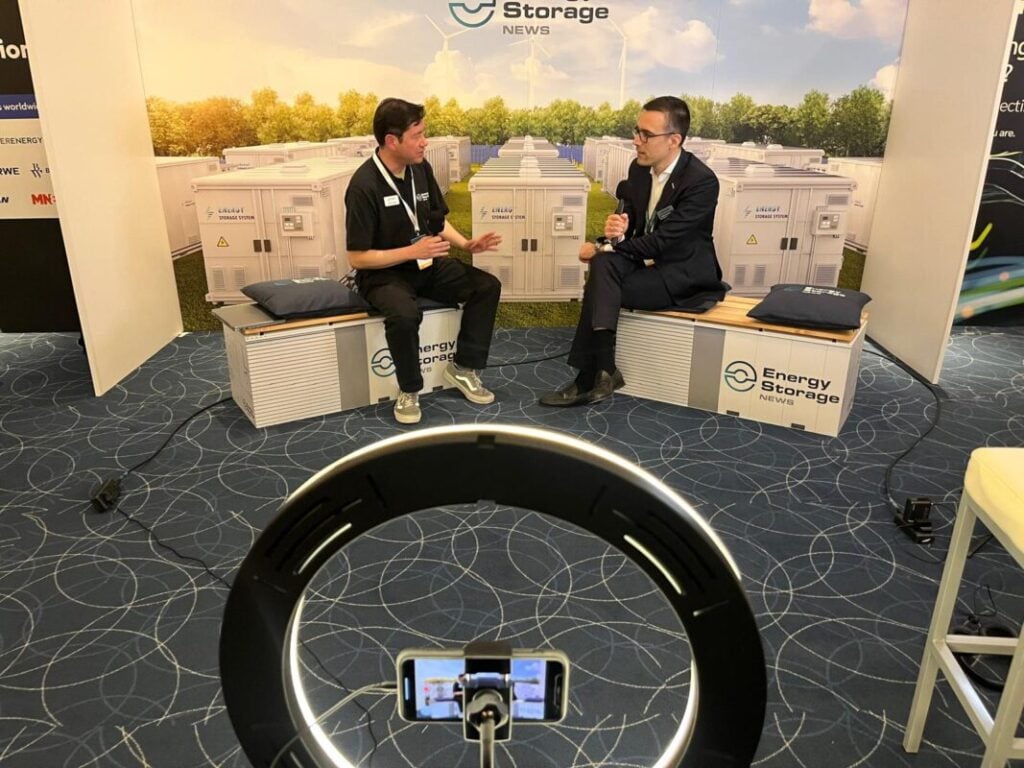
While the industry is all together in London for the Energy Storage Summit, Energy-Storage.news is conducting on-camera interviews. Videos will be available on the site soon.
Zenobē confirms UK grid connection offer
Speaking on a panel yesterday, Georgina Morris-Rowbottom, public affairs and policy lead at BESS developer-investor Zenobē, shared that the company received the first grid connection offer issued by the UK National Energy System Operator (NESO) since reforms to the connection queue were carried out.
That was part of a discussion of what moderator Mark Futyan, chair of clean energy technology provider Arenko, described as “the trauma of grid connections reform,” along with other market changes in the UK in the last year.
Full coverage of the panel is available on Solar Power Portal.