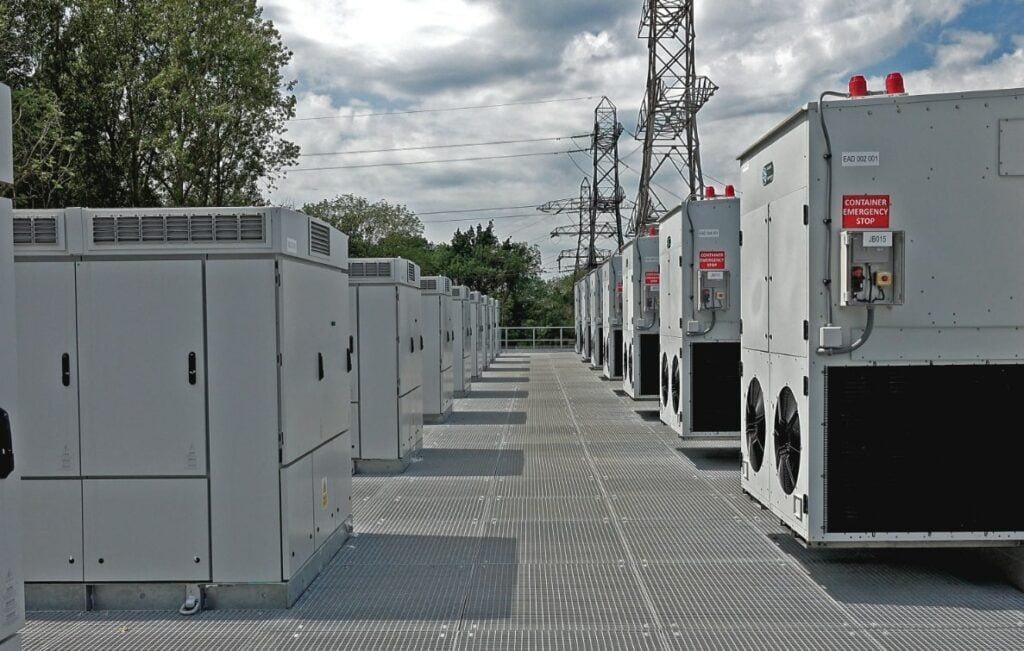
The early numbers on the benefits of the Energy Superhub Oxford’s combination of lithium-ion and vanadium flow batteries are “encouraging”, project owner EDF Renewables told Energy-Storage.news in an interview one year on from its launch.
The project in the UK city of Oxford was officially inaugurated 12 months ago with the opening of one of two main components of the project, its 42-bay EV charging park, claimed to be the most powerful in Europe. Energy Superhub Oxford was launched by developer Pivot Power which was then acquired by EDF.
The other main component is a battery energy storage system (BESS) combining 50MW/50MWh of lithium-ion batteries and a 1.25MW/5MWh vanadium redox flow battery (VRFB), supplied by Wärtsilä and Invinity Energy Systems respectively, and optimised by Habitat Energy. The project was the subject of a deep-dive in Vol.30 of PV Tech Power, Solar Media’s quarterly technical journal.
The two parts of the BESS were energised earlier than the park but it took a while to get their participation in the UK’s ancillary service market as a hybrid asset certified, meaning it’s still too early to quantify the benefits of that hybridisation, EDF Renewables UK’s director of storage and private wire Matthew Boulton told Energy-Storage.news.
Try Premium for just $1
- Full premium access for the first month at only $1
- Converts to an annual rate after 30 days unless cancelled
- Cancel anytime during the trial period
Premium Benefits
- Expert industry analysis and interviews
- Digital access to PV Tech Power journal
- Exclusive event discounts
Or get the full Premium subscription right away
Or continue reading this article for free
“I would say it’s too early to tell but the numbers we can see on the cycle reduction, those are encouraging,” he said.
“Our measured degradation was within 0.1% of what the tables were predicting. I won’t give exact figures but it’s around a couple of percent because of the gentle profile of the battery.”
The main benefit of the combination for ancillary services is that the VRFB can provide the smaller, more numerous responses with the lithium-ion only kicking in when a larger burst of power is needed, helping reduce the latter’s degradation. Boulton emphasised however that the hybridisation’s capability to extend the life of the lithium-ion batteries was not pivotal to the success of the project.
“It’s been an interesting exercise. The challenge is that when a battery is providing these services it has to hit that curve. So a 50MW battery has to hit the shape of that curve for 50MW service, but if you’re providing the first megawatt of that service as a one megawatt battery (the VRFB) the curve is almost 50 times as steep, and we’ve managed to show the flow can do that,” Boulton said.
“If the pumps are running the flow can respond instantaneously, but then it has to it has to neatly handover to where the lithium-ion kicks in. So it’s been a really interesting theoretical challenge and we’re pleased that we were able to prove it can work.”
Since going online the BESS has been providing the typical mix of ancillary services to grid operator National Grid ESO as well as energy trading in the day-ahead and intraday market, but this mix has changed substantially since the project went online, he added.
Last year the UK market was much more weighted towards ancillary services (82% of revenues for the largest BESS operator Gresham House, for example) while now the market is more around 50:50 between ancillary services and energy trading, Boulton said. A big part of this is due to a significant saturation as well as retirement of some ancillary service markets.
When trading energy, the lithium and VRFB systems are treated as distinct systems, Boulton added.
A big recent talking point in discussions on the UK market for BESS is the ‘skip rate’ the technology is seeing in the Balancing Mechanism (BM), which means the proportion of the time when its offers or bids are overlooked in favour of more expensive options, which happens 80-90% of the time. Boulton said this is a major concern with the BM a “an absolutely fundamental part of our revenue strategy assumption going forward”.
“The BM is one of the places BESS can add the most value and we should be getting a fair treatment in it.”
The Superhub’s BESS was the first in the UK to connect directly to the high-voltage transmission network rather than to lower-voltage distribution networks. The benefits of doing this were numerous, Boulton explained, including an earlier connection date, a more reliable connection and greater visibility in the National Grid ESO control room.
Being the first was also a major challenge for the project, but will be much easier for the company’s other Superhub projects. It has 36 grid connection points across the UK for c.50MW BESS projects, with two currently in the commissioning stage and all locations chosen because of their EV charging potential.
The Energy Superhub Oxford is powered by a transmission-connected private wire with a maximum power rating of 16MW or 12MW on average, leading EDF to call it Europe’s most powerful EV charging hub.