A market brief on the first tender to be held in Western Australia under the nationwide Capacity Investment Scheme (CIS) for renewables and energy storage has been published.
The tender, set to open in mid-July, will seek an indicative 500MW of renewable energy resources in Western Australia, dispatchable over a 4-hour duration (2,000MWh).
Projects would connect to the South West Interconnected System (SWIS) state transmission network and participate in the Wholesale Electricity Market (WEM) of Western Australia.
Registration for the tender will close in early August. Project bid closing date will be in mid-August and selected bidders will be invited to submit financial value bids in the second stage of the process between September and November. Successful bids will be announced in February 2025.
Try Premium for just $1
- Full premium access for the first month at only $1
- Converts to an annual rate after 30 days unless cancelled
- Cancel anytime during the trial period
Premium Benefits
- Expert industry analysis and interviews
- Digital access to PV Tech Power journal
- Exclusive event discounts
Or get the full Premium subscription right away
Or continue reading this article for free
The state is not interconnected with Australia’s other major population centres in the South and East, which are instead part of the National Electricity Market (NEM), although both markets are managed by the Australian Electricity Market Operator (AEMO).
The 24-page brief has been published by the operator’s service arm, AEMO Services, for the federal government Department of Climate Change, Energy, the Environment and Water (DCCEEW) which is coordinating the rollout with Australian state energy departments.
Government ‘had to intervene and make something happen’ with CIS
A total of 32GW of new renewable energy capacity is being sought through the CIS, including variable renewable energy (VRE) resources alongside 9GW of dispatchable capacity backed with energy storage.
The scheme aims to support Australia’s policy goal of getting to 82% renewable electricity by 2030, while enabling the retirement of coal-fired power plants.
It began with a pilot tender launched in New South Wales (NSW) last year in alignment with that state’s NSW Electricity Roadmap, which had already been seeking to write up long-term service agreement (LTSA) contracts with developers prior to the CIS’ creation from late 2022 onwards.
A joint tender for Victoria and South Australia launched in December last year and federal energy minister Chris Bowen announced the forthcoming mid-2024 start of the WA tender in April. Each of the tenders to date have been oversubscribed, with 40GW of bids from PV and wind developers received for the 6GW of capacity tendered for so far, as reported by sister site PV Tech in May.
The CIS has been created to help investors and developers in renewable energy and energy storage manage downside risk, Salim Mazouz, branch head of the energy division at DCEEW told Energy-Storage.news.
The scheme offers developers revenue underwriting, under agreed ‘floor and ceiling’ prices, that DCEEW describes as a long-term safety net for revenues. At the same time, projects that make merchant market revenues above the agreed ceiling price pay back the difference to the state.
“Fundamentally, what we found, both for storage and for variable renewables, is that there’s a high level of uncertainty currently in the market,” said Mazouz, who is head of the policy and engagement branch of the Office of the CIS at DCEEW.
“We sought to ensure that there is downside risk protection for investors, so we went in with the design of the Capacity Investment Scheme to ensure that, for example, debt has more of a chance of being harnessed in the context of these kinds of investments, because increasingly, equity holders were finding it difficult to get debt coverage due to the risk levels.”
In an interview with Energy-Storage.news Premium, to be published in full in the coming days, Mazouz said that with the energy market and energy policy in Australia subject to a lot of changes in the past, the DCEEW needed to “intervene and make something happen”.
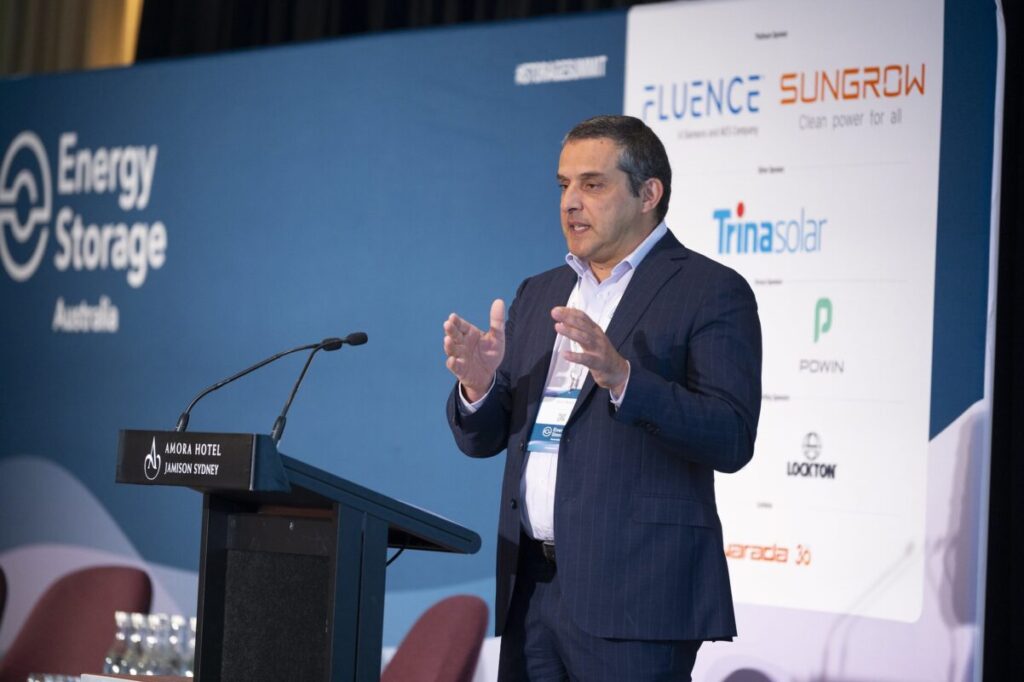
Mazouz also presented some of the details and thinking behind the design of the scheme in a keynote presentation at the Energy Storage Summit Australia 2024, held in Sydney, NSW, in May by our publisher Solar Media. The summit returns to Sydney in March next year.