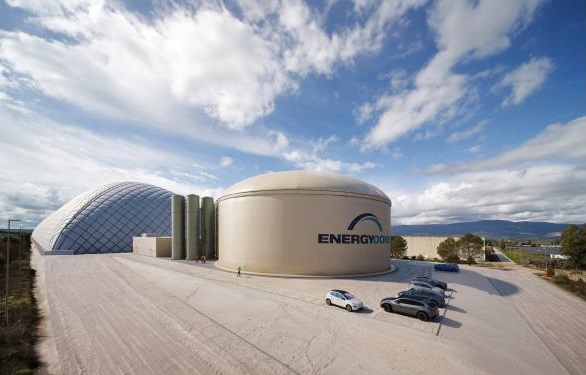
Carbon dioxide-based long-duration energy storage (LDES) company Energy Dome and digital infrastructure company New Era Energy & Digital (NUAI) have signed a memorandum of understanding (MOU) to deploy Energy Dome’s CO2 Battery Plus technology in Odessa, Texas.
The MOU will enable Italy-headquartered Energy Dome to implement its technology at NUAI’s Texas Critical Data Centres (TCDC). It creates a framework for the parties to evaluate how Energy Dome’s proprietary CO2 Battery system can support NUAI’s efforts to deploy large-scale power capacity, aiming to fulfil the energy needs of its AI-optimised 1GW data centre.
Key priorities include optimising speed to power, minimising dependence on limited grid interconnection timelines, guaranteeing the high availability essential for mission-critical data centre operations, and promoting lower-emissions power generation.
According to Energy Dome, its CO2 Battery Plus technology aims to improve the efficiency and flexibility of gas-fired power generation by combining energy storage with waste heat recovery.
Try Premium for just $1
- Full premium access for the first month at only $1
- Converts to an annual rate after 30 days unless cancelled
- Cancel anytime during the trial period
Premium Benefits
- Expert industry analysis and interviews
- Digital access to PV Tech Power journal
- Exclusive event discounts
Or get the full Premium subscription right away
Or continue reading this article for free
Although it can be paired with any form of generation, including renewables, when used with open-cycle gas turbines (OCGTs), the company claims the CO2 Battery can boost power output, enhance operational flexibility, and cut emissions, making it suitable for large-scale AI and data centre applications.
The CO2 Battery technology stores energy by compressing CO2. In the conventional setup, both pressure and heat generated during charging are stored separately: heat in a thermal storage system for later use during discharging.
Conversely, the CO2 Battery Plus uses waste heat directly from the OCGTs’ exhaust during discharge, eliminating the need for prior heat storage. This method is meant to enhance efficiency, offer combined-cycle-like performance, and reduce costs.
The CO2 Battery Plus operates in three different modes: Charge, Discharge (SuperBoost), and Generation (Boost).
In Charge mode, when demand is low or renewable energy is abundant, power is utilised to compress gaseous carbon dioxide. This CO₂ is then stored as a liquid in standard pressure vessels.
In Discharge mode during peak-demand hours, liquid carbon dioxide evaporates and heats up using heat from the gas turbine exhaust, which drives an expander to operate the CO2 Battery turbine. This process supplies extra power, roughly equivalent to an additional gas turbine of the same type, more than doubling the output.
In Generation mode, the CO2 Battery’s compressor and turbine operate simultaneously, without any net transfer of mass between the gas and liquid CO2 storage. The gas circulates in a closed loop, which can boost the net power output of the gas turbine by as much as 25%.
The MOU highlights a rising trend of data centres adopting or exploring LDES technologies, including a Google partnership with Energy Dome announced last July, whereby the search engine giant would make a strategic investment in the Italian company and evaluate the CO2 Battery’s capabilities.
Following this first LDES deal for Google, in February, it was announced that Google plans to use 30GWh of US startup Form Energy’s iron-air batteries for a data centre in Pine Island, Minnesota, to be installed by utility Xcel Energy. Google and Microsoft are among the end-user members of the Long Duration Energy Storage Council (LDES Council), a trade association formed to promote LDES commercialisation and market awareness.
Form also recently signed a 12GWh supply agreement in the US with AI data centre infrastructure developer Crusoe.
Google has additionally announced plans with utility DTE Energy to develop a new data centre in Michigan, featuring 1,600MW of solar energy combined with 450MW of energy storage. Based on SEC filings, the site, possibly in Van Buren Township, will be called Project Cannoli and will incorporate 400MW/1,600MWh of BESS along with 50MW of LDES.
Earlier this year, research and consultancy firm Sightline Climate ranked Energy Dome as the top non-lithium LDES company on its LDES leaderboard.
In July 2025, Energy Dome and Wisconsin utility Alliant Energy’s 20MW/200MWh project was approved by state regulators. Construction on the 10-hour project is expected to begin this year and be completed by the end of 2027. Energy Dome’s first 200MWh project in Sardinia, Italy, reached financial close in 2024, and an off-take deal was signed with Engie near the end of that year. Subsequent CO2 Battery deployments in the US and other territories, including India, are expected to closely replicate the first-of-a-kind project on the southern Italian island.