
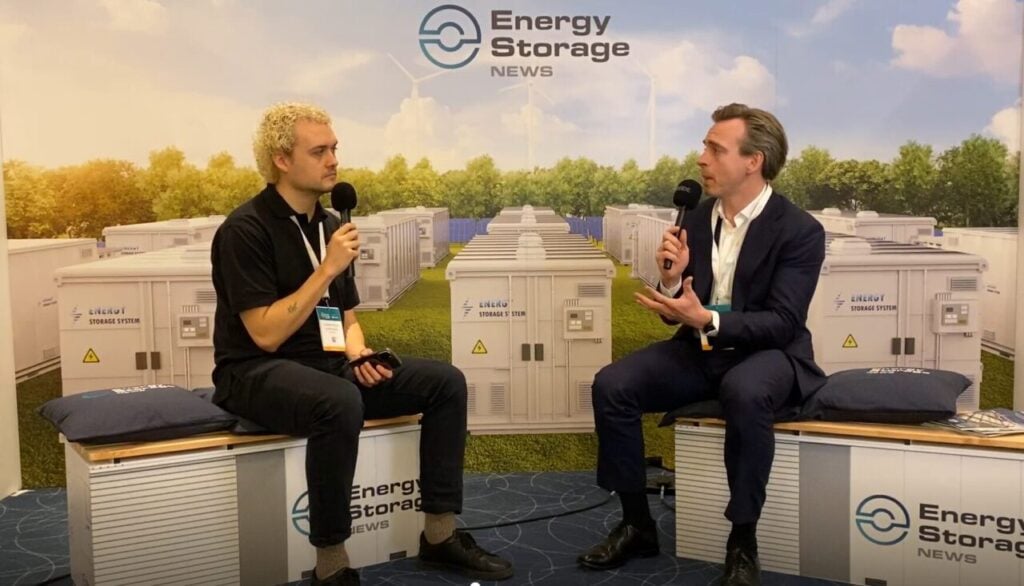
We caught up with the CEO of owner-operator BW ESS, Erik Strømsø, about the firm’s next deployment plans, tolling trends, procurement and LDES, with its 11.5-hour Bannaby BESS in Australia further proof of lithium-ion’s long-duration potential.
BW ESS was founded in 2021 by parent firm BW Group, a Singapore-headquartered shipping and energy company. It is interesting to follow as one of the most international pure-play large-scale battery energy storage system (BESS) platforms around. There are not many companies building or operating projects in four countries or more, that aren’t big power firms like RWE, Engie etc.
Its first two markets with operational projects have been the UK and Sweden, where it acquired project platforms of developers Penso Power and Ingrid Capacity, respectively, in 2023-24. In Australia, it has some notable projects in development, including an 11.5-hour BESS called Bannaby and a 480MWh system currently in commissioning, while its next markets it will enter are Germany, Spain and Italy, where it is already building one.
Read on for a write-up and full video recording of our sit-down interview with Strømsø at the Energy Storage Summit 2026 in London this week. Shortly after that, he took part in the ‘Shaping Bankable Storage: Market-Tested Insights‘ panel discussion, the first of the event.
Try Premium for just $1
- Full premium access for the first month at only $1
- Converts to an annual rate after 30 days unless cancelled
- Cancel anytime during the trial period
Premium Benefits
- Expert industry analysis and interviews
- Digital access to PV Tech Power journal
- Exclusive event discounts
Or get the full Premium subscription right away
Or continue reading this article for free
Industry is now firmly infrastructure
“The industry has grown a lot since we started, even in just the last 12 months. It used to be a bit niche and there was a question on whether it was technology or infrastructure,” Strømsø says.
“Gradually the pendulum has moved towards it being infrastructure, we’re really heading in that direction of it being established as an infrastructure asset class. Daily newspapers are covering it, you’re seeing an influx of batteries in most countries, and if you’re talking about it at the dinner table, people will sometimes know what you’re talking about.”
“And you’re seeing infrastructure investors really start making some serious investments into the space.”
Going into new markets, building in Italy and FID in Germany
The company enters new markets via partnership with local developers as, Strømsø said, it doesn’t make sense to sit in Zurich (where the firm is now headquartered) and try and develop projects in Spain or Germany.
“These deals haven’t all been identical because you know, it’s just not possible to do the same deal in every country. But we’ve generally found developers that we believe are leading in the space, and we work with them to develop the best possible portfolios in these markets, utilising the experience and expertise we have from different markets,” Strømsø says.
The company is building two projects in Italy, one which has a capacity market (CM) contract and another which has a contract from MACSE, Italy’s relatively unique storage-only capacity procurement scheme predominantly focused on the South.
The MACSE project is around 700MWh, bid in by development partner ACL. “ACL actually originally developed a lot of the projects that won,” Strømsø said.
“Meanwhile in Germany we hope to reach final investment decision (FID) on our first project this year, while Spain is a little further out,” he adds.
In a related move, BW ESS recently sold a 49% stake in its UK portfolio, comprising the 100MW/331MWh operational Bramley project and two other, larger ones under construction, to investor AIP. Strømsø said that is related to that portfolio reaching a maturity that enabled a different kind of investor to come in, and recycle that capital into other projects and markets.
“This is the type of transaction that we’re likely to do more of as well. On the one hand, AIP is a very sophisticated infrastructure investor which really has a deep understanding of energy storage. But then on the other hand, it’s not trying to be a developer, owner, operator doing everything like we do,” he says.
Tolls and offtake
Like any BESS owner-operator hoping to commercialise big projects, BW ESS has dipped into the long-term tolling market. Oil and gas major Shell is trading its Bramley project via a toll deal, the Italy project has revenues secured through MACSE, while the Sweden projects are more merchant.
We ask Strømsø how he sees the dynamics in the toll market evolving, where there is generally agreed to be more parties seeking tolls than parties providing them at a good level.
“You have a lot of developers kind of lining up outside of the various offtake providers, whether it’s the traders or the utilities or the energy companies, and it creates an imbalance the negotiating dynamic. Because you know if you’re sitting there as an energy company that you know once you sign that toll, you make this project suddenly investable and bankable. And if the signature doesn’t come then there is no project,” Strømsø explains
“We tried not to be a part of that dynamic. We are operating in markets where we are very comfortable with the general fundamentals of the flexibility opportunity in those markets. So we will start construction of our projects on the basis that they might operate merchant, and we will fund it from our own balance sheet.”
“And during construction most of the time we have ended up signing various types of offtakes, tolls, floors, capacity swaps etc. But we’re doing it from the position of building this project anyway and we’re trying to optimise our revenue stream. We’re not trying to get somebody to underwrite an investment for us.”
BESS pricing trends
Two recent events have led some to talk about BESS prices going up and perhaps the steady cost declines of recent years slowing going forward. Lithium carbonate prices recently tripled in the space of a month while China removes removing VAT export rebates for battery and solar products to curb overcapacity.
“There’s no doubt that if you look at the continued capacity increases that we’re seeing in the supply chain and the continued innovation that’s happening in the technology stack, we will we will continue to see cost efficiencies,” Strømsø says.
“But we came from a period of very rapid declines and I don’t think it’s going to be a straight line. Right now you have some challenges as you say on the lithium price and on the tax rebate and in China.
“But overall, this is still moving in the direction where batteries are going to continue to move the goal posts on on pricing and what they can offer to the grid in in a more cost efficient way than any other technology.”
LDES project: 11.5-hour lithium-ion BESS
Highly related to that last point is BW ESS’ Bannaby BESS which won a contract in a recent long-duration energy storage (LDES) tender in New South Wales’ (NSW), Australia, along with five other lithium-ion projects (alongside other technologies).
Bannaby is being developed for an eventual four-hour capacity of 750MW/3,000MWh, but its long-term contract won in the tender was for 233MW/2,676MWh, an 11.5-hour duration.
Strømsø: “It’s a very long-duration asset, these types of durations are very often mentioned in the same sentence as pumped hydro, so this is really moving into a different type of space for batteries entirely.”
“And what I mentioned earlier with with cost efficiencies continuing, I don’t see that same trend for pumped hydro.”
“And as regulators and system operators get more comfortable with you know the reliability of of batteries and they are doing that at the moment. I see no reason why you won’t have more of these types of tenders where this type of longer duration is valued.”