
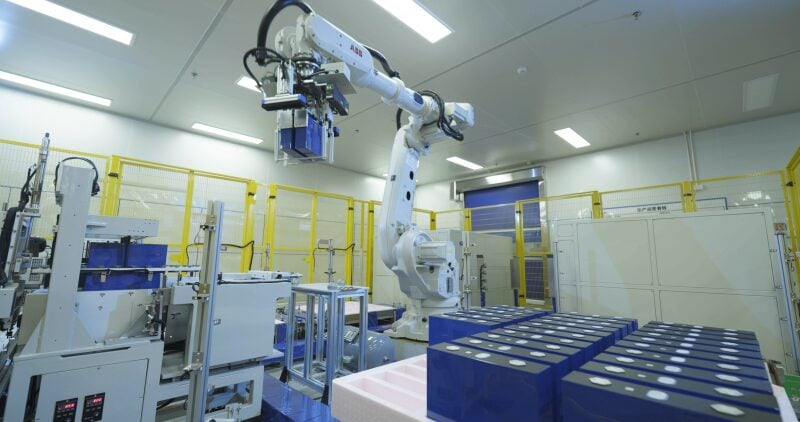
We analyse and compare the metrics of the various LFP battery cells of 587Ah and above, from leading providers CATL, Eve Energy, Hithium, Rept Battero, CALB and BYD.
According to International Renewable Energy Agency (IRENA), battery storage costs have reduced massively over the last two decades. Between 2010 and 2024, the costs of fully installed battery storage projects reduced by 93%.
While there are a number of battery chemistries used, there has been a shift towards using lithium iron phosphate (LFP) batteries in battery energy storage systems (BESS) in recent years, and even more recently a substantial growth in the size offered (in Ampere-hours, or Ah) to 587Ah and beyond.
This article looks at the LFP cells on offer from leading players CATL, Eve Energy, Hithium, Rept Battero, CALB and BYD and their capacity, energy density, cycle life, round-trip efficiency and operating temperature (and more).
Try Premium for just $1
- Full premium access for the first month at only $1
- Converts to an annual rate after 30 days unless cancelled
- Cancel anytime during the trial period
Premium Benefits
- Expert industry analysis and interviews
- Digital access to PV Tech Power journal
- Exclusive event discounts
Or get the full Premium subscription right away
Or continue reading this article for free
IRENA has stated that LFP’s market share for BESS grew from 48% to 85% between 2021-2024. The market share growth is being driven by their lower costs, higher cycle life and better safety, and an International Energy Agency (IEA) report stated that LFP battery prices fell by 15% last year compared to only a 5% reduction in nickel cobalt manganese oxide (NMC) batteries. This made LFP batteries about 40% cheaper than NMC batteries in 2025, fuelling their growth towards a global 90% market share in BESS by the end of 2025.
The market is dominated by China and Chinese companies are the ones at the forefront of LFP development and implementation, more so than for NMC. A study from 2025 showed that over 98% of LFP production is based in China, and while producers in other countries are looking to scale, such as in Korea, it is a Chinese-heavy market because they are cheaper and can currently be rolled out on much larger scales because of the battery production infrastructure and overall production ecosystem that exists within China.
Why LFP is being chosen for BESS
LFP batteries have gathered a lot more market dominance because of their advantages over other Li-ion chemistries. NMC has a higher energy density than LFP, but it has a higher risk of thermal runaway than LFP and is a lot more expensive because LFP does not use expensive metals, such as cobalt and nickel. So, LFP is a cheaper, environmentally friendly (due to no rare Earth mining), and safer option for large-scale BESS.
While safety and cost are a big factor in LFP adoption, LFP batteries also have a good longevity that makes them ideal for grid-scale and commercial and industrial (C&I) BESS. The life cycle is much better than NMC batteries, with most LFP batteries exceeding 6,000 cycles compared to 4,000 for NMC—with above 10,000 cycles being possible for a number of batteries today. LFP batteries also have a comparable round trip efficiency (RTE) around 90-95%.
Looking deeper into the safety aspects, it’s clear why LFP has become a battery of interest for both BESS and EV applications. Li-ion batteries tend to have issues with thermal runaway, and there have been various incidents involving NMC BESS. However, LFP has a much higher onset temperature for thermal runaway above 230°C, and they release less oxygen and heat if a failure does occur—so there is a lot less chance of a fire occurring.
Move beyond 280Ah and 314Ah
The market of LFP cells for BESS has gone through various phases. 280Ah cells were mainstream and were the flagship product for many companies, but these cells were mostly replaced in 2025 by 314Ah cells. However, the growth of LFP BESS in various storage applications is causing another industry shift already.
The major players who commercialised 280Ah and 314Ah cells are already moving onto much bigger systems to meet growing energy demands and are now promoting 587Ah capacities and above. These promise numerous benefits although the extent to which BESS manufacturers and system integrators are adopting these is not yet clear.
587Ah cells are the main ones being pushed by many LFP manufacturers and are seen by some the industry as the “golden balance point” for current BESS infrastructure, as 20-foot BESS units using them don’t necessarily exceed 45-ton weight limits and offer a high capacity.
Some companies like BYD have managed to design much higher capacity systems, but around 587Ah is being categorised as the golden point because they can still incorporate advanced cooling systems without pushing beyond the standard 45-ton weight limit—even though they typically require 80kW cooling capacity compared to 60kW cooling capacity for 314Ah cells—while offering a higher capacity than 314 Ah cell. Systems built with cells much larger than 587Ah may risk going over this weight threshold, which would require non-standard transport arrangements to site them.
One of the main advantages of 587Ah cells over 314Ah cells in terms of thermal characteristics, is that even though they do produce more heat and require larger cooling systems, there are fewer cells to cool per container. This also means that there are fewer components and less wiring within the container to manage. This not only creates fewer places for hotspots to manifest, but it also makes it simpler for the battery management system to manage the BESS. This allows the containers to maintain thermal efficiency and consistency and therefore provide a better thermal stability at higher capacities. So, even though 587Ah cells produce more heat, they can be more efficiently managed, which is why they are seen as a potential ‘sweet spot’ for BESS because they can provide more capacity without needing to be excessively heavy.
Here we look at what LFP cells at 587Ah and above are being pushed by companies for large-scale BESS applications.
CATL
CATL is one of the leading manufacturers of advanced battery technologies across both BESS and EV industries, and that includes LFP cells. CATL’s LFP cells have gone through three main generations. The first was the 280Ah cell that provided 350-370Wh/L of volumetric energy density, 6000-8000 cycles and 20 ft container system capacity of 3.72MWh. The second generation was the 314Ah cell that replaced 280Ah cells with a volumetric energy density of 390-400Wh/L, cycle life of 8000-1000 cycles and a 20 ft container system capacity of 5MWh.
Even though these cells are still available, CATL has moved on to its third generation of LFP Cells at 587Ah and the standard in the market is expected to shift once again. These BESS cells have a volumetric energy density of 430-434Wh/L, a cycle life of at least 12,000 cycles, expected lifespans above 20 years, and a round trip efficiency (RTE) of 96.5%. The cells have also been designed to work in temperature conditions of -40°C to +70°C and have a 20 ft container system capacity of 6.25MWh.
EVE Energy
Eve has developed a 628Ah cell called Mr Big. While its official stated capacity is 628Ah, the actual tested capacity is between 670-680Ah. It has been announced that EVE’s cells have a volumetric energy density of 386Wh/L and a gravimetric energy density of 193.3Wh/kg.
It’s been announced that it takes around 8000 cycles to reach 80% state of health (SOH) and has been designed for a 15–20-year service life. The reported RTE is 94% with operating temperatures ranging from -30 to 60°C: including a charging temperature range of 0-60°C, discharging temperature range of -30-60°C and a storage temperature range of 0-35°C.
Rept Battero
Rept Battery also built a 500Ah+ battery, only this time it’s been rated for 588Ah, not 587Ah, but is practically the same capacity as those which are 587Ah. These cells have a volumetric energy density of 430Wh/L, a gravimetric energy density of 190Wh/kg, a cycle life of 10,000-12,000 cycles, and service life above 20 years. The reported RTE is up to 96.5%, with a thermal operating range of -40-65°C. This includes a storage temperature of -40-60°C, charging operating temperature of -10-65°C and a discharge operating temperature of -35-65°C.
Hithium
Hithium was another early mover in LFP-based LDES and now has cells that are 587Ah, 1175Ah and 1300Ah. Both 587Ah and 1175Ah have been used in GWh-scale BESS installations, with the 1300Ah cell moving to mass production in Q4 2026.
The following table compares the three high capacity LDES cells that are being developed and installed by Hithium:
| 587Ah | 1175Ah | 1300Ah | |
| Gravimetric energy Density (Wh/kg) | 185Wh/kg | 180Wh/kg | 190Wh/kg |
| Volumetric Energy Density (Wh/L) | 413-415Wh/L | 400Wh/L | 406Wh/L |
| Cycle life | Over 11,000 cycles | Over 11,000 cycles | Over 10,000 cycles (25 years’ service life stated) |
| RTE | RTE not explicitly given but energy efficiency stated to be 94.5% | Not disclosed | 96% RTE |
| Operating Temperature | -30-60°C Charging: 0-60°C Discharging: -30-60°C Storage: -20-35°C | 30-60°C Charging: 0-60°C Discharging: -30-60°C Storage: -20-35°C | 30-60°C Charging: 0-60°C Discharging: -30-60°C Storage: -20-35°C |
CALB
CALB has two 500+ Ah cells for BESS applications: a 588Ah cell and 684Ah cell. Both have been stated to have a volumetric energy density of 450Wh/L, a charge-discharge efficiency of up to 95% (not an RTE), and operating temperature range between -35-65°C. While a lot of the characteristics have been stated to be the same for both cells, the 588Ah cell has a cycle life of 10,000 cells (to 70% SOH) and will be used to create 20 ft containers with 6.25MWh capacity, whereas the cycle life for the 684Ah cells has been stated to be over 15,000 cycles (with a 20+ year lifespan) and will be used to create 6.9MWh capacity 20 ft containers.
BYD
BYD has been developing the biggest cell sizes by far at 2710Ah, but whether they are preferable from a thermal management perspective over other BESS systems remains to be seen. Cells of this size require fewer parts, so the packs are simpler.
However, even though there is less wiring at the pack level, it does mean that more heat is created in localised spots, which means that more advanced cooling systems may be required.
However, BYD have been innovating battery technologies from BESS all the way through to the fastest EV charging batteries today. There is limited information on the 2710Ah cells themselves, as a lot of the information relates to the installations they are being trialled in. It has been stated that they have a cycle life of around 10,000 cycles and an operating temperature range of –30°C to 50°C. When installed in a current BESS system, called Haohan, they have shown a system energy density of 233.8kWh/m³ and the Haohan has a minimum unit capacity of 14.5MWh.
Also note that BYD is less likely to sell its battery cells as a standalone product, instead focusing on selling integrated BESS units. It does sell battery cells but relatively little of this is publicly revealed.
Comparing the companies
All the cells at 587Ah an above have a nominal voltage of 3.2V, and while they have been discussed individually above, the following table summarises the different high-capacity cells from the leading manufacturers:
| CATL | EVE | REPT | HiTHIUM | CALB | BYD | |
| Cell capacity (Ah) | 587Ah | 628Ah (actual tested capacity between 670-680Ah) | 588Ah | 587Ah 1175Ah 1300Ah | 588Ah 684Ah | 2710Ah |
| Gravimetric energy density (Wh/kg) | Not disclosed | 193.3Wh/kg | 190Wh/kg | 180-190Wh/kg depending on cell capacity | Not disclosed | system energy density of 233.8 kWh/m³ in Haohan BESS system |
| Volumetric Energy density (Wh/L) | 430-434Wh/L | 386Wh/L | 430Wh/L | 400-415Wh/L depending on cell capacity | 450Wh/L | |
| Cycle life/system life | 12,000+ | 8000 (15-20 year service life | 10,000-12,000 (20+ years’ service life) | 10,000-11,000+. Up to 25 years’ service life | 588Ah: 10,000 cycles 684Ah: 15,000 cycles (20+ year lifespan | 10,000 cycles |
| Efficiency | 96.5% RTE | 94% RTE | 96.5% RTE | 587Ah: 96% DC RTE 1175Ah: not disclosed 1300Ah: 96% DC RTE | charge-discharge efficiency up to 95% | Not disclosed |
| Operating Temperature | -40°C to +70° | -30 to 60°C Charging: 0-60°C, Discharging: -30-60°C Storage: 0-35°C | -40-65°C Charging: -10-65°C Discharging: -35-65°C Storage: -40-60°C, | -30-60°C Charging: 0-60°C Discharging: -30-60°C Storage: -20-35°C | -35-65°C | –30°C to 50°C |
Looking beyond LFP
The growth of LFP has been quick in the BESS space, rapidly moving from 280Ah to 314Ah and now 587Ah and beyond. While LFP is likely to remain the dominant chemistry for a number of years, both lithium manganese iron phosphate (LMFP) and sodium-ion (Na-ion) batteries are talked about as a potential disruptor. LMFP batteries have a similar chemistry to LFP batteries with a higher energy density, but they don’t yet have the cycle life and stability for large-scale commercial BESS applications. Na-ion is becoming a more mature technology and is seen as possibility for BESS because it is much safer, cheaper (due to more abundant and low-cost raw materials), has logistical advantages because the batteries can be discharged to 0V without issue, and has better cold temperature performance, so it could be favoured in colder regions in the future. However, LFP has a higher energy density than Na-ion, so LFPs have a lower footprint and weight when building same-capacity systems. The jury is still out what BESS systems will employ in the next decade, but for the foreseeable future, LFP technology will continue to dominate, and there is a big push towards making 587Ah batteries the standard cell technology.