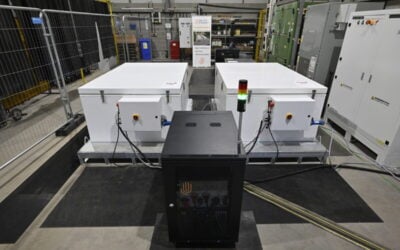
Swedish company Vattenfall will operate the Energy Buffer Unit while Belectric will continue to own it. Image: Vattenfall.
A large-scale storage system co-located at a German solar farm by the PV plant’s developer Belectric, has been given the green light to operate in the grid-balancing frequency response market.
The Energy Buffer Unit (EBU) at Alt Daber solar farm, Brandenburg, can now contribute to providing frequency control in Germany’s high voltage grid. The project added 2,000kWh of Belectric’s containerised battery storage system to 67.8MW of ground mounted solar.
Belectric’s Tim Mueller told PV Tech Storage earlier this year that the company decided to add the energy storage in order to provide new revenue streams while demonstrating that the batteries could help stabilise the grid and could adequately replace fossil fuel generators in this respect.
“We were thinking, what would be possible commercially and what would also be necessary?
Try Premium for just $1
- Full premium access for the first month at only $1
- Converts to an annual rate after 30 days unless cancelled
- Cancel anytime during the trial period
Premium Benefits
- Expert industry analysis and interviews
- Digital access to PV Tech Power journal
- Exclusive event discounts
Or get the full Premium subscription right away
Or continue reading this article for free
“We found out that for the moment the biggest problem is not to shift energy, rather to stabilise the grid; this is something that is a bit ahead but we will need that in the next couple of decades or even the next few years,” Mueller said.
The Alt Daber-based EBU has been cleared by 50 Hertz, the transmission network operator (TNO), to provide 1.3MW of frequency response. According to Belectric the certification process required some rethinking of parameters appropriate to batteries with some of the testing developed specifically for this installation.
Belectric has taken the news as a victory for storage, claiming the TNO’s approval is evidence that “battery storage improves the safety of transmission network operation, even during heavy fluctuations like a generator or interconnector trip”.
Frequency regulation in Germany is provided on a weekly tender basis, with available resources and service providers pooled. In the case of Alt Daber, Swedish company Vattenfall is contracted to manage the system and market its capabilities to the primary operating reserve market, while Belectric will continue to own it. In February Belectric announced it is trialling a similar model in Britain led by the National Grid, which is responsible for the UK network.
EBU is lead acid based and its production is standardised to keep costs as low as possible. Belectric is selling EBU at an upfront cost for the unit of around €560,000 (US$625,000) for a device with 948kWh storage capacity. Interestingly, at Energy Storage Europe earlier this year, the company publicly advertised EBU’s price, an unusual step at an event where rival storage providers kept even this detail closely guarded.
EBU starts at €560,000 (US$625,000). This and lead image: Belectric.