Australia’s energy minister, Chris Bowen, has argued that the upcoming federal election is a “sliding doors moment” for the country’s energy transition. Should the Liberal-National Coalition be elected, much of the progress made in this area could be reversed, Bowen said.
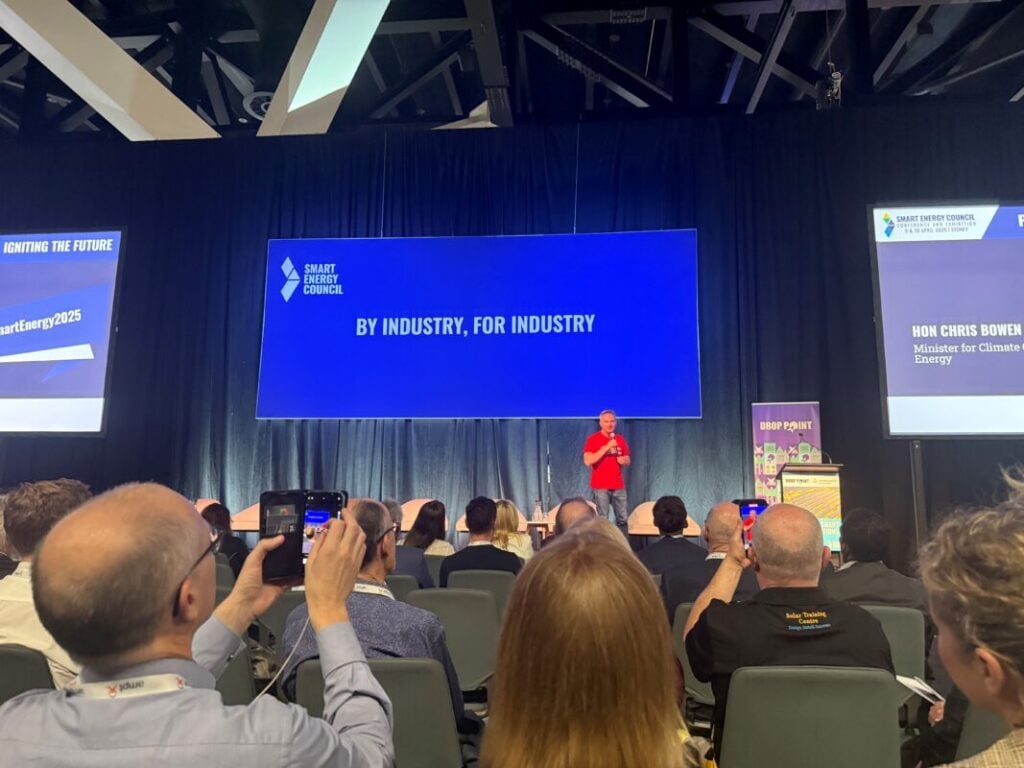
“I’m pleased with our progress in the past few years. But we’re just getting started,” Bowen said in an opening keynote address at the Smart Energy Conference industry event in Sydney, Australia, this morning.
“Everything we’ve done is stoppable and reversible under a new government.”
Since taking office, the Anthony Albanese Labor government have overseen several world-leading schemes to support the uptake of renewable energy generation and innovative energy technology, including the Capacity Investment Scheme (CIS).
Try Premium for just $1
- Full premium access for the first month at only $1
- Converts to an annual rate after 30 days unless cancelled
- Cancel anytime during the trial period
Premium Benefits
- Expert industry analysis and interviews
- Digital access to PV Tech Power journal
- Exclusive event discounts
Or get the full Premium subscription right away
Or continue reading this article for free
Bowen warned that everything is reversible under a new government led by climate sceptic Peter Dutton. Dutton has already announced his intention to gut the CIS mechanism to focus more on coal-fired power and gas.
Bowen zeroed in on a specific Liberal-National Coalition pledge: Dutton’s plan to cap renewable energy growth at 54% of the country’s electricity mix. The country is anticipated to pass the 50% threshold later this year, which could mean a dramatic drop-off in clean energy developments.
“That would mean, in effect, between 2026 and 2050, there will be no renewable energy installation in Australia, no role for household batteries, no longer grid batteries, and no role for renewable energy,” Bowen said.
“That would be the biggest economic own goal in modern history, in Australia. It would mean not seizing the opportunities that are before us as a country with the potential to have the best renewable energy resources in the world. This is all at stake on 3 May.”
The 3 May federal election is gearing up to be a critical juncture in the country’s energy transition. It will determine whether Australia capitalises on the economic opportunity for energy storage and renewables, Energy-Storage.news has heard.
Speaking at the Energy Storage Summit Australia 2025 in Sydney last month, Tim Buckley, director of the think tank Climate Energy Finance (CEF), said during a panel discussion: “I’m bullish that if we keep the current policy, we can deliver on 82% renewables and batteries will play a key role in that. A change of federal government would be policy chaos and delay.”
‘An AU$2.3 billion vote of confidence in decisions Australians want to make’
Bowen, who donned a ‘Cheaper Home Batteries’ t-shirt on the stage this morning, as pictured above, said that the Labor Party’s recent pledge to introduce an AU$2.3 billion (US$1.38 billion) home battery subsidy scheme should it be re-elected is a “vote of confidence in decisions Australian households want to make.”
“Some have said it is the biggest, best and most positive intervention in renewable energy. I’m not here to disagree. All this is at stake,” Bowen added.
Announced on Sunday (6 April), the Cheaper Home Batteries Program would be offered via the existing Small-scale Renewable Energy Scheme. Small businesses and community facilities would also be able to access the subsidy, with support for up to 50kWh of batteries sized up to 100kWh eligible.
Under the scheme, Bowen predicts that around 1.1 million batteries could be installed.
“We’ll keep going with a plan for consumer energy to step forward and play a much more significant role through batteries. With our policy that we announced on Sunday, we forecast and project around 1.1 million new batteries. That’s what progress looks like,” Bowen said.