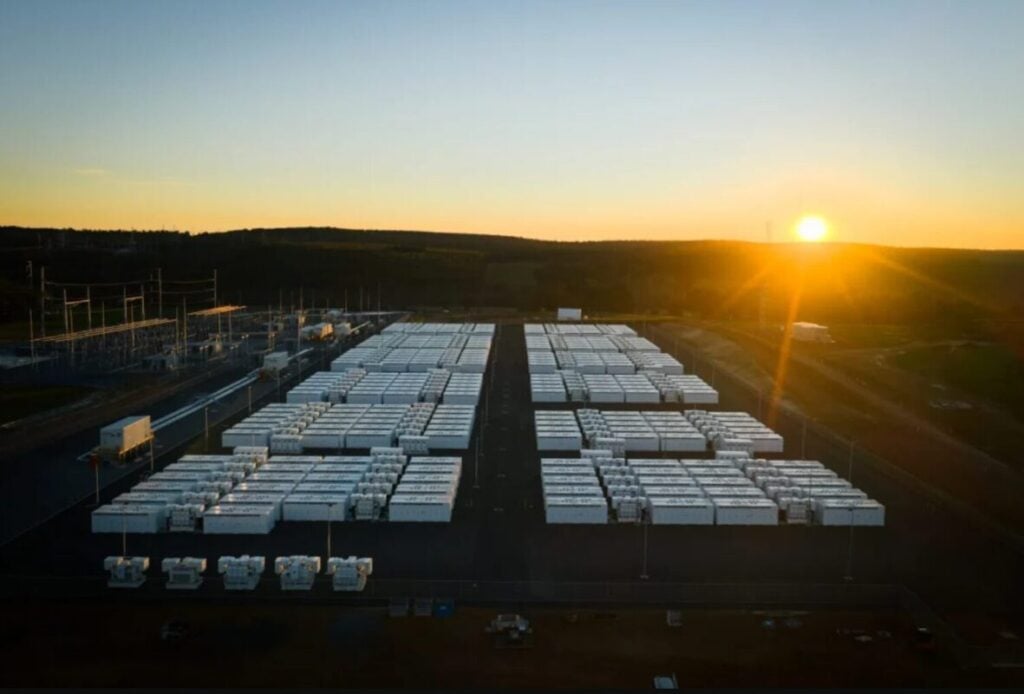
ASL (formerly AEMO Services) has completed New South Wales’ (NSW) largest-ever tender for long-duration energy storage (LDES), contracting six new battery projects for a combined 1.17GW/11.98GWh.
The tender outcome represents the largest storage capacity award in NSW to date, both in terms of total gigawatt capacity and number of contracted projects. The six successful lithium-ion battery energy storage systems (BESS) range in output from 100MW to 330MW, with storage durations of 8.7 to 10.6 hours.
ASL awarded Long-Term Energy Service Agreements (LTESAs) to 117% of the indicative tender size of 1GW and at least 8GWh, exercising its flexibility to recommend contracts above the target were determined to be in the long-term financial interests of NSW electricity customers.
The successful projects bring the state’s total contracted new storage capacity to 30GWh, marking substantial progress toward the 42GWh required by 2034 under ASL’s stretch infrastructure objectives.
Try Premium for just $1
- Full premium access for the first month at only $1
- Converts to an annual rate after 30 days unless cancelled
- Cancel anytime during the trial period
Premium Benefits
- Expert industry analysis and interviews
- Digital access to PV Tech Power journal
- Exclusive event discounts
Or get the full Premium subscription right away
Or continue reading this article for free
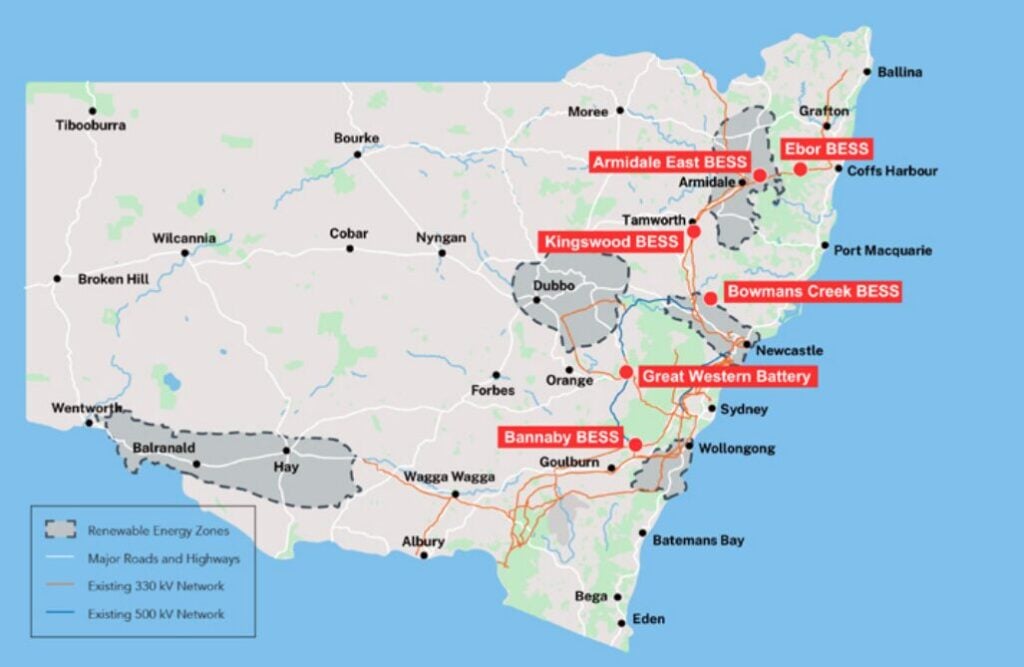
The successful projects span multiple regions across NSW, connecting to existing network infrastructure without requiring Access Rights. You can find a full breakdown of the successful projects below:
| Project name | Proponent | Technology | Output/Capacity | Nominal storage duration |
|---|---|---|---|---|
| Ebor BESS | Bridge Energy | Lithium-ion BESS | 100MW/870MWh | 8.7 hours |
| Bowmans Creek BESS | Ark Energy | Lithium-ion BESS | 250MW/2,414MWh | 9.7 hours |
| Armidale East BESS | FRV Services Australia | Lithium-ion BESS | 158MW/1,440MWh | 9.1 hours |
| Bannaby BESS | BW ESS Australia | Lithium-ion BESS | 233MW /2,676MWh | 11.5 hours |
| Kingswood BESS | Iberdrola Australia | Lithium-ion BESS | 100MW/1,080MWh | 10.8 hours |
| Great Western Battery | Neoen Australia | Lithium-ion BESS | 330MW/3,500MWh | 10.6 hours |
The Great Western Battery, owned by Neoen Australia, represents the largest single award at 330MW/3,500MWh, followed by Ark Energy’s Bowmans Creek BESS at 250MW/2,414MWh and BW ESS’ Bannaby BESS at 233MW/2,676MWh.
The Armidale East BESS (158MW/1,440MWh), Ebor BESS (100MW/870MWh), and Kingswood BESS (100MW/1,080MWh) complete the portfolio of successful developments.
Among these, the Ebor BESS has secured its 14-year LTESA through Energy Vault’s Australian development partner Bridge Energy, representing an AU$310 million (US$216 million) investment utilising Energy Vault’s proprietary B-VAULT technology.
Energy Vault Chairman and CEO Robert Piconi emphasised the strategic importance of the Australian market expansion.
“Supporting Bridge Energy on achieving this award represents another important growth milestone in advancing our Energy Asset Management strategy in owning and operating energy assets over the long term,” Piconi said.
The Ebor project, located in the New England Region of NSW, will provide 8-hours of dispatchable capacity using Energy Vault’s Vault-OS Energy Management System.
Construction is expected to generate up to 60 direct jobs, with the facility targeted to commence operations in 2028.
Strategic contribution to NSW energy objectives
The contracted projects are expected to contribute approximately 59% toward the minimum objective for 2030 of 2GW and 16GWh of long-duration storage, once all facilities become operational.
When combined with outcomes from prior LTESA tenders, NSW will meet its 2030 objective and exceed the 2034 minimum objective of 28GWh.
The projects will contribute approximately 43% toward the 2034 minimum objective once operational, with timing determined by individual commercial operations dates.
All successful projects comprehensively demonstrated their value to NSW electricity customers and benefits to their host communities through the competitive tender process.
ASL CEO Nevenka Codevelle emphasised the effectiveness of the procurement framework.
“The tender process and the financial products we’ve designed are working as intended, and NSW is on its way to meet the high bar we’ve set for securing long-duration energy storage,” Codevelle said.
The projects are expected to make positive contributions to improving potential reliability outcomes for NSW, while several facilities will be capable of providing essential system services, including frequency and voltage control, as well as energy storage functions.
The procurement strategy utilises LTESAs to address the “missing money” challenge that has historically impeded the development of long-duration storage projects.
The LDES LTESA structure enhances project bankability and accelerates the delivery of new electricity infrastructure by providing developers with revenue certainty.
As NSW’s independent Consumer Trustee, ASL established an ambitious development pathway in the 2025 Infrastructure Investment Objectives Report, targeting 42GWh of long-duration storage by 2034 – significantly exceeding statutory minimum requirements.
The enhanced target reflects potential consumer benefits from additional storage capacity, including improved resilience against reliability risks.
Market development and upcoming opportunities
The successful tender demonstrates continued market confidence in NSW’s long-duration storage procurement framework, with developers utilising the flexibility of LTESA products to suit individual project requirements.
These agreements deliver consumer value by unlocking investment in additional capacity that can reduce wholesale electricity price volatility.
Limondale BESS, the first project awarded an LDES LTESA in 2023, is currently in commissioning and approaching commercial operations.
The 50MW/400MWh facility represents the initial deployment of 8-hour-plus storage projects that would not have reached financial close without the LTESA framework, according to ASL.
The procurement success stems from Australia’s energy storage market experiencing significant expansion, with multiple states implementing capacity mechanisms to secure grid-scale storage.
South Australia, for example, recently launched its first capacity tender for 700MW of long-duration energy storage, indicating coordinated national efforts to replace retiring thermal generation with renewable energy and storage infrastructure.
Future tender pipeline maintains momentum
ASL has outlined a structured pipeline of future procurement opportunities to maintain investment momentum and achieve long-term capacity targets.
The next long-duration storage tender will commence in Q2 2026, seeking 12GWh of projects, followed by an additional 12GWh tender in 2027.
These upcoming tenders will target projects capable of operation by 2030 to support the Minimum Objective, alongside longer lead-time developments for 2034 commercial operations.
ASL will concurrently recommence Generation LTESA tenders, with a 2.5GW procurement scheduled to begin in Q2 2026.
A current tender seeking 500MW of firming and demand response projects operational by the end of 2027 remains on track for completion by May 2026. The structured approach provides market visibility while maintaining competitive pressure for future procurement rounds.
Codevelle noted the finite nature of planned procurement opportunities beyond 2027.
“There are no guarantees of further LDS tenders beyond this point, so we expect competition to strengthen even further for these future tender rounds,” Codevelle said.
The Energy Storage Summit Australia 2026 will be returning to Sydney on 18-19 March. It features keynote speeches and panel discussions on topics such as the Capacity Investment Scheme, long-duration energy storage, and BESS revenue streams. ESN Premium subscribers receive an exclusive discount on ticket prices.
To secure your tickets and learn more about the event, please visit the official website.