
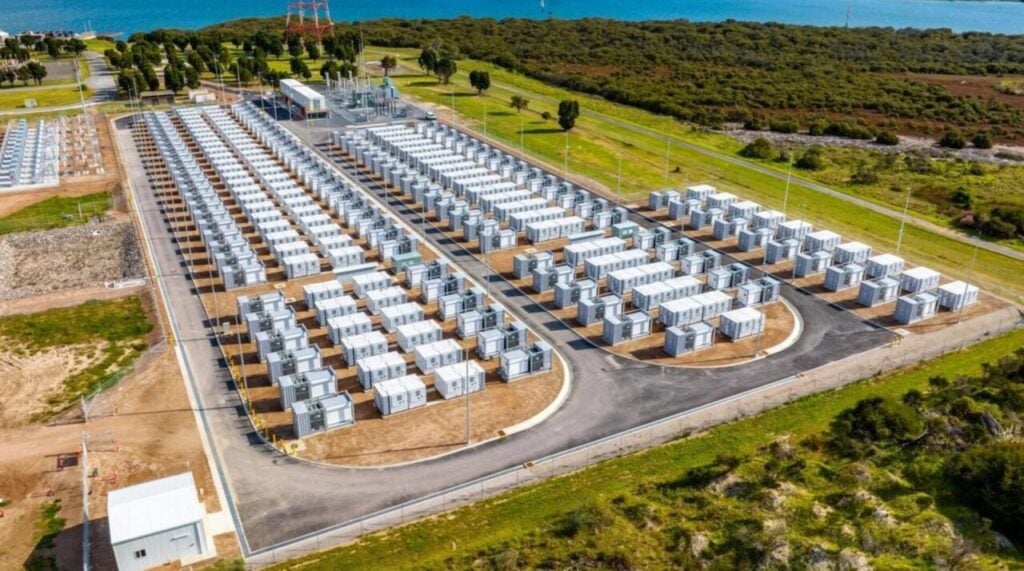
Australia’s most severe heatwave in six years has tested the resilience of the National Electricity Market (NEM) and its growing grid-scale battery energy storage fleet, according to Javier Savolainen, market development manager at Wärtsilä Energy.
Temperatures have soared above 40°C across large areas of New South Wales, Victoria and South Australia this week, with some inland regions experiencing consecutive days above 46°C.
The extreme weather event began intensifying on 7 January, with many regions recording their hottest temperatures in six or seven years, a period when bushfires ravaged much of Australia in what has since been remembered as ‘Black Summer’.
The heatwave has highlighted the operational constraints facing Australia’s battery energy storage systems (BESS) during prolonged periods of peak demand.
Try Premium for just $1
- Full premium access for the first month at only $1
- Converts to an annual rate after 30 days unless cancelled
- Cancel anytime during the trial period
Premium Benefits
- Expert industry analysis and interviews
- Digital access to PV Tech Power journal
- Exclusive event discounts
Or get the full Premium subscription right away
Or continue reading this article for free
Many grid-scale BESS installations across the East Coast provide between 2- 3 hours of storage duration, a discharge capacity that Savolainen warns falls short during multi-day extreme weather events when air conditioning demand remains elevated for extended periods.
Savolainen says: “Batteries and pumped hydro are critical parts of the solution, but have limits during extreme heat events. Most battery systems currently provide only up to two to three hours of support, which falls short during prolonged peak demand or renewable energy droughts.”
Battery performance can degrade in extreme heat, with lithium-ion systems requiring active cooling to maintain optimal efficiency and prevent thermal runaway.
The sustained high temperatures across multiple states have placed additional strain on battery cooling systems, potentially reducing their effective capacity during the periods when grid support is most critical.
Savolainen notes that Australia’s energy system faces ongoing challenges despite significant progress in storage deployment.
“Australia’s heatwaves are once again placing enormous strain on the nation’s energy system. While record renewable energy generation in 2025 confirms that a renewable-led power system is the right long-term direction, we are not at a point where renewables alone can meet demand during extreme weather.”
Alongside battery storage systems, Wärtsilä, a Finnish technology company, is also a global supplier of flexible gas engines and power plant solutions, specialising in multi-fuel engines that can operate on natural gas, biogas and hydrogen blends for utility-scale power generation and grid balancing applications.
In this interview with ESN Premium, Javier Savolainen discusses the effects of recent extreme weather and temperatures in Australia on the performance of the NEM as well as its fleet of grid-scale battery storage systems. He also examines how, in a grid primarily powered by renewable energy, alternative methods for ensuring reliable power supply, such as gas engines, may be necessary. Savolainen explores:
• Battery storage’s performance: Australia’s severe heatwave has revealed that most grid-scale BESS provide only 2-3 hours of storage duration, falling short during multi-day extreme weather events when air conditioning demand remains elevated for extended periods.
• Solar generation offsets storage gaps: Renewable energy sources met up to 76.6% of demand during peak periods on 7 January, with rooftop solar PV now surpassing coal capacity, though the evening demand peak still challenges storage systems.
• Climate-resilient firming needed: Savolainen advocates for flexible engine power stations, including gas, that maintain full performance in extreme heat and use minimal water, as ageing coal plants and conventional gas turbines lose 15-20% output during heatwaves.
Solar PV steps up to dampen battery storage’s limitations
The limitations of battery storage have been partially offset by unprecedented solar generation during daylight hours.
Data from the Australian Energy Market Operator (AEMO) showed that solar generation, combined with wind and hydropower, met as much as 76.6% of demand during peak periods on 7 January, with renewable energy sources providing almost half of all electricity supply over 24-hour periods.
Indeed, this has been bolstered via Australia’s strong solar penetration on residential properties, with more than one in three Australian homes now having a rooftop solar PV system, contributing to what is being described as a “solar-soaked” grid.
This strong uptake of rooftop solar PV systems saw its cumulative generation capacity surpass that of coal in the first half of 2025, reaching 26.8GW, with AEMO also estimating in December 2025 that this figure is likely to expand to 42.5GW by 2036.
However, the mismatch between peak solar generation during midday hours and peak electricity demand during evening periods has exposed the critical role that storage technologies must play in a renewable-dominated system.
“Peak electricity demand often coincides with scorching, cloudy or windless conditions, meaning firming capacity must perform reliably when Australians most need it,” Savolainen explains.
The current heatwave has demonstrated this challenge, with peak demand occurring during late afternoon and early evening hours when solar generation begins to decline but air conditioning loads remain at maximum levels.
Water availability concerns for pumped hydro
Water availability presents additional challenges for alternative storage technologies.
“Pumped hydro, while valuable, is increasingly exposed to water variability that is expected to worsen with climate change,” Savolainen says. Severe fire weather conditions accompanying the heatwave have led to concerns about water scarcity across affected regions.
The ageing thermal generation fleet has also struggled during the extreme conditions. Savolainen notes that “the NEM’s coal fleet, now averaging 39 years of age, is becoming increasingly unreliable, with outage risks only set to grow.”
Gas generation faces similar challenges, Savolainen says, with “conventional gas turbines losing up to 15-20% of their output due to heat-related derating and often relying on significant water use for cooling.”
Savolainen advocates for climate-resilient firming technologies that can complement battery storage during extreme weather.
“Flexible engine power stations are increasingly being adopted globally because they maintain full performance even at very high temperatures and use minimal water due to air-cooling. Their consistent output during heatwaves makes them well-suited to Australia’s conditions and reduces the need to overbuild capacity just for summer peaks.”
Savolainen believes that, while gas generation will continue to play an “essential back-up role” in a renewables-led grid, the resilience capabilities vary significantly between different gas technologies.
Despite the challenges, AEMO has issued relatively few supply warnings during the event, with electricity spot prices remaining subdued despite record demand levels. This stability demonstrates the progress made in grid resilience, while highlighting the need for continued investment in diverse storage and firming technologies.
“Investing in firming solutions that can withstand extreme heat and water scarcity will be critical to keeping the lights on today, while enabling higher shares of renewables and securing Australia’s energy future over the decades ahead,” Savolainen concludes.
What is causing Australia’s heatwave?
This severe heatwave affecting Australia’s east coast is being caused by a combination of meteorological factors that have created a “blocking” weather pattern.
The main driver is a strong, slow-moving high-pressure system positioned over the Tasman Sea, east of Australia, which is acting like a jam in the flow of weather, preventing the normal west-to-east movement of weather systems and trapping hot air over the continent for multiple consecutive days.
Meanwhile, the extreme temperatures originate from Australia’s northwest regions, particularly northern Western Australia and the Northern Territory, which is commonly referred to as the country’s “heat engine.”
A very hot and dry air mass has been building in these northern regions for several weeks and is now being transported southward by persistent north-westerly winds.
A weather trough is dragging this accumulated hot air from the north down into southern and eastern Australia, resulting in temperatures 8-16°C above the January average across Victoria, South Australia and southeastern New South Wales.
The high-pressure system over the Tasman Sea is preventing cooler air masses from moving in from the south, essentially creating a lid that traps the hot air over the continent. At the same time, the north-westerly wind flow continuously feeds more hot, dry air from the interior into the southern regions.
The blocking pattern is forecast to weaken today (9 January) as a stronger cold front is expected to push through southeastern Australia.
The Energy Storage Summit Australia 2026 will be returning to Sydney on 18-19 March 2026. To secure your tickets and learn more about the event, please visit the official website.