ARENA chief executive Ivor Frischknecht (right) talks to Queensland Minister for Energy and Water Supply, Mark Bailey, at the launch of Ergon Energy’s solar and battery trial. Image: ARENA
Effective ways of assigning economic value to services provided by aggregated storage systems must be found to progress the use of such technology, according to a technical consultant involved in a recent report assessing Australia’s energy storage landscape.
Small-scale batteries, which store power generated by renewables such as solar energy, can be aggregated together to operate as one system and add value to the network by performing functions such as grid-balancing.
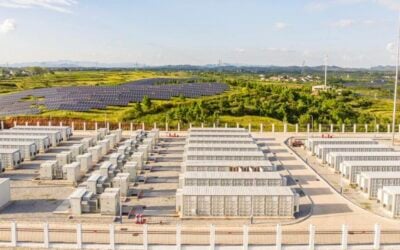
To explore the potential for such technology, the Australian Renewable Energy Agency (ARENA) announced this month AU$400,000 support for utility company Ergon Energy to trial a ‘virtual power plant’ model, aggregating 33 solar PV and storage systems across residential rooftops in Cannonvale, Toowoomba and Townsville, Queensland. Each system consists of a 4.9kW SunPower PV array and a 12kWh/5kW Sunverge battery storage and control system. The government of Queensland has in place a “50% energy by renewables by 2030” target and this project is among a raft of measures aiming to support that.
Ergon Energy CEO Ian McLeod said the project will trial the use of storage for demand management measures, conferring possible network-wide benefits in what he called “an important step towards more efficient ways to run electricity networks and also towards giving customers greater choice and control in how they manage their electricity needs”.
Try Premium for just $1
- Full premium access for the first month at only $1
- Converts to an annual rate after 30 days unless cancelled
- Cancel anytime during the trial period
Premium Benefits
- Expert industry analysis and interviews
- Digital access to PV Tech Power journal
- Exclusive event discounts
Or get the full Premium subscription right away
Or continue reading this article for free
ARENA chief executive Ivor Frischknecht said the latest trial would show whether battery systems could be used to manage the supply of renewable energy to the grid by performing demand management and reducing network peak load.
Meanwhile, ARENA also commissioned a report, ‘Energy Storage Study: Funding and knowledge sharing priorities’, prepared by technical services company AECOM to investigate energy storage markets worldwide and how they relate back to the Australian market.
Craig Chambers, market sector director, power generation, of AECOM, told PV Tech storage that currently there is no economically-measured value given to the services provided by aggregated energy storage systems. Chambers was involved in putting together recent the “Energy Storage Study…” document.
He said that the first step is to develop more sophisticated information and data management systems to allow grid operators to manage the network and adapt to the uptake of these aggregated systems.
Chambers added: “Currently many of our networks are highly sophisticated at the transmission level, however less so at low voltages.”
The second step would be to develop a greater understanding of the network capabilities of integrating distributed technologies at the distribution end of the network. This step would be followed by pricing the economic value of these aggregated systems, Chambers said.
“Once we have the information and data management systems developed, we will need to solve the problem of pricing the economic value to the market of the aggregated use of distributed technologies such as storage on both a location and time basis,” Chambers said.
Towards the end of 2014, another Australian company, Reposit Power, was given ARENA funding to trial GridCredits, a system that allows consumers to access their rooftop generated electricity at night and during peak times, thus reducing the demand placed on the grid, also allowing energy to be sold back into the market from batteries. From a technical point of view, the pilot was described by IHS analyst Sam Wilkinson as “one of the most interesting examples” of software as a differentiator in the energy storage marketplace.
Aggregating small systems vs large-scale devices
Chambers claimed that even though centralised large-scale energy storage devices are easier to control, network operators will have to “tackle” small-scale battery aggregation in the future, because they will eventually form part of Australia’s grid.
He said: “The future is inevitably moving toward the use of more distributed electricity assets and demand management solutions. Each energy storage device will need to adapt within the network topology and constraints of each location and we can’t think that one configuration is better than another without appreciating all the factors.”
Read Tom Kenning’s blog, ‘Australian energy storage value begins behind-the-meter’ which looks at some significant conclusions from the AECOM/ARENA report.
“
The future is inevitably moving toward the use of more distributed electricity assets and demand management solutions”.