The New South Wales Independent Planning Commission has approved Ark Energy’s 3,148MWh Richmond Valley solar-plus-storage project in Australia.
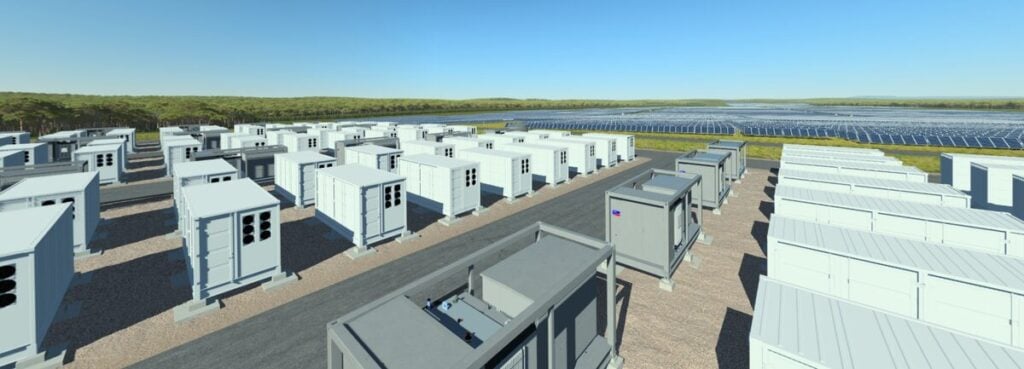
The project, located near Rappville in the Northern Rivers region, comprises a 435MW solar PV power plant paired with a 475MW/3,148MWh battery energy storage system (BESS).
The battery component provides 8-hours of storage duration, enabling solar energy dispatch during evening peak demand periods and grid stabilisation services. The facility will occupy 803 hectares of a 1,475-hectare site, approximately 7km east of Rappville, which has a strong history as a timber and beef town.
In March 2025, Ark Energy signed a supply agreement with Seoul-headquartered Hanwha Energy for the BESS technology. The company confirmed it will use lithium iron phosphate (LFP) technology for the BESS.
Try Premium for just $1
- Full premium access for the first month at only $1
- Converts to an annual rate after 30 days unless cancelled
- Cancel anytime during the trial period
Premium Benefits
- Expert industry analysis and interviews
- Digital access to PV Tech Power journal
- Exclusive event discounts
Or get the full Premium subscription right away
Or continue reading this article for free
The company also executed an Early Contractor Involvement agreement with Elecnor Australia in September 2025 to undertake preliminary engineering and design work. The scope includes site studies, detailed engineering design for the solar PV power plant, and balance of plant design for the battery system, with completion expected by Q2 2026.
The project’s 730,000 bifacial solar modules will feature single-axis tracking technology to maximise energy generation throughout the day. The co-located battery system will provide grid services across the National Electricity Market (NEM), including frequency regulation and peak demand management.
Ark Energy received the planning approval yesterday (16 October) following inclusion of the project in the Federal government’s inaugural Renewable Energy Priority List in March 2025. The Priority List aims to streamline regulatory approvals for significant renewable energy developments and included over 6GW of energy storage.
The Richmond Valley project represents a slightly scaled version of the original proposal that Energy-Storage.news previously reported in July 2024. The initial development application submitted to the New South Wales Department of Planning featured a 500MW solar PV power plant paired with a 275MW/2,200MWh battery storage system.
However, the approved configuration increases the battery power output to 475MW while expanding energy storage capacity to 3,148MWh, representing a significant enhancement from the original 2,200MWh proposal.
Construction is expected to commence in 2026, with completion scheduled for 2027. The project will create 327 construction jobs and 15 permanent operational positions.
The development includes a proposed AU$11 million (US$7.14 million) Voluntary Planning Agreement with Richmond Valley Council to fund community infrastructure, including sporting facilities, libraries, and recreational areas.
Ark Energy, the Australian subsidiary of Korea Zinc Company, has established a substantial renewable energy development pipeline across Australia. The company secured rights for 7GW of development capacity, positioning it among the major players in Australia’s energy transition.
The project was awarded a Long-Term Energy Service Agreement (LTESA) in 2023, which provided revenue certainty for grid services and supported the business case for the substantial battery investment.