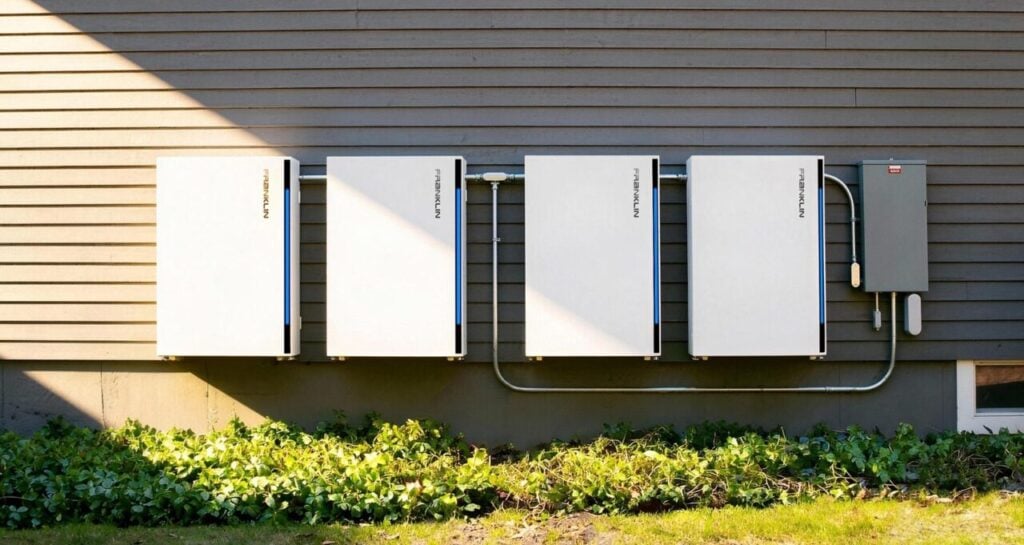
FranklinWH and ConnectDER have had their respective battery and electric meter technologies enrolled into programmes in Arizona expected to accelerate the take-up of home batteries for virtual power plants (VPPs).
FranklinWH batteries available through two Arizona utilities
California-based FranklinWH Energy Storage is participating in two home battery programmes in Arizona, through utilities Salt River Project (SRP) and Arizona Public Service (APS).
Both programmes will involve FranklinWH’s lithium iron phosphate (LFP) aPower residential battery storage system. The aPower2 system has a 15kWh capacity.
SRP’s Battery Partner Programme is a VPP which rewards customers with either FranklinWH or Tesla battery systems for allowing SRP to discharge their battery storage during times of high demand throughout the year.
Try Premium for just $1
- Full premium access for the first month at only $1
- Converts to an annual rate after 30 days unless cancelled
- Cancel anytime during the trial period
Premium Benefits
- Expert industry analysis and interviews
- Digital access to PV Tech Power journal
- Exclusive event discounts
Or get the full Premium subscription right away
Or continue reading this article for free
In APS’s Storage Rewards Pilot, homeowners with FranklinWH aPower batteries are encouraged to share their stored energy with the utility during peak demand times. Participants can receive incentives of up to US$110 per kW, calculated based on the average power they contribute across all demand response events.
FranklinWH is working with the distributed energy resource management system (DERMS) provider EnergyHub, which has previously worked with APS and SRP to manage VPPs.
Arizona homeowners can also take part in these utility VPP incentives by leasing a FranklinWH battery storage system via residential clean energy solutions company Palmetto’s LightReach financing program.
In its 2025 ‘Impact Report’, Palmetto claimed that “Compared to the electricity rate from their incumbent utility, Californians working with Palmetto collectively saved US$27.8 million in 2025.”
FranklinWH emphasised the increasing electricity demand in Arizona, partly due to data centres. He explains that virtual power plant programs enable utilities to harness energy from batteries of participating homeowners during demand surges, thereby stabilising the grid and allowing homeowners to earn payments for their shared energy.
In 2023, FranklinWH raised US$25 million in a Series B funding round to expand its residential battery and energy management software in the US and Puerto Rico.
The round was led by venture capital firm Particle Future, enabling FranklinWH to enhance its R&D, optimise supply chain processes, and grow its operations and sales networks.
ConnectDER’s ‘IslandDER’ approved by Arizona utilities, allowing faster residential storage installation
Meter socket adaptor (MSA) manufacturer ConnectDER has announced that its newest device, ‘IslandDER’ is approved for use by APS, SRP and Tucson Electrical Power (TEP).
ConnectDER develops MSAs for solar, battery storage, and EV charging installations. It allows the technology to connect by plugging directly into the household utility meter socket.
ConnectDER stated that its devices allow for plug-and-play installations, removing the necessity for main electric panel replacements, complete service upgrades, or circuit relocations.
The company’s recent announcement builds on existing supporting within Arizona for its Solar Meter Socket Adapter which is already approved the three utilities and Sulphur Springs Valley Electric Cooperative (SSVEC).
ConnectDER’s EV Meter Socket Adapter is currently cleared for use within APS and TEP service territory.
As reported by our colleagues at EV Infrastructure News, Illinois utilities recently approved ConnectDER’s MSAs for residential EV charger installations.
The Q4 2025 US Energy Storage Monitor by Wood Mackenzie Power & Renewables and the American Clean Power Association (ACP) reported that residential storage installations grew by 8% quarter-over-quarter. This growth was driven by California, Arizona, and Illinois, where attachment rates hit new highs and larger capacity systems captured more market share.
ConnectDER highlighted that Arizona is also increasing its residential solar installations, stating that Arizona is now leveraging its solar abundance to prioritise grid resilience, with recent battery attachment rates reaching an estimated 47%.
The company also noted that installers face a unique challenge with Arizona homes due to meter-main combination sockets that lack space for key system components needed for storage and backup power.
ConnectDER’s IslandDER addresses this by combining a Microgrid Interconnect Device (MID), Current Transformers (CTs), voltage sensing, and communication protocols for real-time grid disconnection, called ‘islanding’, into a single compact device.
It can, ConnectDER claims, manage complex meter-main setups in 15 to 30 minutes without needing extra electrical work. Compatible with storage systems like FranklinWH, Lunar Energy, SolarEdge, and EcoFlow.
The Energy Storage Summit USA will be held from 24-25 March 2026, in Dallas, TX. It features keynote speeches and panel discussions on topics like FEOC challenges, power demand forecasting, and managing the BESS supply chain. For complete information, visit the Energy Storage Summit USA website. ESN Premium subscribers can get an exclusive discount.