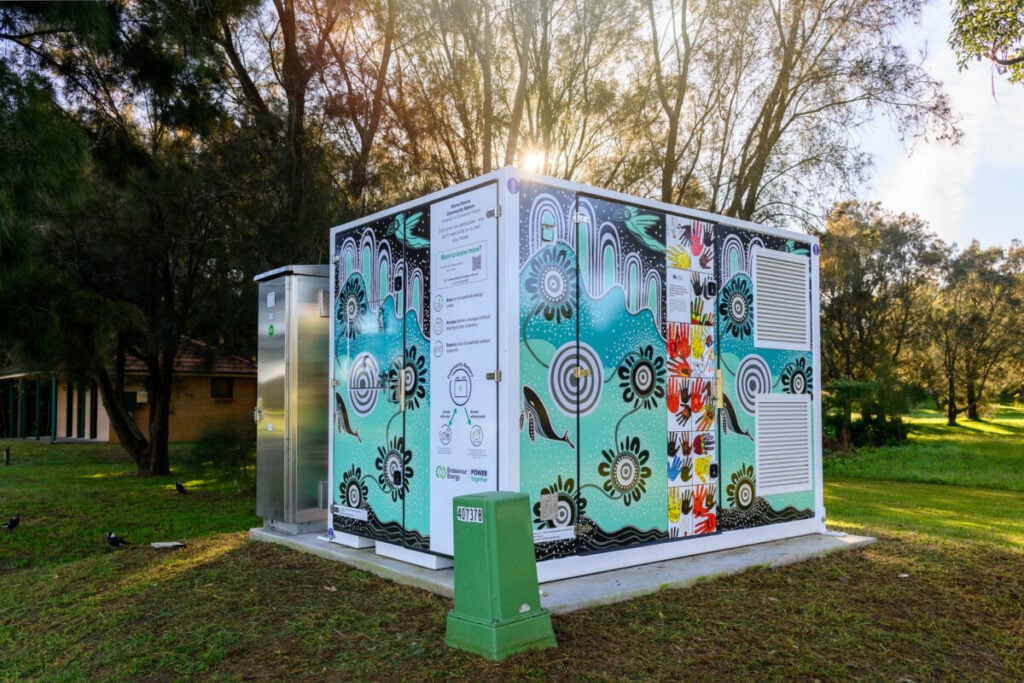
The Australian Energy Regulator (AER) has confirmed that 244 community battery energy storage systems (BESS) are now connected to the country’s distribution networks.
This is according to the AER’s latest Export Services Network Performance Report, which maps a pathway to scaling distributed energy resources (DERs) and consumer energy resources (CERs) across Australia.
The AER said that community batteries represent a growing segment of the country’s energy storage infrastructure, providing grid support services while enabling local renewable energy integration.
Distribution network service providers have emerged as the primary owners of community-scale battery storage systems, controlling 189 of the 244 installations across 14 networks.
Try Premium for just $1
- Full premium access for the first month at only $1
- Converts to an annual rate after 30 days unless cancelled
- Cancel anytime during the trial period
Premium Benefits
- Expert industry analysis and interviews
- Digital access to PV Tech Power journal
- Exclusive event discounts
Or get the full Premium subscription right away
Or continue reading this article for free
This ownership pattern reflects the strategic value these assets provide for network management, congestion relief, and voltage regulation.
The remaining 55 privately owned systems demonstrate growing commercial interest in storage projects that can participate in multiple revenue streams through value stacking arrangements.
The geographic distribution of community-scale batteries varies considerably across jurisdictions, with Queensland leading deployment through Energex’s 53 installations and Ergon Energy’s 13 units.
New South Wales follows with Endeavour Energy operating 54 systems and Ausgrid maintaining 22 installations. This concentration in eastern states aligns with the higher penetration of renewable energy and network congestion challenges in these regions.
Capacity profiles across the networks reveal diverse operational strategies and grid support requirements. Ergon Energy’s installations average 5,562kWh per system, totalling 72,300kWh across 13 units, indicating larger systems designed for extended duration applications.
This contrasts with Endeavour Energy’s 54 installations, which, on average, each provide 5,200kWh of capacity, suggesting a focus on peak demand management and frequency response services rather than extended energy storage.
Community-scale batteries serve multiple functions within Australia’s evolving energy system. These installations can store locally generated solar electricity during periods of high generation and low demand, reducing export curtailment and maximising renewable energy utilisation.
The stored electricity supports demand management for private owners, provides network support services to distribution operators, and enables participation in wholesale energy and frequency control ancillary services markets.
The value stacking potential of community-scale batteries creates multiple revenue opportunities for system owners. These installations can arbitrage wholesale electricity prices, provide grid stability services to AEMO, support local demand management, and offer backup power during outages. The combination of these revenue streams, along with available government grants, improves project economics and return on investment calculations.
Cheaper Home Batteries Program bolsters home battery installations
The Australian government’s Cheaper Home Batteries Program, which launched 1 July 2025 following the Labor Party’s success in the federal election in May, targets residential-scale installations with approximately 30% discounts on battery systems installed alongside solar PV arrays.
The initiative provides full government funding through the purchase of small-scale technology certificates, ensuring that no additional costs are passed on to consumers through energy retailers. This initiative addresses the storage gap for the majority of solar PV customers who lack on-site battery systems.
It has already supported 160,000 battery installations, adding more than 3.6GWh of energy storage capacity to the grid. More than 21 million small-scale technology certificates (STCs) have been purchased through it.
This success saw the Australian government expand the nationwide Cheaper Home Batteries Program in December, increasing the programme to cover an estimated AU$7.2 billion (US$4.76 billion) of support by 2030, more than tripling the initial estimate of AU$2.3 billion.
That equates to an additional 40GWh of energy storage capacity, putting batteries in the homes of around two million people.
Beyond the Cheaper Home Batteries Program, technical standards continue to evolve to support expanding battery deployment. Standards Australia published amendments to AS/NZS 4777.2 in August 2024, addressing grid connection requirements for energy systems via inverters.
These amendments enhance installation and compliance procedures for battery systems, ensuring a suitable response to grid conditions and maintaining system stability across various deployment scenarios.
The AER also noted that the CER Data Exchange project represents a significant infrastructure development for battery storage system coordination.
Led by AusNet Services and the Australian Energy Market Operator (AEMO), the project completed its co-design phase in May 2025, establishing frameworks for secure data sharing between industry organisations. This digital infrastructure will enable better coordination of consumer energy resources, including battery storage systems, for power system security and flexibility services.
Varying impacts from the deployment of battery storage systems
Distribution network service providers report varying impacts from current battery storage system deployment levels.
Some operators indicate that existing penetration rates do not create widespread network issues, while others identify specific locations where battery systems help manage voltage regulation and network congestion.
The geographic distribution of installations, combined with relatively modest current penetration, contributes to manageable network impacts.
AEMO forecasts that solar PV generation will reach over 23,000GWh annually by 2050 in the step-change scenario, representing substantial growth from the approximately 3,500GWh forecast for 2026.
This expansion creates significant opportunities for storage systems to capture and time-shift renewable energy generation, reducing curtailment and improving grid stability.
The broader adoption of CERs and DERs could play a pivotal role in supporting the uptake of variable renewable energy generation; however, regulation must adapt to help support the changing energy mix.
Indeed, the AER notes that the regulatory environment continues to evolve to accommodate the expanding deployment of batteries through the implementation of the National CER Roadmap.
For instance, the CER Taskforce advances 14 of 16 priority workstreams, addressing technical standards, market operations, and data sharing arrangements that support the integration of battery systems across residential, commercial and community scales.
Some distribution network service providers face challenges in accurately reporting community-scale battery installations due to visibility limitations regarding privately owned systems.
Energex and Ergon Energy reported only utility-owned installations due to uncertainty in identifying whether privately owned batteries qualified as community-scale systems under current definitions.
The Energy Storage Summit Australia 2026 will be returning to Sydney on 18-19 March 2026. To secure your tickets and learn more about the event, please visit the official website.