
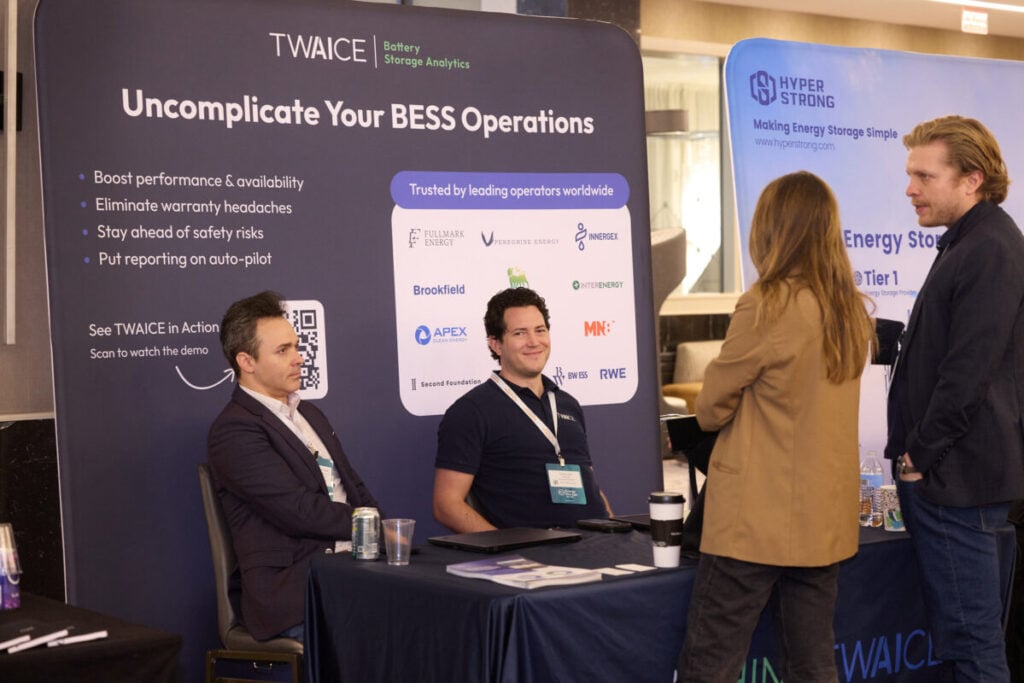
Lennart Hinrichs, executive VP and general manager for Americas at TWAICE, discusses the value proposition of BESS data analytics for the North American market.
There are a growing number of cloud-based data analytics providers active in the battery storage market, each proposing to help operators gain much deeper visibility into their assets than they would otherwise get by relying solely on the OEM’s energy management system (EMS).
Software-based data analytics are designed to monitor, calculate and, where necessary, estimate metrics within the battery energy storage system (BESS), from cell up to system level, that determine health, performance and lifetimes.
Headquartered in Germany, TWAICE’s founders, Michael Baumann and Stephan Rohr, began their research into lithium-ion batteries, including lifecycles and second-life applications, in 2014 at the Technical University of Munich.
Try Premium for just $1
- Full premium access for the first month at only $1
- Converts to an annual rate after 30 days unless cancelled
- Cancel anytime during the trial period
Premium Benefits
- Expert industry analysis and interviews
- Digital access to PV Tech Power journal
- Exclusive event discounts
Or get the full Premium subscription right away
Or continue reading this article for free
Having expanded into the North American market and opened offices and R&D centres in Chicago, US, in 2021, TWAICE has raised funding from investors that include US-based Energize Ventures and Coatue.
In March, TWAICE senior BESS engineer Matt Drazenovich teamed up with Chris Swanson, director of performance engineering at Fullmark Energy, to detail the real-world application of data analytics across the US BESS developer’s portfolio in California.
In the pair’s Guest Blog, ‘BESS asset operation in CAISO is complex, but lean teams can leverage advanced analytics,’ they discussed how the cloud-based platform helps Fullmark make key market compliance and dispatch decisions.
In this interview, conducted just after Lennart Hinrichs spoke at the 2026 edition of Energy Storage Summit USA in Texas last month, the TWAICE general manager for Americas explains the challenges data analytics aims to solve, including bridging the crucial gap between technical performance and commercial outcomes.
What industry challenges are driving demand for solutions from companies like TWAICE, and where do you think you have the most value to add?
As BESS fleets scale from single assets to portfolios, operators face growing pressure to maintain performance, manage safety and commercial risks, and coordinate faster across more systems, vendors, and data sources. What may work for a single asset, breaks at portfolio-scale, or when assets need to compete in increasingly dynamic commercial markets.
The challenge is not just accessing fragmented data but consistently understanding how assets are actually performing across those systems. Turning fragmented data into a consistent, interpretable view of performance, independent of individual system definitions, is where TWAICE adds most value. As fleets grow, this becomes critical to scale efficiently and protect revenue.
What is the biggest challenge that would require a BESS operator to require an external analytics provider?
The biggest challenge is that there’s no consistent way to understand how assets are performing across systems and stakeholders. In many fleets, OEMs, integrators, EMS providers, and O&M teams each have a partial view of operations and often define and calculate key performance metrics differently.
When performance drops or alarms increase, operators struggle to identify the root cause or determine who is accountable for resolving the issue. This becomes difficult to solve with existing system-level tools, as each is designed around its own data and definitions.
That is where analytics becomes necessary. TWAICE gives operators a clear, consistent view of what’s happening, so issues can be diagnosed more quickly, responsibility becomes clear, and supplier and warranty discussions are backed by evidence.
Is battery analytics beneficial mainly for increasing revenue or for providing analytical insights into the BESS for health, longevity, etc.?
BESS analytics matters because it directly connects technical performance to commercial outcomes. It helps operators identify issues like imbalances, state of charge (SoC) errors, or thermal anomalies early, while also improving availability, recovering lost energy, and supporting better trading decisions.
The challenge is that this link is not always visible with existing tools. Operators may see technical issues or revenue impacts, but not how the two relate. Analytics makes that connection clear, so operators can act on it and support both system performance and revenue.
How does TWAICE’s experience in Europe inform its approach to the US market?
TWAICE’s European experience informs our US approach. As BESS portfolios grow, operators in Europe and the US run into many of the same operational challenges: inconsistent data, limited cross-site comparability, difficulty separating expected behaviour from real performance issues, and too much engineering effort spent on root cause analysis.
Our work in Europe has given us broad exposure to different OEMs, technologies, and operating models, which helps us recognise those patterns early and build the baselines, data quality checks, and fleet-wide visibility needed to scale operations. At the same time, our approach in the US is tailored to the specific dynamics of the market, including regional trading structures and operational requirements.
But the foundation is the same: better data, earlier detection, faster root-cause identification, and a standardised way to manage complex fleets at scale. We’ve found that owners and operators managing global portfolios especially value this consistency, as it allows them to compare performance, make decisions and scale operations with confidence.
Additional reporting by Cameron Murray.