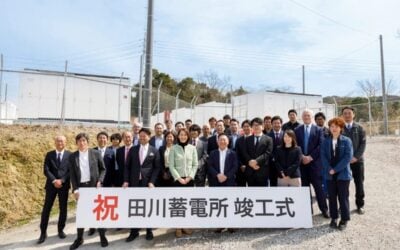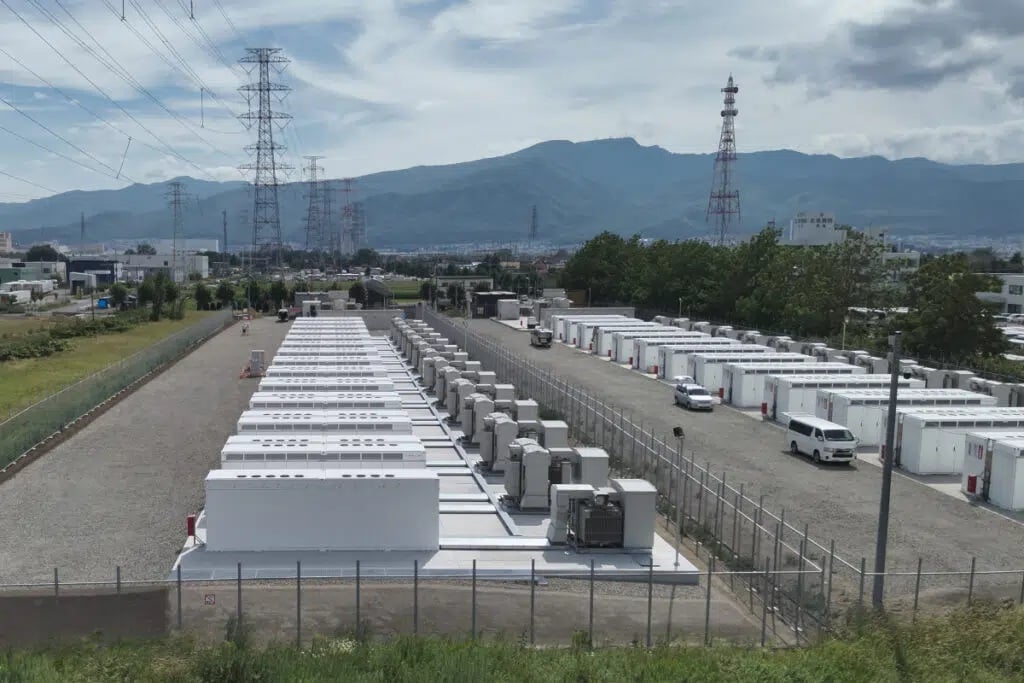
Renewables developer HD Renewable Energy and utility Tokyo Gas signed a deal for two large-scale projects in another busy week for Japan’s growing battery storage market.
Tolling agreement for projects with 20-year LTDA contracts
Hongde Energy Technology Japan, an arm of Taiwanese developer HD Renewable Energy (HDRE), has invested in a 99MW battery energy storage system (BESS) project, and another 50MW asset in Aomori Prefecture, northwest Japan, which Tokyo Gas aims to bring into commercial operation in the 2029 fiscal year (FY2029). Financial terms were not disclosed.
The deal was announced by both companies on 16 April. Tokyo Gas said it has upped its target to invest in 1GW of operational BESS capacity by FY2030 to 2GW “in the early 2030s,” having already planned 955MW of projects in the last two years, since it entered the market.
The utility has leveraged its experience in electricity trading to develop three energy storage market initiatives: in-house BESS project development, offtake for third-party assets and optimisation services. The 1GW by FY2030 target includes 800MW of Tokyo Gas-owned projects and 200MW of optimisation services for high-voltage grid batteries.
Try Premium for just $1
- Full premium access for the first month at only $1
- Converts to an annual rate after 30 days unless cancelled
- Cancel anytime during the trial period
Premium Benefits
- Expert industry analysis and interviews
- Digital access to PV Tech Power journal
- Exclusive event discounts
Or get the full Premium subscription right away
Or continue reading this article for free
The two new assets in Aomori’s Hachinohe City and Towada City have both been selected to receive 20-year contracted capacity payments in the Japanese government’s Long-Term Decarbonization Auction (LTDA) scheme run by national association of grid operators OCCTA.
HDRE will develop and construct the systems, which Tokyo Gas will operate, paying HDRE over the 20-year term. In addition to the LTDA contract, they will earn revenues through wholesale electricity market trading and supply and demand adjustment markets. Under the LTDA scheme’s rules, 90% of revenues earned in-market must be returned to OCCTA.
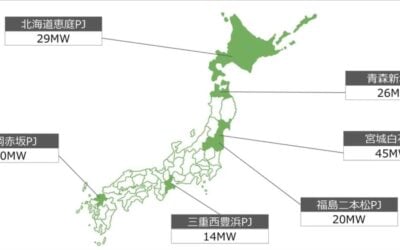
HDRE has secured 400MW of capacity in the auction’s first two years of running. The company and Tokyo Gas are already partnered through tolling contracts for 190MW of other BESS projects in four other prefectures across Japan, with the Aomori projects bringing their total to 340MW under contract.
HDRE also recently brought into operation what it claimed was Japan’s first large-scale fully merchant BESS, a 50MW/104MWh asset in Hokkaido, with Brawn Capital. The Taiwan-headquartered company said it had put overseas expansion at the heart of its 2026 strategy at the beginning of the year.
2MW/8MWh sweet spot for most market participants
While LTDA-contracted BESS projects at the scale of dozens of megawatts per site and 3-hour to 6-hour storage duration are being constructed today, the Japanese market’s operational and under construction grid batteries are typically of 2MW output and 8MWh capacity.
The market opened a couple of years ago through regulations enabling participation in electricity markets and the stacking of JEPX wholesale market and supply-demand ancillary services revenues. Most market players are testing the waters with relatively small front-of-the-meter (FTM) projects, partly due to low land availability and grid connection constraints.
Just in the past week, several new 2MW/8MWh projects were announced as operational, planned, or under construction.
They include real estate developer Hulic’s two projects in Saga and Hyogo Prefectures, supplied by Sungrow and due to begin operation in July 2026, Hulic said on 15 April. They will be optimised by aggregator Shizen Connect and form part of a JP¥100 billion (US$623.9 million), 10-year investment plan into battery storage between 2024 and 2034 for the real estate company.
Retail electricity provider Tokyu Denki & Gas (Tokyu Power Supply), said on 14 April that it will begin operation of a similarly sized project in Omaezaki, Shizuoka Prefecture, before the end of this month.
The company, part of the Tokyu Group and affiliated to Tokyu Land, which has its own BESS market ambitions, will also bring into operation a project in Mie Prefecture in May and in Gunma Prefecture in June. Tokyu Power Supply’s projects will aid the decarbonisation of the company’s railway operations, including the Tokyu Setagaya Line in Tokyo, which it is targeting to supply with 100% renewable energy from a solar PV plant through offsite power purchase agreements (PPAs).
Disaster relief, renewables curtailment drive other use cases
Energy-Storage.news counted at least four other projects of similar scale announced in the past week.
In addition to the market-based applications outlined above, disaster relief is also a driver for BESS adoption in Japan—evidenced by a contract signed between Nippon Chikudenchi (Japan Storage Battery Co.) and the city government of Iwata, Shizuoka Prefecture, on 14 April.
Noting that the average two-person household requires approximately 17kWh of electricity for 72 hours (roughly 5.6kWh per day), Japan Storage Battery said its planned 8MWh system could support around 470 households for three days.
The same company also said it began operation of another 2MW/8MWh system, integrated by TMEIC using CATL batteries, on 13 April in Gifu Prefecture.
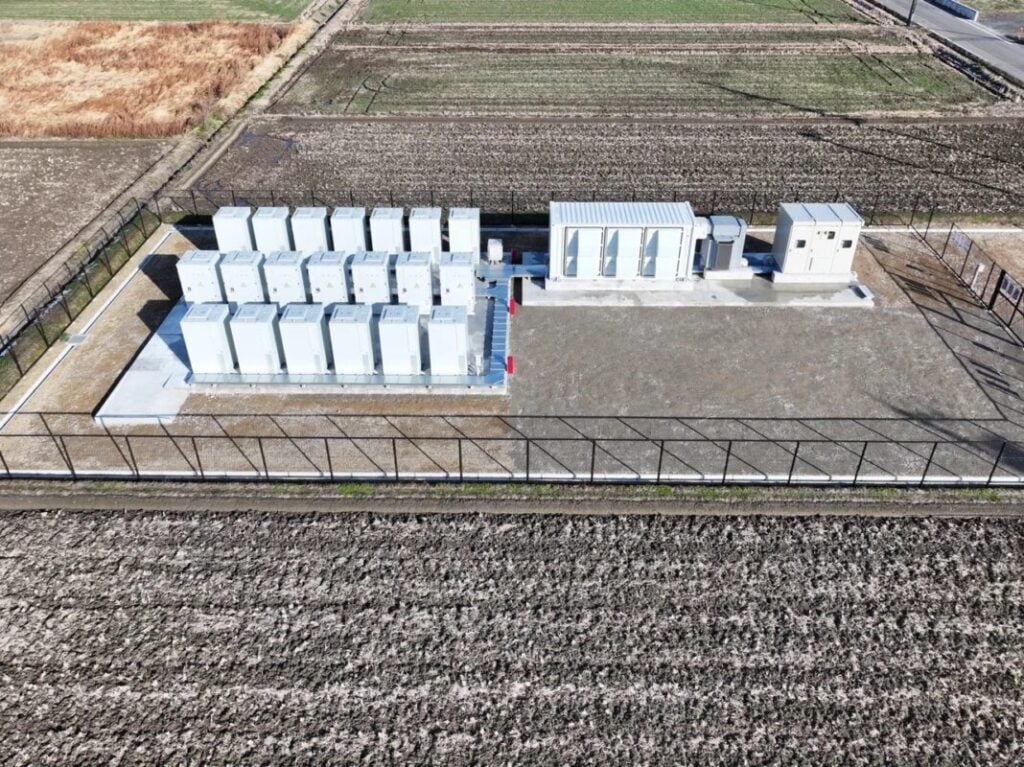
Finally, for now at least, RE100 Electric Power, a renewable energy developer, corporate electricity retailer and producer of non-fossil fuel energy certificates, in addition to announcing two new 2MW projects and a 100MW co-development agreement, said on 17 April that it will begin a new battery-backed optimisation service for solar PV generators.
Working in the service areas of Shikoku Electric Power and Tohoku Electric Power, which are both experiencing curtailment of output (known as ‘output control’ in Japan) from large-scale solar plants (known as ‘Megasolar’ in Japan), RE100 will support power plant operators to design and operate co-located BESS assets. In other words, the solar-plus-storage plants will store electricity generated in times of surplus and sell the power back to the grid when demand and prices rise.
Energy-Storage.news publisher Solar Media (part of the Informa Group), will host the Energy Storage Summit Asia 2026, on 1-3 July at QSNCC, Bangkok, Thailand. See the website for more details, including agenda and ticket information.