Amid growing interest in Japan’s battery storage market, a consortium of major Japanese businesses is targeting 174MW of deployments.
Libra LLC, a consortium of domestic companies, was formed on 26 March 2026 and announced publicly a week later on 3 April.
Led by real estate developer Tokyu Land and its subsidiary, asset manager ReENE Inc., Libra has been invested in by eight other organisations including joint ventures (JVs), general leasing and real estate, construction companies and banks.
The formation of the consortium comes at a time when developers and investors have identified opportunities for revenue-stacking business models for battery energy storage system (BESS) assets, including wholesale electricity trading and arbitrage on the JEPX market, balancing ancillary services markets and, to a lesser extent, capacity market contracts.
Try Premium for just $1
- Full premium access for the first month at only $1
- Converts to an annual rate after 30 days unless cancelled
- Cancel anytime during the trial period
Premium Benefits
- Expert industry analysis and interviews
- Digital access to PV Tech Power journal
- Exclusive event discounts
Or get the full Premium subscription right away
Or continue reading this article for free
Several of the companies have already participated in energy storage projects either directly or through investment, both in Japan and abroad and will likely be familiar names to readers of Energy-Storage.news.
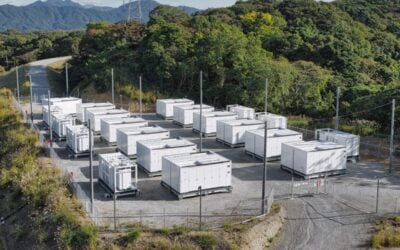
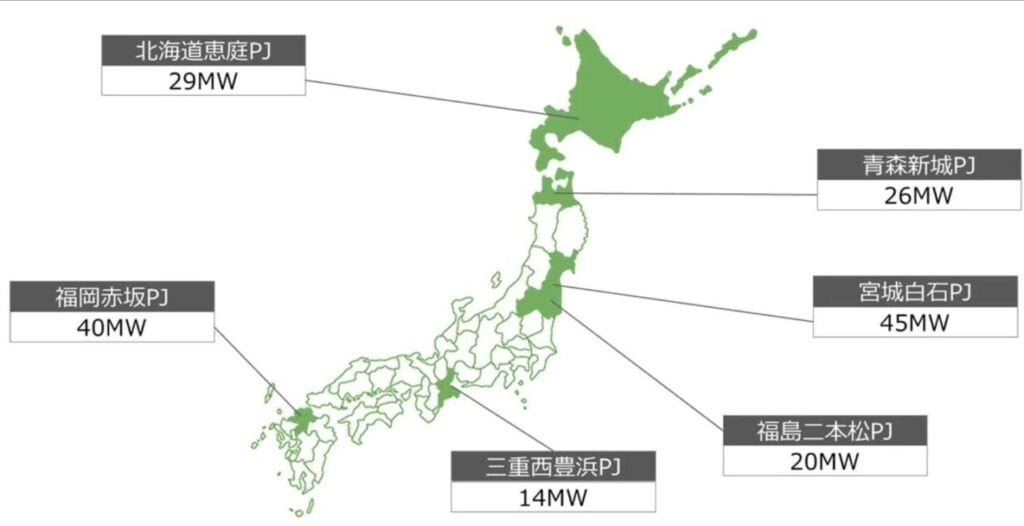
The consortium aims to deploy the 174MW across six large-scale BESS projects, representing an estimated JP¥30 billion (US$189.8 million) investment. Development rights to the projects have been acquired by Tokyu Land.
Activities will commence from the start of the Japanese fiscal year 2027 (FY2027), which begins 1 April 2027. Projects range in size from 14MW to 45MW and are distributed in southern, western, northeastern and northern regions of Japan as shown in the map above.
Tokyu Land (Tokyu Fudosan) will manage projects during the development phase, while Liene provided consulting and support to verify the business models behind the consortium and established the special purpose company. ReENE will act as asset manager.
ReENE has 1.5GW of renewable energy projects under management already and has sold 240MW of BESS projects to date. Its subsidiary ReENE Energy, which already manages and operates 3.5GW of renewables and 121MW of BESS across 22 projects, will be responsible for operations and maintenance (O&M), alongside Itochu Corporation, one of Japan’s major trading companies and an existing investor in BESS projects at home and abroad.
Tokyu Land entered the grid-connected battery storage business in 2023 and began operation of its first 2MW project in Saitama, near Tokyo, early in 2025. In the renewables space, the company has been involved with developing and operating around 2.1GW of solar PV, wind power and biomass generation projects in Japan as of the end of last year.
Most companies making early BESS investments in Japan have got started with projects of about 2MW output and 8MWh capacity (4-hour duration), before either replicating that model or moving to bigger projects. Tokyu Land said it is developing a total of 340MW of BESS nationwide.
The investors in the consortium Libra LLC alongside Tokyu Land are:
- IBeeT, a distributed energy JV between Itochu and financial services company Tokyo Century
- Fuyo General Lease
- Nomura Real Estate
- Maeda Construction
- Nippon Steel Kowa Real Estate
- Sumitomo Mitsui Trust Bank and Sumitomo Mitsui Trust Panasonic Finance
More BESS activities in busy couple of weeks
With Japan’s FY2026 just underway, several other notable BESS project activities have been announced in the past few days.
This morning, Tokyu Corporation—owned by the same Tokyu Group as Tokyu Land but operated entirely separately—said it had been selected by the Tokyo Metropolitan Government’s national energy storage support scheme.
Tokyu Corporation and affiliate Tokyu Power Supply will invest in 46MW/184MWh of BESS across Japan.
Under the scheme, BESS project owners receive Capex subsidies worth up to 50% of upfront cost. In the most recent second staging of the annual solicitation for FY2025, the Tokyo Metropolitan government selected 15 projects in the Tokyo transmission system area, totalling 187.8MW/758.9MWh, according to reporting from market intelligence firm Japan Energy Hub.
Last week, Energy-Storage.news reported that developer Hexa Energy Services had brought into operation what the company claimed is Japan’s first BESS project with a 20-year capacity market contract under the national government’s Long-Term Decarbonization Auction (LTDA).
On Monday (6 April), New York-headquartered investment firm Stonepeak said that Kingdom, a BESS platform it established in Asia, executed its first project financing facility for a 29MW project in Okayama Prefecture, in the southwest of Japan’s main island Honshu.
Japanese bank MUFG, which many readers will know as active in financing BESS projects in other countries including the US, is the original lender and mandated lead arranger for Kingdom’s Mimasaka project, one of nine for the developer that has an LTDA contract in place, totalling 479MW. CATL will supply batteries for the project, Stonepeak said.
The LTDA was welcomed as a means to securing long-term contracted revenues, but it comes with a major catch, in that 90% of profits from any merchant activities must be returned to OCCTO, Japan’s association of grid operators that administers the scheme.
Some developers therefore are seeking fully merchant opportunities, while others, such as UK-headquartered Eku Energy are spreading their portfolio risk across a combination of tolling and LTDA contracts.
Yesterday, Energy-Storage.news reported that French renewables and energy storage developer Neoen, owned by asset manager Brookfield, is building a 100MW/400MWh project in Japan’s western Kansai region.
Neoen said in an English language press release that it will partner with fellow French company Equans and a Japanese company called Toho on the Ako Battery project, in Kansai’s Hyogo Prefecture.
However, Toho and Equans were not referenced in a Japanese-language press release, and given that Toho is a fairly common name in Japanese business, Energy-Storage.news has reached out to the developer for clarification on which Toho it is working with.
Neoen said it has secured both development rights for Ako Battery last year and a grid connection agreement a few months ago with transmission and distribution (T&D) company Kansai Electric Power. A notice to proceed (NTP) is expected to be issued in the coming months, for an expected start of operation in 2028.
The project’s business model was not disclosed in Neoen’s announcement.