“We have learned more in the past six months than we have in the past six years, because those battery storage systems with the merchant element are commissioning as we speak,” said François-Régis Pialoux, director of energy at ING Australia.
Pialoux’s assessment captures the rapid evolution confronting energy storage financiers in Australia, where the past 18 months have started to reshape how banks approach battery storage lending.
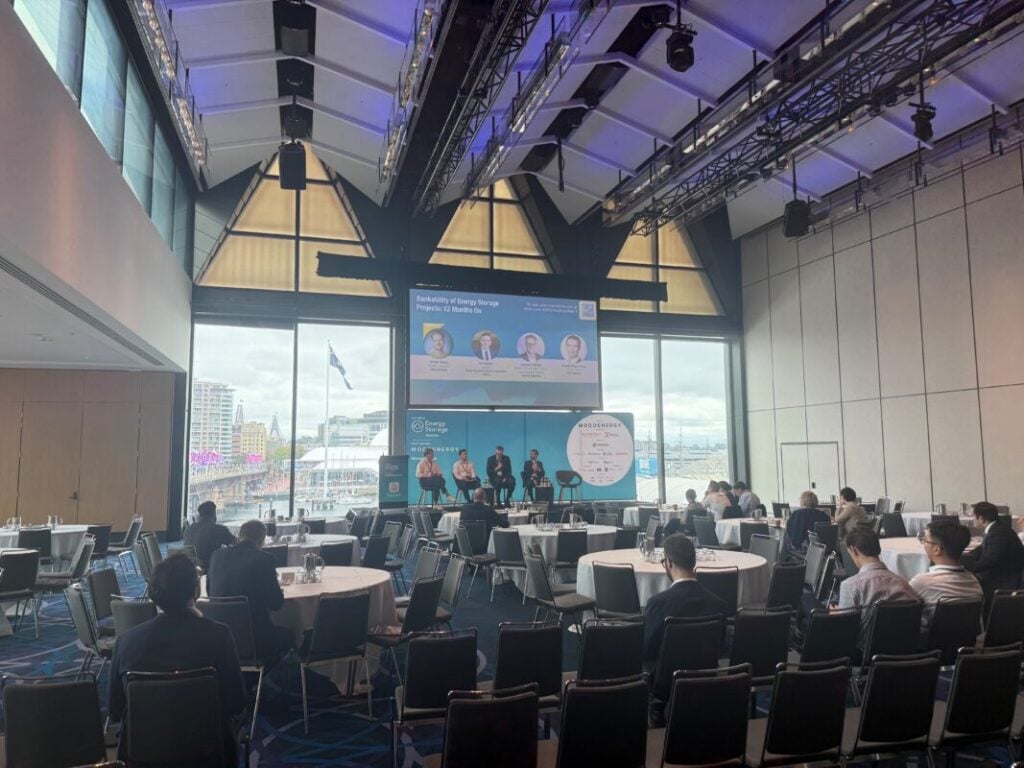
Speaking at the Energy Storage Summit Australia 2026 in March, representatives from ING, Société Générale, and the Clean Energy Finance Corporation (CEFC) revealed how dramatically the landscape has shifted as merchant exposure has become the norm, price spreads have compressed, and rapid deployment threatens to outpace demand.
Pialoux described a period of accelerated learning that has exceeded the combined total of the previous six years. The bank began financing battery storage systems on a standalone basis in 2020, but those early projects were fully contracted with limited risk exposure compared to today’s merchant-heavy structures.
Try Premium for just $1
- Full premium access for the first month at only $1
- Converts to an annual rate after 30 days unless cancelled
- Cancel anytime during the trial period
Premium Benefits
- Expert industry analysis and interviews
- Digital access to PV Tech Power journal
- Exclusive event discounts
Or get the full Premium subscription right away
Or continue reading this article for free
Two critical lessons have emerged from operational experience. The first concerns the hands-on nature of battery operations compared to traditional renewable energy generation.
“You give a solar PV plant to two different sponsors, the way they would operate the solar farm would be quite similar,” Pialoux explained.
“But if you give the same battery system to two different sponsors, the outcome is likely to be quite different. So, sponsor selection and how the battery systems are operated are key.”
The second revelation has upended earlier assumptions about grid risk.
“The expectation was that battery systems would be immune from any grid risk, because they generate in the morning and evening, and they wouldn’t have any curtailment issues,” Pialoux said.
“And we are starting to see that actually this is not the case, and this is also a common theme for batteries that will need to be considered by banks.”
Despite these challenges, Pialoux emphasised that lender appetite remains strong: “We still think batteries are a must-have in the coming five to ten years. Coal is going to retire, and battery storage will need to be there.”
The merchant risk equation
The financing sweet spot for standalone battery projects has settled into a contracting range of 50% to 70%, according to Campbell Webster, director and team leader for energy at Société Générale Australia and New Zealand.
“The sweet spot from a contracting point of view, let’s call it somewhere between 50 to 70%,” Webster said.
“We’ve seen deals that have been done with 70% contracting with really strong offtakers and really strong sponsors who’ve been able to gear above 80%, but then there’s been at least one merchant battery done in most recent times with gearing in the 30 or 40% range on the upper side, and with very strict controls.”
The market has largely transitioned to virtual tolls, which Webster described as now representing the market norm.
“You can have investors, commodity traders, reinsurers, corporates sign virtual tolls. And so, it’s really broadened the offtake market in that sense,” he explained.
Yet the fundamental tension remains: lenders require fixed repayment profiles, while batteries generate revenue from volatility that is itself volatile. Nick Hawke, director at the CEFC, argued that the lending market needs to evolve its structural approach.
“There is a very real possibility in the battery market that you have a couple of quarters of very little volatility. You might have a lock-up or default, and then the next month a massive issue, outage of a coal plant, huge amount of revenue for the project,” Hawke said.
“There is a balance to be structured in between that I think the market needs to think about.”
Banks, however, remain conservative in their debt sizing methodology.
“We’re not banking those one-off events,” Webster emphasised.
“Equity sponsors will put them in their model and make their own assumptions, but we’re not including those assumptions in what we look at for bankability and debt sizing.”
The speed of battery deployment has also caught experienced lenders by surprise. Pialoux revealed that price spreads have compressed dramatically from initial expectations of AU$180-200/MWh (US$124-138/MWh) for merchant battery storage systems financed several years ago to consistently suppressed levels approaching AU$100/MWh over recent months.
“Did we expect that spreads would be suppressed? Yes, we did. Did we expect that it would happen so fast? I don’t think so,” Pialoux said.
“The reality is, battery storage systems are being built much faster than any other large-scale renewables assets in Australia. A wind farm will take you three to three and a half years to build. A battery, like the largest battery in the world at the time, took 200 days to build.”
The scale of potential oversupply looms large in lenders’ risk assessments. Pialoux pointed to the government’s rooftop solar and battery program, targeting approximately 25GW by 2030, roughly equivalent to average demand across the National Electricity Market (NEM).
“In four years, if assuming that the demand hasn’t changed, you could have the full demand theoretically addressed by or met by behind-the-meter batteries, which is quite crazy,” he said.
This near-term oversupply risk has become the primary focus for banks. “We don’t think about the merchant in the long term and what the long-term risks are,” Pialoux explained.
“We are really thinking about the short term and the potential oversupply in the short term.”
Government support falls short
Government contracting mechanisms, including the Capacity Investment Scheme (CIS), have provided project credibility but have not yet proven sufficient as standalone revenue sources for debt sizing. Webster was direct in his assessment.
“I think, from a bankability point of view, the reality was, when it came out, it was probably a little bit weird to work it out right,” Webster said.
“There are caps in the CIS, cap and floor, and there’s an overall annual cap, which made it very hard to size against. So ultimately, you haven’t seen any project with CIS that has been banked with just CIS.”
Hawke noted that bidding strategies have evolved, with some developers initially underbidding and subsequently struggling to deliver economically viable projects.
However, he expressed confidence that recent tender rounds are producing more bankable outcomes: “Players that I’m talking to that bid in the most recent CIS round for 8-hour battery, they are really confident that that contract alone will get the project away later this year.”
For long-duration storage, the revenue model remains fundamentally challenged.
“The issue of long duration is that the revenue model is difficult until there’s either a policy that drives those projects being built or a market mechanism that rewards deep insurance-style capacity, which we currently don’t have,” Hawke said.
Webster noted that 8-hour duration batteries supported by Long-Term Service Energy Agreement (LTESAs) are beginning to appear bankable: “We’re starting to see some long-duration batteries now, the eight-hour batteries supported by LTESA, which seem really quite bankable because a larger portion of their contracting profile.”
12GWh of LTESAs were recently awarded to successful lithium-ion projects in the latest long-duration energy storage (LDES) tender in New South Wales. ESN Premium recently spoke with Thimo Mueller, general manager, commercial, at ASL, about the tender’s successes.
Portfolio structures provide alternative path
While standalone merchant batteries face debt sizing constraints, several have been successfully financed within portfolio structures. Webster revealed that gigawatt-scale portfolios comprising multiple technologies have served as a home for merchant batteries.
“There have been quite a few merchant batteries done within portfolios, including ones my bank has financed,” Webster said.
“These are gigawatt, two-gigawatt-type portfolios that have got all sorts of technologies implementing batteries and solar in them as well. That’s where we are seeing a home for some of these merchant batteries, because they generally can sit in there without the debt sizing screwing up the whole portfolio.”
Pialoux noted that portfolios with experienced sponsors receive favourable consideration: “If it’s part of a bigger portfolio of financing, especially with parties or sponsors that have experience in the markets, then banks are happy to give more flexibility.”
However, for standalone merchant projects, the path remains challenging.
“If that’s something that’s happening to you as a sponsor, obviously, you should expect that you’ll be talking to fewer banks, probably five, six banks will be entertaining that,” Pialoux said.
“And you should expect that your gearing, or the amount of debt you’ll be able to capture on day one, is going to be quite small.”
The past 18 months have transformed energy storage from a nascent asset class requiring government-backed contracts into a mature financing market comfortable with measured merchant exposure.
Webster summarised the evolution: “From a bankability point of view, it’s certainly an asset class. It’s very popular. It’s one that we like to do.”
Hawke reflected on the remarkable deployment success: “We’ve seen an incredible number of batteries built in the past few years. I think it’s probably the best success story in terms of the Australian energy transition – 15GW now, with 15GW under construction and commissioning. If you told any of us that three or four years ago, no one would have believed it.”
The question facing lenders is no longer whether batteries are bankable, but rather how to structure financing that accommodates both the technology’s essential role in the energy transition and the volatile revenue reality that defines its economics.
Interested in Australia? Read Energy-Storage.news’ Energy Storage Summit Australia coverage and related content.