

At The Smarter E 2026, three companies across the battery energy storage value chain described the same shift, PowerUp among them: battery analytics is moving from a screen operators watch, to a decision layer the whole ecosystem acts on.
Grid-scale storage has changed shape fast. Sander Jacobs, Chief Commercial Officer at Renewance, put the scale plainly: a decade or two ago, a large project might hold tens of megawatt-hours. Today the conversation runs in gigawatt-hours. As the assets grew, so did the stakes attached to keeping them healthy for 15 to 20 years.
That maturation mirrors what solar went through. The early years rewarded getting product into the field. The years that follow reward operating it well. Jean-Marc Guillou, Business Unit Director at Socomec, put it like this: the industry is shifting from product-centric to revenue-centric. Battery analytics is the layer that makes that possible, and building it is PowerUp’s business, led on the commercial side by its Chief Revenue Officer, Philippe De La Fortelle.
At The Smarter E, Jacob Yang, Marketing Consultant at PowerUp, sat down with all three. PowerUp’s Philippe de la Fortelle spoke to the analytics itself. Socomec’s Jean-Marc Guillou spoke to building it into the asset. Renewance’s Sander Jacobs spoke to acting on it in the field, as an independent service provider. Three lenses on one critical industry shift.
Try Premium for just $1
- Full premium access for the first month at only $1
- Converts to an annual rate after 30 days unless cancelled
- Cancel anytime during the trial period
Premium Benefits
- Expert industry analysis and interviews
- Digital access to PV Tech Power journal
- Exclusive event discounts
Or get the full Premium subscription right away
Or continue reading this article for free
The Blind Spot Below the BMS Threshold
Start with the system already on site. The battery management system (BMS) does essential work. It measures voltage, current, and temperature at the cell level, and it raises an alarm when a value crosses a safety threshold. That protection is correct and necessary, and analytics does not replace it.
The gap is what happens before a threshold. Philippe, PowerUp’s Chief Revenue Officer, described the BMS as local and reactive by design. It flags conditions once they cross a line. Many of the conditions that erode revenue build quietly below that line: a limiting cell that holds back its neighbours, a rack that drags down an entire power conversion system (PCS), a cooling circuit drifting from its expected behaviour.
Analytics operating upstream of the BMS gives operators early visibility into those trends. It identifies deviations, localises them, and leaves the protective logic untouched.
The magnitude is not hypothetical. In contributing to specialist insurance group kWh Analytics’ 2026 Solar Risk Assessment, PowerUp reported that 75% of BESS sites show early HVAC-related risk signals. These are the kind of temperature drifts that climb while staying below the BMS safety threshold, so the BMS does not flag them. PowerUp’s inter-rack imbalance white paper, When Healthy Racks Can’t Deliver, documents the parallel case on the performance side, where healthy-looking racks still leave a meaningful share of an asset’s capacity stranded.
See and Undestand It: PowerUp and the Analytics Layer
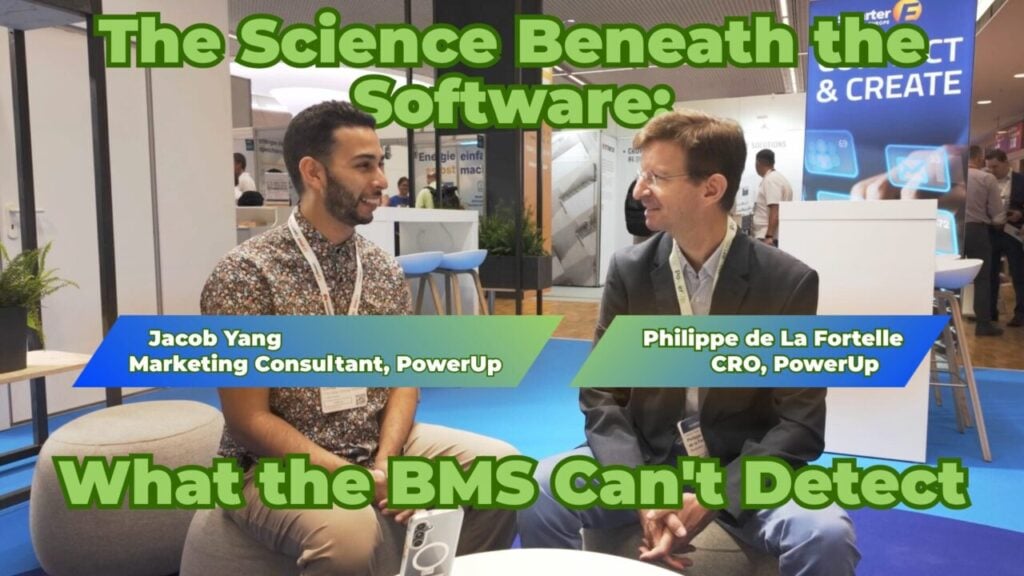
PowerUp is a battery analytics company, and its platform, Battery Insight®, sits above the BMS layer. What sets the approach apart, from Philippe De La Fortelle’s perspective, is the foundation underneath the software. PowerUp spun out of CEA-Liten, part of the French research institute CEA, in 2017, carrying more than 15 years of research into how lithium-ion batteries degrade. Electrochemical models sit at the core, with AI-enhanced features added on top rather than in place of the science. Philippe drew the contrast with platforms that are AI in nature and cannot always explain the chemistry behind their outputs.
“The science-based understanding is at the heart of what we do.”
– Philippe de la Fortelle, Chief Revenue Officer, PowerUp
That foundation feeds three levers Philippe tied directly to owner economics.
- Availability: surfacing a developing fault early gives operators time to intervene before it forces a shutdown, which protects availability during high-value market hours.
- Capacity: resolving imbalance and related anomalies can recover usable capacity that would otherwise sit stranded, an improvement he placed in the range of 10 to 20% where those conditions are found and corrected.
- Lifetime: identifying why some racks age faster than others can extend their service life by three to five years, deferring capital that would otherwise go to early replacement.
The analytics surfaces the deviation, the likely root cause, and a suggested next action. The decision stays with the operator.
Build It In: Socomec and the Integrator’s Job
Analytics has to reach the people running the asset. One way it gets there is embedded into the system at the point it is built, and that is where an integrator like Socomec comes in. The group is family-owned, founded in 1922, and its energy storage business unit builds BESS for the commercial and industrial (C&I) segment, working with IPPs and large industrial sites adding solar and storage.
“This is the paradigm shift: from product-centric to revenue-centric.”
– Jean-Marc Guillou, Business Unit Director, Socomec
Jean-Marc described a monitoring platform, SoLive Pro BESS, that pairs an energy management system with embedded battery data analytics, delivered through Battery Insight by PowerUp. The design goal Jean-Marc kept returning to was translation. A single C&I cabinet can hold more than 400 cells in series, and explaining cell imbalances to an owner at the electrochemical level can be its own challenge. SoLive Pro BESS reduces that complexity to simple KPIs an IPP can act on, with the option to bring in deeper expertise when a site needs it.
He also made the case for keeping the software stack agnostic. Battery technology is moving quickly, with new chemistries such as sodium-ion (Na-ion) and long-duration energy storage (LDES) formats arriving alongside lithium iron phosphate (LFP), and an integrator has to absorb that change without re-architecting every time. Add European cybersecurity obligations for anything connected to the grid, and the software layer becomes as much a part of the product as the hardware.

Act On It: Renewance and the Service Layer
A platform that flags an issue still needs someone to fix it. Renewance, a service provider founded in 2015, spoke to that part of the energy storage lifecycle equation. Chief Commercial Officer Sander Jacobs framed a service provider’s interest in analytics around the same three outcomes owners care about: performance, longevity, and cost-effectiveness.
“It’s all about timeliness. Seeing it early, and correcting it before it impacts your revenue generation.”
– Sander Jacobs, Chief Commercial Officer, Renewance
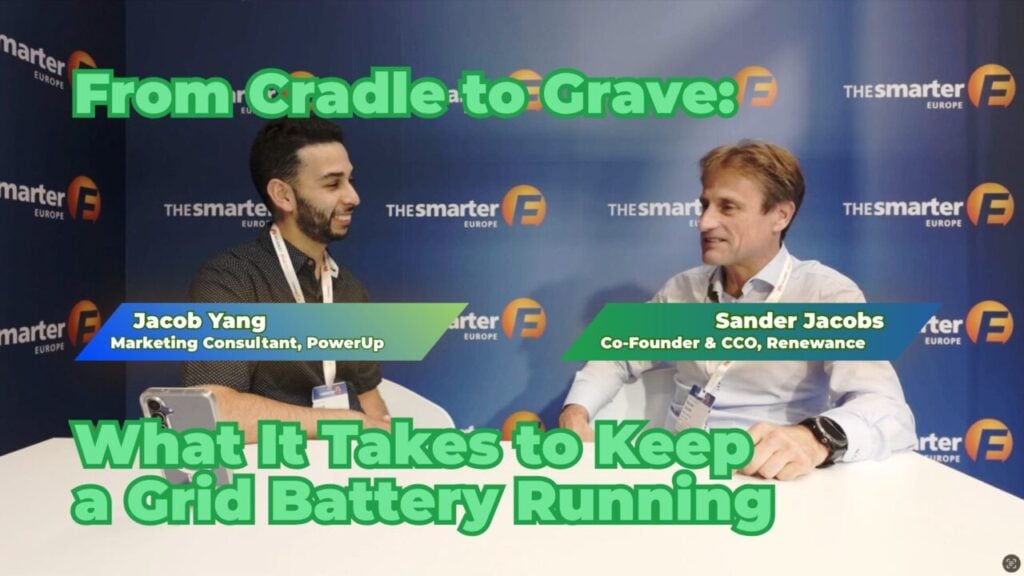
His most concrete example was timing. When a battery analytics platform surfaces a trend and a timely alert, a service provider can fold the correction into a scheduled maintenance visit rather than dispatching an emergency crew later. That avoids a truck roll, avoids the downtime, and protects performance. Imbalance is the recurring case. Racks drift out of balance, energy strands, and unless the impact is reported and quantified, an owner may not know it is happening. Catch it early, plan the rebalancing into existing maintenance, and the energy comes back.
Sander’s larger point was about integration. A battery analytics platform used on its own still leaves someone to translate alerts into work orders. Wired into a service provider’s asset management system, the same alert opens a ticket, triggers a workflow, and lands in a full record of service and health history. That history also pays off at end of life. An asset with a complete, logged history reveals a clearer picture in the second-life and used-equipment market than a module that arrives with nothing but a spot health check.
What It Means for Owners and Operators
Read across the three conversations and the goals line up, even though the three operate at different scales. PowerUp names availability, capacity, and lifetime. Renewance names performance, longevity, and cost-effectiveness. Those are the same goals in different words: get more out of the asset, make it last, and keep it economical. Socomec frames why that matters: the move from selling a product to operating it for revenue.
That shift looks the same in the commercial and industrial systems Socomec builds and at the grid-scale PowerUp and Renewance work in. What changes is the vantage point. PowerUp detects, Socomec integrates, Renewance acts. Same shift, three sides of one industry.
For an owner or operator, the practical starting move is less glamorous than the analytics itself. Philippe’s advice was to decide at the start of a project how battery and system data will be collected and stored, so it can actually be used later. Data that is never captured, or that stays locked up for legal or technical reasons, cannot be analysed by anyone. Get the data foundation right, choose analytics you can trust, and connect it to a team that can act.
That is what the state of BESS analytics looks like in 2026: detection, integration, and service, the three jobs the industry now expects at every scale.
Read the full interviews:
The Science Beneath the Software: What the BMS Can’t Detect with Philippe De La Fortelle, PowerUp
Analytics by Default: How Socomec Builds C&I Storage to Last with Jean-Marc Guillou, Socomec
Cradle to Grave: What It Takes to Keep a Grid Battery Running with Sander Jacobs, Renewance
About the Author
Jacob Yang has over a decade of marketing experience and seven years of renewables experience working with companies across the project lifecycle for solar, wind, and BESS in residential, C&I, and grid-scale segments. He oversees PowerUp’s marketing efforts and plays a critical role in its growth trajectory.
