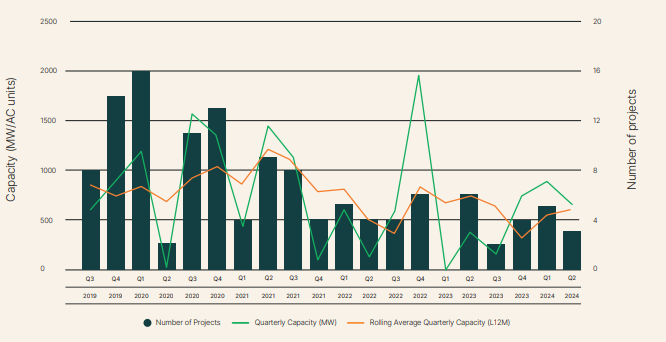
The Clean Energy Council (CEC) of Australia has revealed that six large-scale energy storage projects totalling 573MW/2,047MWh reached financial commitment in the second quarter of 2024.
According to the organisation’s latest Renewable Projects Quarterly Report, covering the second quarter of 2024, four of the last five quarters have now seen over 2GWh of energy storage projects reach financial commitment in Australia.
The rolling 12-month average for energy storage project investment remains high at nearly AU$1.6 billion (US$1.08 billion).
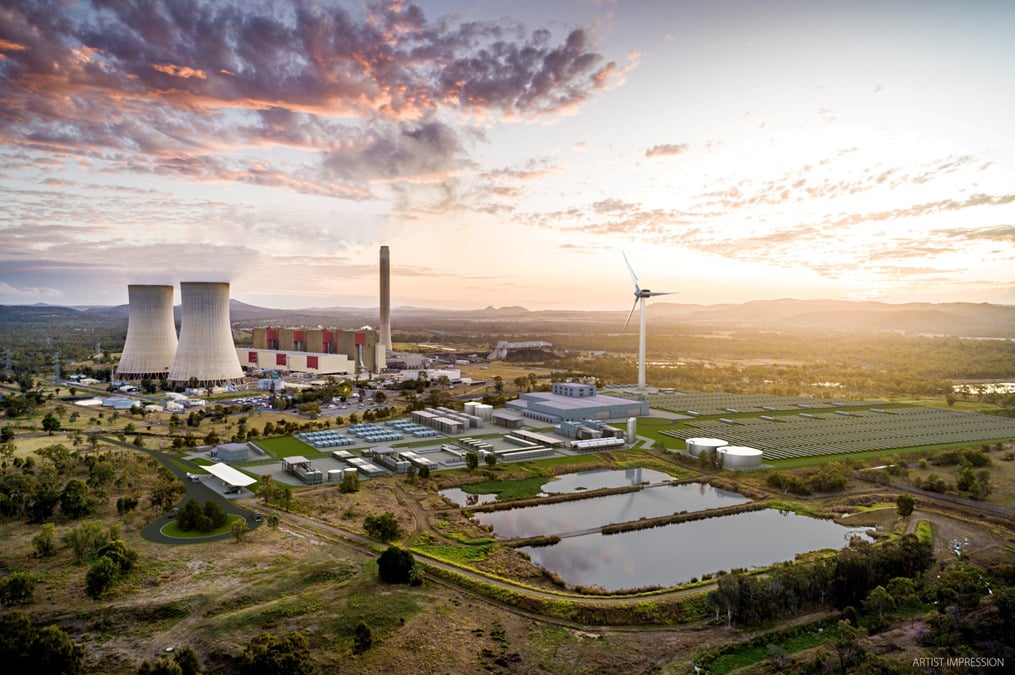
The largest energy storage project to reach this milestone is the 4-hour duration 300MW/1,200MWh Stanwell Big Battery in Queensland, with the battery energy storage system (BESS) to be built at the site of Stanwell Power Station, a 1,460MW coal power plant.
Try Premium for just $1
- Full premium access for the first month at only $1
- Converts to an annual rate after 30 days unless cancelled
- Cancel anytime during the trial period
Premium Benefits
- Expert industry analysis and interviews
- Digital access to PV Tech Power journal
- Exclusive event discounts
Or get the full Premium subscription right away
Or continue reading this article for free
The BESS is central to the Australia government’s plans to transition the site, which is about 22km from the nearest city, Rockhampton, to clean energy resources. To reinforce this belief, the Queensland government committed to investing AU$448 million in the project’s development, which is expected to cost in the region of AU$747 million.
New South Wales had the majority of projects reaching financial commitment in the second quarter, with four.
Five projects also began construction, totalling 373MW/817MWh, the lowest amount to reach this stage in a quarter since Q1 2023.
The CEC’s report also outlines that five of the six projects are viewed as storage components in an overall hybrid generation and storage project, further establishing the viability of co-located energy storage units with variable renewable energy generation, such as solar PV and wind.
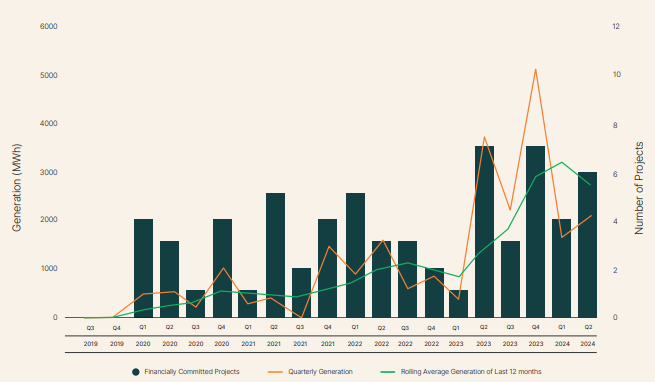
Indeed, the second quarter also posted positive figures for renewable energy generation. The CEC believes energy storage is thriving due to the continued investment in large-scale generation, which recently eclipsed 2023’s total.
Despite the strong figures for energy storage in the second quarter, it should be noted that the figures were lower than the first quarter of 2024, which saw five projects totalling 895MW of capacity reaching financial commitment – the best quarter since the end of 2022.
The number of energy storage projects reaching financial commitments has undoubtedly been aided by growth in renewable energy generation. Indeed, CEC’s report reveals that 577MW of onshore wind projects reached financial commitment, a sizeable feat considering no onshore wind reached the milestone in 2023.
For solar PV, a total of 161MW projects have reached financial commitment since the start of 2024. In doing so, this means that the combined figures for wind generation and solar PV have surpassed the entirety of 2023’s numbers.
The CEC’s report indicates that there are 84 renewable electricity generation projects either at the stage of reaching financial commitment or under construction. These projects represent a capacity of 12.8GW.
Additionally, there are 44 storage projects currently in the pipeline, starting from financial commitment onwards, totalling 8.8GW/21.8GWh.
Commenting on the figures, Kane Thornton, chief executive of the Clean Energy Council, said large-scale storage continued its remarkable run, demonstrating that a record-breaking 2023 was not a one-off.
It is pleasing to see investment in large-scale generation continuing to move in the right direction, but we are not yet at the levels we need to see,” Thornton said.
“Strong investment in new renewable energy generation is critical to driving down power prices and ensuring energy security for Australia. With governments, regulators and industry working to overcome the barriers to new investment, we remain confident that this will deliver the certainty necessary for further uptick in new investment in the near future.”
Victoria tops BESS discharge figures in winter 2024
In other news, OpenNEM, which grants the public information on the National Electricity Market (NEM), Victoria topped the charts for the amount of energy discharged from BESS across the 2024 winter period, with around 74.1GWh.
This was followed by South Australia, with 38.7GWh, who also managed to run on 100% renewable energy in the last week of winter (26 August to 1 September), as reported by our sister site PV Tech. Rooftop solar PV generated 21.1% of the 102.2% figure, accounting for around 56GWh generated over the week at an average price of AS-$52.02/MWh.
On the other hand, utility-scale solar provided 3.9% of the overall mix, around 10.4GWh, at an average price of AUS-$30.96/MWh. Energy storage provided 1.4GWh, around 0.5% of the total mix.
Elsewhere on the NEM, batteries discharged 34.1GWh over the winter period in New South Wales, and Queensland discharged 22.3GWh. The island state of Tasmania, famed for its abundancy of pumped hydro energy storage, discharged 0GWh from BESS over the winter, while PHES provided 1,720GWh across the winter period.
Western Australia, which operates on the South West Interconnected System (SWIS), saw its batteries discharge 11.7GWh throughout winter.