Australia’s Clean Energy Council (CEC) has said that energy storage saw a strong year in 2024 with a capacity of 4,029MW/11,348MWh having reached financial commitment.
This figure is slightly lower than the record set in 2023, which was 4,663MW/11,509MWh. The total investment for these projects amounted to at least AU$3.9 billion (US$2.46 billion) for the year.
The organisation’s latest ‘Quarterly Clean Energy Investment Report’ found that Australia rounded off 2024 with 870MW/1,936MWh of new energy storage reaching commitment in the final quarter.
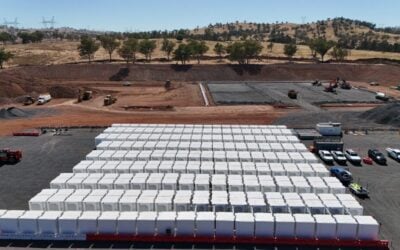
Additionally, five battery energy storage projects began construction in Q4 2024, totalling 867MW/2,475MWh. Three of these projects are co-located with an accompanying generation project.
Try Premium for just $1
- Full premium access for the first month at only $1
- Converts to an annual rate after 30 days unless cancelled
- Cancel anytime during the trial period
Premium Benefits
- Expert industry analysis and interviews
- Digital access to PV Tech Power journal
- Exclusive event discounts
Or get the full Premium subscription right away
Or continue reading this article for free
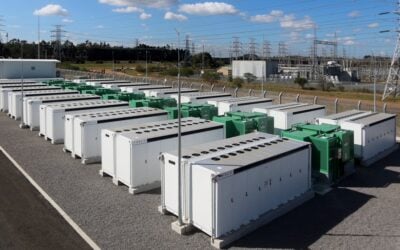
This was spread across five projects. The largest of these was Lightsource bp’s 222MW/640MWh Woolooga BESS in Queensland. The developer has tapped Chinese battery manufacturer Hithium Energy who will supply the BESS.
Hithium said the deal marks the first deployment in Australia of the company’s 5MWh containerised standard 20-foot BESS solution, using Hithium’s own prismatic 314Ah lithium iron phosphate (LFP) lithium-ion (Li-ion) cells.
More recently, battery recycling firm Livium, via its wholly owned subsidiary, Envirostream Australia, has partnered with Hithium to recycle lithium-ion batteries from Lightsource bp’s Woolooga solar-plus-storage site. The BESS will be co-located with a 214MW solar PV power plant spread across three sites.
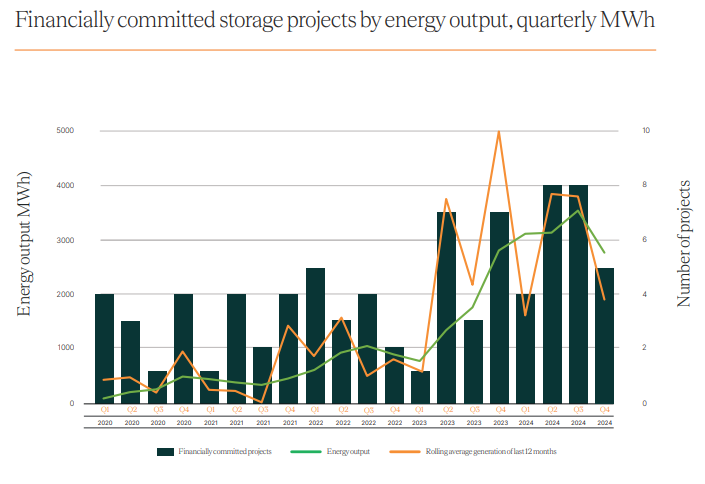
Four of the five projects that reached financial commitment in Q4 2024 are hybrid storage assets. This means they integrate energy storage with another form of generation, such as solar PV or wind power. In the fourth quarter, the average combined capacity of these hybrid projects was 174MW/387MWh.
Currently, 88 renewable energy generation projects have either reached financial commitment or are under construction, totalling 13,187MW of capacity. Additionally, 52 committed energy storage projects are in development, equated to 10,531MW and 26,285MWh of capacity and energy output, respectively.
Since 2017, 223 energy generation and storage projects have been commissioned, resulting in 17,019MW of installed electricity generation capacity and 2,112MW or 3,669MWh of energy storage.
You can read the full article on our sister site, PV Tech.