
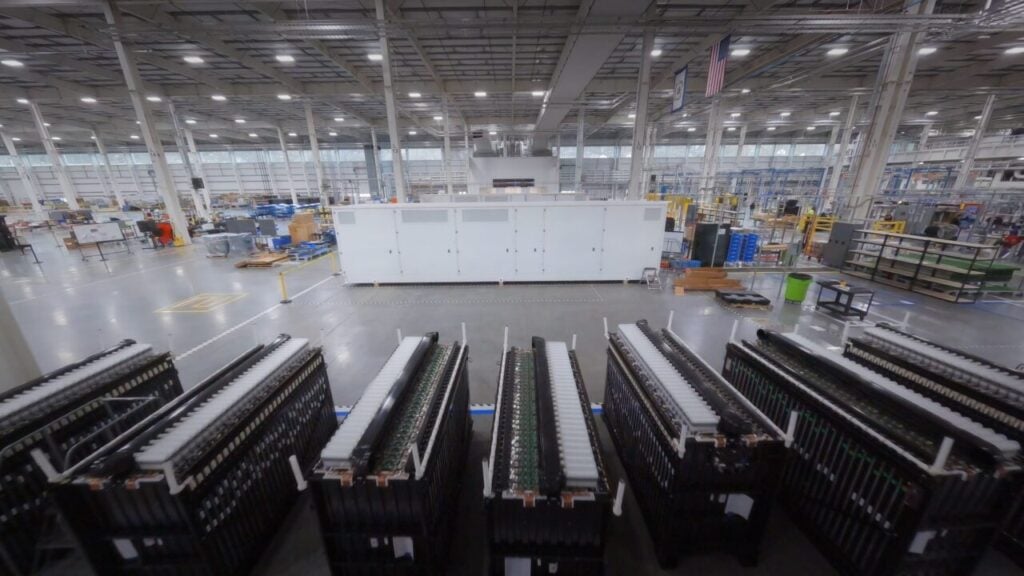
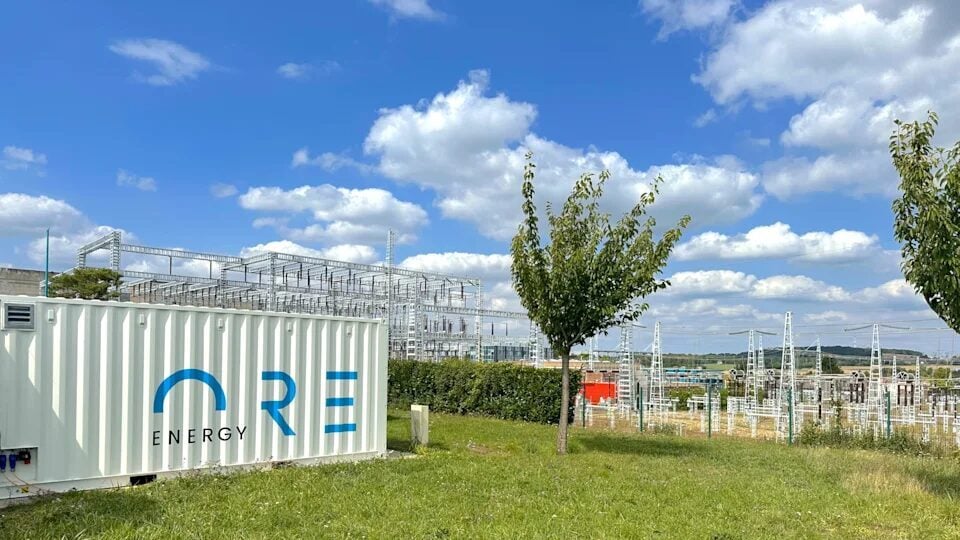
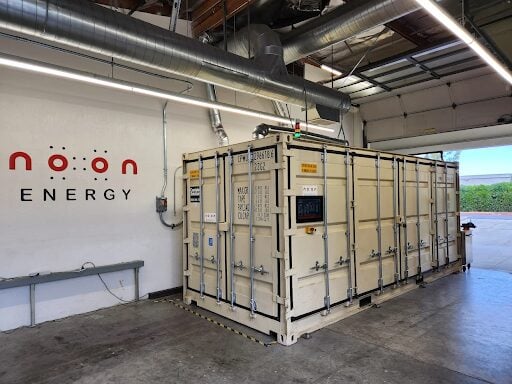
Form Energy, Noon Energy and Ore Energy are all commercialising proprietary 100-hour battery technologies for LDES applications, but how do they compare on metrics like cost, energy density and round-trip efficiency? We look at what they have revealed, as well as what they haven’t.
Short-duration energy storage systems based on lithium-ion technology are effective at providing energy when renewable systems stop working—such as at night-time when solar stops harvesting energy. However, long duration energy storage (LDES) provides energy to the grid over a much longer time period, building grid resilience and reliability so that the grid can run on variable renewable energy (VRE) in the long-term.
Various 100-hour multi-day storage (MDS) batteries have recently been commercialised by Form Energy, Ore Energy and Noon Energy. These MDS batteries are based on either iron-air or solid oxide fuel cell architectures and have not been designed to compete with conventional lithium-ion (Li-ion) technology, which is generally deployed today with a nameplate discharge duration of no higher than 8-12 hours. (And some say it will never go significantly beyond that.)
Instead, they are lower cost systems that have a lower round trip efficiency (RTE) than Li-ion; but their cost and ability to slowly provide energy over days rather than years could make them a valuable grid asset for situations when renewable energy systems are not active for days due to extreme weather conditions.
Try Premium for just $1
- Full premium access for the first month at only $1
- Converts to an annual rate after 30 days unless cancelled
- Cancel anytime during the trial period
Premium Benefits
- Expert industry analysis and interviews
- Digital access to PV Tech Power journal
- Exclusive event discounts
Or get the full Premium subscription right away
Or continue reading this article for free
There has already been a lot of interest in these batteries as backup systems, showcased recently by the Form Energy deal with Google where a 300MW/30GWh iron-air battery is set to be installed alongside 1.6GW of renewable energy capacity for Google’s data centre in Minnesota. Form Energy, Ore Energy and Noon Energy have all been installing various levels of MDS capacity at various locations, so this article looks at how these batteries differ from a technical perspective (where the data and information is publicly available or has been disclosed).
100-hour batteries: the difference between iron-air and SOFC flow battery tech
Form Energy and Ore Energy have developed iron air-batteries, whereas Noon Energy’s battery is a cross between a solid oxide fuel cell (SOFC) and a redox flow battery. Even though they are all 100-hour batteries, they have different working principles.
Iron-air batteries work on the principle of reverse rusting. When the battery is discharged, that battery sucks in oxygen from its surroundings and the oxygen flows over the surface of the iron electrode. This rusts the iron and generates electricity. This process is reversed during charging, and the supplied electrical current removes the rust through deoxidisation, releasing the oxygen from the battery and returning the electrode back to metallic iron.
Noon Energy’s battery works of the principles of SOFC and redox flow technology. For the SOFC part, the cells contain a ceramic electrolyte that converts a fuel into electricity at high temperatures using oxygen. The redox flow aspect of Noon’s battery comes from the system having redox flow like storage (charge) and discharge tanks separate from the power stack. During charging, excess renewable energy is converted into carbon-based media storage, releasing oxygen to air, whereas when the battery needs to be discharged, oxygen is drawn in via this discharge tanks and converts stored energy back into electricity.
Both types of batteries are still packed together like other BESS systems, in that the cells are arranged into modules, the modules create larger systems that are housed inside shipping containers, and multiple shipping containers are installed together to increase capacity. Next, we will look at the characteristics and performance metrics of each of these batteries.
Energy density
Energy density is a difficult one to quantify for commercial BESS applications as no official statistics have been given by the companies. The reason for this is that, while still important, energy density is not as critical a metric for BESS applications as it is for electric vehicles (EVs) and portable electronics.
Instead, the cost in US$ per kWh is a more suitable metric for commercial BESS systems, and the capacity of an installed system is often of more well-documented than energy density.
However, despite a lack of transparency on energy density, the theoretical energy density of an iron air battery is around 1200Wh/kg (more than double different Li-ion cell’s theoretical energy density and about six times the actual real-world density). Noon Energy’s batteries have been stated in Office of Scientific and Technical Information (OSTI) reports as having an energy density ten times that of aqueous flow batteries—but that is also an ambiguous statement in itself, as the energy density of a redox flow battery can vary massively depending on the type.
However, like Li-ion batteries, theoretical energy densities are never met in real-world situations, so it’s likely that the numbers are much lower than the upper theoretical limits.
But what about the US$ cost per kWh? This information is available, but mostly from the perspective of what the companies are looking to achieve in the coming years as more installations go online. This is because there is often a range of potential values depending on the use case of the system and its location.
So, to date, the three companies have stated they are looking to achieve the following:
Form Energy: US$15-20 per kWh
Ore Energy: US$18.50 per kWh (based on the current conversion rate of the stated €16 per kWh by Aytac Yilmaz, co-founder of Ore Energy, in an online interview)
Noon Energy: Less than US$20 per kWh
System life
Like energy density, cycle life not quoted as often for long duration BESS as it is for batteries that are being constantly charged and discharged in full (like short-duration BESS and EV batteries). So, while the companies have not stated their cycle life, the anticipated system lifetime has. This means we can infer somewhat, what the rough cycle life of the batteries will be. It is difficult to quantify the SOFC cell as they again vary depending on the specific cell, but it is much easier to understand the potential for the iron-air systems.
Form Energy have stated that their system lifetime is around 20 years, and while there is no data for Ore Energy, being the same type of battery architecture, we can assume that it is going to be similar. According to Fraunhofer Umsicht, iron-air batteries can last for 30 years and 10,000 charge/discharge cycles, but this is based more on conventional battery cycling. Assuming that that 100-hour batteries are good for at least 20 years, the batteries should be capable of several thousand cycles, in theory, but the reality will be different because they cycling will be much slower than other types of batteries.
This means that actual cycling amount will be a lot less than the theoretical limits. Battery experts have weighed in on LinkedIn, with claims that these batteries may only be usable for 25-43 cycles a year, which would only mean 500-860 lifetime cycles (assuming a 20-year life cycle). If they last for the theoretical 30 years, this increases to 750-1,290 lifetime cycles. In both cases, the number of cycles is much lower than other battery applications. It does mean that it’s likely that if more cycles are required per year, that the iron-air batteries could handle it within their stated system lifetimes.
One piece of evidence of cycling ability that has been published, is that the Form Energy batteries have maintained over 80% capacity after more than 1,000 cycles. Depending on how often they are used, this could cover the entire usable lifetime of the battery. So, the number of usable cycles, and in turn the system lifetime of the iron-air batteries, will also be dependent on capacity retention and how quickly the batteries degrade over prolonged use.
Thermal characteristics
Form Energy has stated that the operating temperature of its batteries is between -40°C and 50°C. While Ore Energy has not given any specifics on this, it can be assumed that the operating range is going to be similar. Iron-air batteries are also non-flammable and don’t undergo thermal runaway so are very safe from a thermal perspective. Form Energy has announced that it has completed UL9540A safety testing, where the batteries were subjected to extreme abuse scenarios, with results of no uncontrolled heating, no fires, no thermal runaway, and no dendrite formation.
The operating temperature of Noon Energy’s battery system is much higher because SOFCs generate very high temperatures inside the cell. The specific operating temperature range has not been explicitly disclosed but SOFCs operate between 600-1,000°C, but most new SOFC cells nowadays have an operating temperature range of 600-800°C to reduce costs and improve lifespan. Given the drive for lower costs and long usable lifetimes in BESS applications, it would be likely that Noon Energy’s would sit within the lower temperature range.
Round-trip efficiency (RTE)
The round-trip efficiency (RTE) is generally an important metric because it compares how much energy a battery can discharge compared to how much energy was used to charge it. The energy lost is usually as heat. Li-ion batteries have a very high RTE of 85-90%, but the 100-hour batteries’ RTEs are much lower. However, this is offset by the cost of these systems, so even though the RTEs are lower, they are more commercially feasible than Li-ion for infrequent cycling LDES—because while Li-ion could technically discharge at much slower rates over long time periods, it would be a lot more costly to use them.
There are varying reports out there into what the actual RTEs of these batteries are. Peter Kelly-Detwiler on LinkedIn has reported that the RTE of Form Energy’s batteries are around 40%. Form Energy’s own presentations between 2021-2023 stated an RTE of between 35-38%, but this number could have increased since then. For Ore Energy, there are no specific published results, but it could be assumed that it would fall in a similar range to Form Energy, most likely within 40-50% , which would be similar to Energy Solution Intelligence’s report that states iron-air RTEs are approximately 40-50%.
For Noon Energy, there are a couple of different reports but the RTEs overall are much higher than iron-air batteries. An Electrochemical Society abstract published by the Institute of Physics (IOP), by authors from Noon Energy, stated that their design supports an RTE of at least 60%, while an OSTI report has stated that the battery can operate with an RTE up to 80%.
Discharge characteristics
All three batteries can discharge stored charge for at least 100 hours, however, while the iron-air batteries have only stated 100 hours, there are various reports that the Noon Energy system can exceed 200 hours. Whether this is feasible in long-term real-world scenarios is another thing. Iron-air batteries are also designed for deep discharge, meaning that they be discharged down to 0% state of charge (SOC) without any degradation issues of them starting back up again. This is because they just become fully rusted, but this rust can be completely reversed, so no damage occurs from deep discharge. Lithium-ion meanwhile degrades faster if it is kept at 100% or 0% for too long.
For Noon Energy’s cells, nothing has been said about deep discharge capabilities, but it is less likely than iron-air batteries. While traditional redox flow batteries can be discharged down to 0% SOC without damage, SOFCs is a different matter—and because the main energy generation and storage mechanism is based on SOFC technology, this is likely to affect the deep discharge capabilities of the battery. SOFCs can be discharged to 0%, but this is considered an uncontrolled condition and a failure mode when operating in a stack, so it’s unlikely that deep discharge will be utilised. Deep discharge may still be possible with Noon’s specific design, but this would have to be confirmed by the company.
Comparing the three batteries
While the various metrics have been compared to each other above (as much as is possible with the available information), the following table summarises the known differences between the three 100-hour batteries.
| Performance Metric | Form Energy | Ore Energy | Noon Energy |
| Battery Type | Iron-air | Iron-air | SOFC flow |
| Theoretical energy density (Wh/kg) | 1,200Wh/kg | 1,200Wh/kg | Hard to quantify without actual values are SOFCs are very system dependent |
| US$ per kWh | US$15–20 per kWh | US$18.50/€16 per kWh | Less than US$20 per kWh |
| Discharge Time | 100 hours | 100 hours | Up to 200 hours stated |
| Deep discharge capability | Yes | Yes | Unknown but unlikely |
| RTE | 35-40% (varying reports with different numbers) | 40-50% (assumed) | 60-80% |
| Operating Temperature | -40°C – 50°C | -40°C – 50°C (assumed) | 600-1,000°C (assumed) Likely to be 600-800°C |
| System life | ~20 years | ~20 years | Undisclosed |
| Applications | More renewable energy integration and multi-day resilience in low generation periods. Replacing US peaker plants. Grid balancing and reducing grid congestion. Industrial power supply. Data centre power management. | More renewable energy integration and multi-day resilience in low generation periods. Improving EU grid resilience. Grid balancing and reducing grid congestion. Utility scale storage. Data centre power management. | Behind the meter storage for customers paying high electricity rates. Supporting microgrids and island grid decarbonisation (more renewable integration) that are traditionally reliant on diesel generators. Grid balancing and reducing grid congestion. Hyperscale data centres and industrial power management. |
As more large-scale BESS systems are installed in the future from these companies, and the technology becomes more established, we may find more technical information on the cells coming to the fore, but right now, a lot of the focus is on capacity and what power is being supplied to grid operations over the 100 hours. Over time, we will have a clearer insight into system life, cycle life and cost US$ per kWh as the commercial systems establish themselves over many years in real-world settings and we will see what they all actually deliver (rather than what they can theoretically deliver).