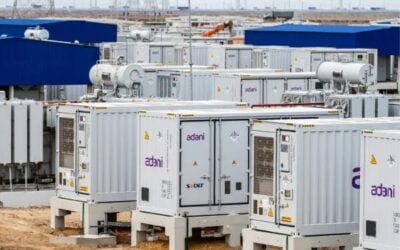
The expression of interest (EOI) takes renewables integration as its primary focus, but includes consideration of a number of the other possible benefits of storage, from supporting increased distributed generation to balancing grid networks. Image: Tata Solar.
India’s Ministry of New and Renewable Energy (MNRE) has invited expressions of interest (EOI) for energy storage demonstration projects to integrate renewables, recognising that the technology “has the potential to become highly attractive for both grid-connected and off-grid renewable energy applications”.
The government ministry published the EOI documents yesterday, calling for demonstration projects that support the increased deployment of renewable energy sources. However, in addition to trialling effective ways to mitigate the variable power output of technologies including solar PV and wind power, MNRE also highlighted the potential network benefits of energy storage.
The ministry wants interested parties to also consider the use of energy storage for applications including “time shift” (load shifting), grid stabilisation, peak shaving, “improved generation efficiency and improved transmission capacity utilisation,” it said. Among a number of other aims, MNRE also wants to find ways to scale up deployment once the appropriate technologies have been decided upon and also support the increased use of distributed generation over centralised.
The country has in place a very aggressive renewable energy target of adding 175GW of new generation by 2020. This will include what MNRE called both “grid-interactive systems” such as rooftop solar connected to local grids and utility-scale PV on high voltage transmission grids, as well as off-grid systems, including water supply pumping in rural areas and rural micro-grids.
Try Premium for just $1
- Full premium access for the first month at only $1
- Converts to an annual rate after 30 days unless cancelled
- Cancel anytime during the trial period
Premium Benefits
- Expert industry analysis and interviews
- Digital access to PV Tech Power journal
- Exclusive event discounts
Or get the full Premium subscription right away
Or continue reading this article for free
Market opportunities for energy storage in India are an estimated 15GW to 20GW by 2020, across various sectors, according to a 2014 assesment by India Energy Storage Alliance (IESA). Image: IESA.
Demonstration projects should be used to assess the application and location specific “value” and “impact” of energy storage. This will entail looking at both the economic value and technical performance and cost curves for storage systems. From there, the ministry said, data will be provided from the ground to assist policy makers.
“The convergence of these routes will allow policy makers to understand the economics of the energy storage markets across applications and segments, prioritising various applications and technology sets and developing/deploying storage technology development and deployment strategies.”
Enthusiasm in India for renewable energy appears to be strong at government level, with prime minister Narendra Modi’s administration announcing a raft of other measures alongside the 175GW target since coming into power in 2014. These include a plan to install several thousand micro-grids across various rural areas. Anticipation over the government’s near future aims in renewables are already having an effect on the energy storage and solar industries in the country. Last year, India Energy Storage Association (IESA) founder and executive director Rahul Walawalkar blogged for PV Tech Storage on a coming decade of “energy infrastructure transformation,” with a particular focus on storage and renewables. Walawalkar wrote that an assessment of the addressable market for storage conducted by IESA in 2014, “suggests a potential of 15 GW to 20 GW by 2020 in India, for various applications ranging from telecom tower backups to grid ancillary services and renewable integration”.