
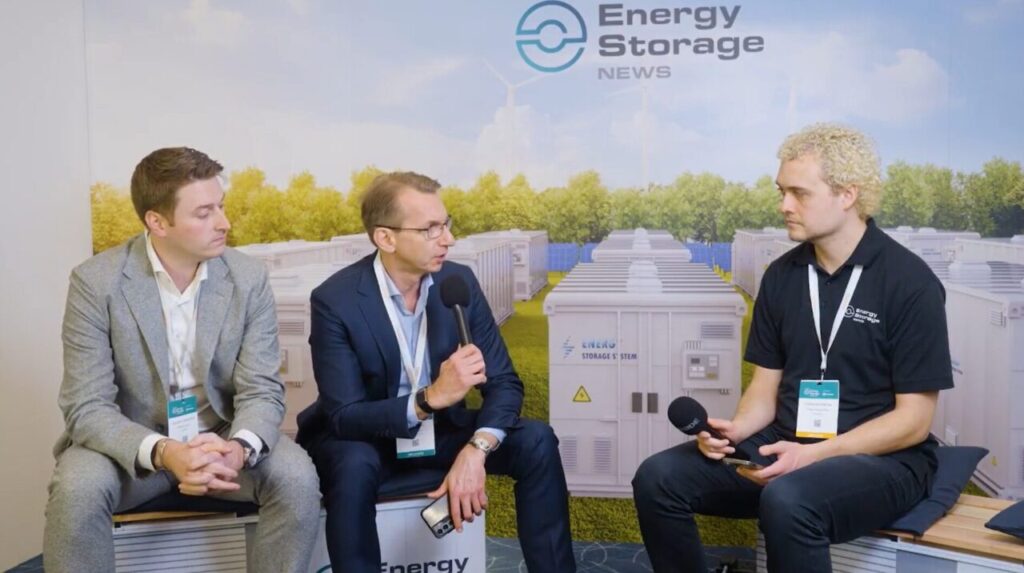
European IPP R.Power’s head of BESS and CCO sat down with Energy-Storage.news at the Energy Storage Summit 2026 last month for a video interview to discuss the firm’s storage activity and approach to procuring technology.
The firm is active in Poland, Romania, Germany, Italy, Spain and Portugal with a large portfolio of operational solar PV projects, to which it is now adding battery energy storage systems (BESS), both standalone and co-located.
BESS activity most advanced in Poland and Romania
Its projects under construction are primarily, for-now, in Poland and Romania, CCO Rafal Hajduk says. It has over a gigawatt (GW) of projects in Poland with capacity market (CM) contracts, following wins in both 2024 and 2025.
But it also has two BESS projects in Italy which are nearly at ready-to-build (RTB) stage, both over 100MWh, Hajduk adds. R.Power keeps the majority of its projects but does sell some too, Hajduk says.
Try Premium for just $1
- Full premium access for the first month at only $1
- Converts to an annual rate after 30 days unless cancelled
- Cancel anytime during the trial period
Premium Benefits
- Expert industry analysis and interviews
- Digital access to PV Tech Power journal
- Exclusive event discounts
Or get the full Premium subscription right away
Or continue reading this article for free
See the chat with the R.Power team below, from the start.
The firm has recently secured optimisation deals for its standalone projects under construction in Poland and Romania. Power firm Axpo will trade its 150MW/300MWh Jedwabne project in Poland, while in Romania energy trader GEN-I will optimise its 127MW/254MWh Scornicesti project.
“In both cases, these are floor arrangements. So this is basically a revenue share with a floor and that results from our offtake strategy which is to have a majority of revenues secured long-term,” Hajduk says.
“The deals are pretty novel in their respective countries. In Poland I think it’s the second of its kind, while in Romania, as far as we know, it’s the first of its kind.”
“The next development we would like to see is if it is possible to enter into toll agreements in these countries, that’s something we’ll be seeking for future projects as well.”
But is the supply of tolls less prominent in those countries, we ask? “Well, we see interest from offtakers.
I think it is achievable to also have trolling agreements in countries like Poland and Romania,” Hajduk concludes.
Approach to procurement
R.Power head of BESS Laurens Vanochten says that the firm has a centralised BESS procurement team and shared some of its learnings around how to be successful when buying equipment.
See below for the part of the interview where Vanochten discusses the firm’s approach to procurement.
“For each project, together with the BESS team, we define on a project-level and an engineering-level all the parameters we deem necessary for the project. We jointly formulate the RFQ (request for quotations) that goes out to the market,” Vanochten explains.
“There’s always a sort of competitive process, and then based on the offers that we get, we basically try and select based on, of course, value for money, but also on things like reliability, availability and efficiency.”
“To be honest, it’s not always easy to compare one offer to the other. One thing mentioned several times at this conference is that you need to have a very clear RFQ. This leads to much clearer offers to help you have a better benchmark and makes it much easier to compare offers against each other.”
Each project has a separate procurement process and the firm has no preferred partners at this stage. Though note it has not yet publicly revealed its BESS suppliers for initial projects.
Long-term capacity guarantees
Poland and Italy are both markets where the bedrock of the business case for many of the initial large-scale BESS projects are 15 to 17-year long, government schemes: the CM mentioned earlier and the MACSE scheme respectively.
With R.Power active in both markets, Vanochten is a good person to get the views of on a challenge around procurement, which came up in a panel earlier at the event.
A panellist said that getting capacity guarantees from suppliers beyond 10 years started to get quite expensive, presenting a challenge in terms of marrying up the length of the MACSE contract with your product warranty.
“It goes without saying that the longer we want the guarantees, the more expensive it gets. Somebody has to pay for that. I think this morning it was discussed in reference to the MACSE projects, where you had to deal with limitations from the programme of, I believe, a 1% degradation allowance on an annual basis,” Vanochten says.
“This, of course, meant that the projects had to be massively oversized in order to maintain the awarded capacity throughout the entire lifetime. These are all aspects that drive up the price. If you need guarantees longer than the market standard, you have to pay a premium for it, same with oversizing. This plays into your final bids and all needs to be considered.”
Hajduk adds that it is a very different equation with the CM in Poland which, like all CMs, has a de-rating factor for BESS. A de-rating factor limits how much of a project’s MW power capacity can be bid in, based on how ‘reliable’ the system operator believes a technology is on being called upon when needed. This means BESS projects in Poland only ever have a portion of their capacity in the CM, while most MACSE projects’ had all of their capacity in it.
Poland as a testing ground for both manufacturing and downstream deployments
Discussing trends in BESS procurement and pricing more generally, Vanochten agrees that Poland is showing strong potential as a hub for local European manufacturing, with both LG Energy Solution and Sungrow setting up BESS manufacturing there. He adds that numerous new products will get their first deployments in Europe there, including Fluence’s Smartstack and Envision Energy’s latest product.
(However, we reported on a project in Germany this week, which may be the first Smartstack, although we’ve asked this to be confirmed).
And below for the discussion about BESS pricing and local manufacturing in Europe.