
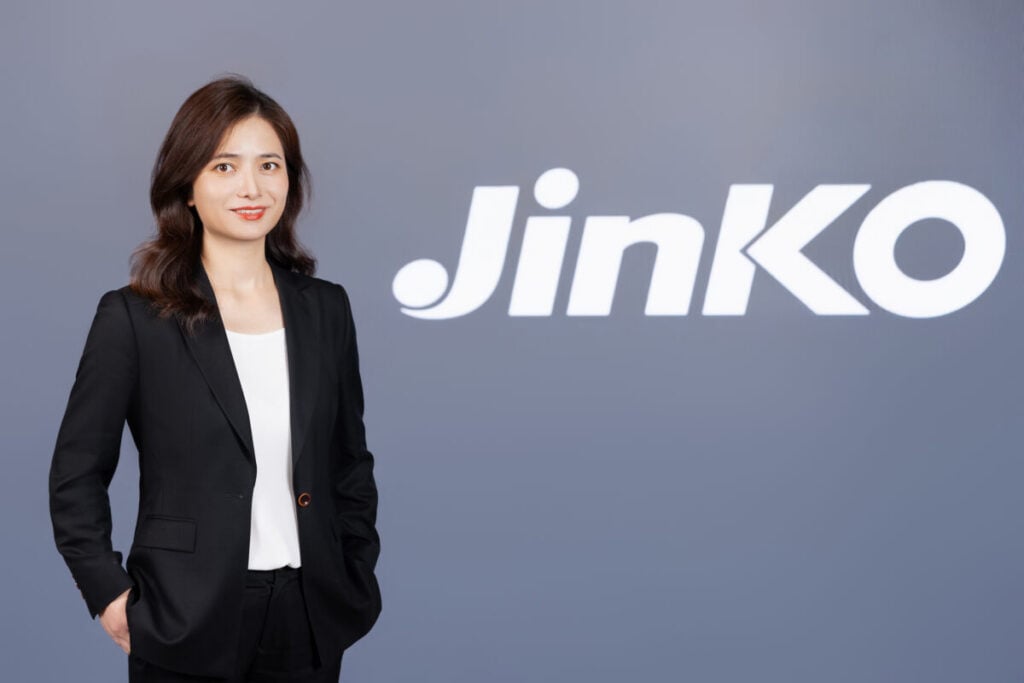
Anita Li, vice president of Jinko ESS, reflects on a ‘transformational year’ in which the energy storage arm of the vertically integrated solar manufacturer continued to expand.
Jinko Solar was among the original members of the Solar Module Super League (SMSL), the loose grouping of leading power players in solar PV created by our colleagues at PV Tech.
As with its rival major Chinese solar manufacturers, Jinko Solar has both tapped into its position in the renewable energy space and broadened its addressable markets with a full-on expansion into the battery energy storage system (BESS) sector.
Jinko ESS has put lithium iron phosphate (LFP) BESS products onto the market including its 5MWh utility-scale solution, Suntera, and commercial and industrial (C&I) solutions from 50kWh to 1MWh.
Try Premium for just $1
- Full premium access for the first month at only $1
- Converts to an annual rate after 30 days unless cancelled
- Cancel anytime during the trial period
Premium Benefits
- Expert industry analysis and interviews
- Digital access to PV Tech Power journal
- Exclusive event discounts
Or get the full Premium subscription right away
Or continue reading this article for free
What did 2025 mean for the energy storage industry from your company’s perspective and the bigger picture?
Energy storage has evolved from a ‘nice-to-have’ complement to a ‘must-have’ cornerstone of the global energy transition. The global market reached a new high, with annual new installations expected to hit 247GWh in 2025, representing over 20% year-on-year growth.
However, 2025 was not merely a year of expansion; it was a pivotal ‘Year of Transformation’ and ‘Value Discovery.’ The industry’s growth engine is shifting from pure policy-push to market-driven economics. Competition is maturing beyond homogenised products and price wars towards a focus on safety, technology, service, operations, and full lifecycle value.
For Jinko ESS, 2025 was a year of strong validation. We project annual shipments will exceed 6GWh, which is six times [the shipments] of 2024, showcasing robust business growth potential and solidifying energy storage as the company’s second major value growth [engine].
What do you think 2026 will hold, in terms of both things to look forward to and in terms of challenges ahead?
With an increasing number of solar PV companies entering the storage sector, 2026 is poised for more intense competition.
Rapid product iteration and pricing pressures will remain significant challenges. The large-scale commercial rollout of next-generation, high-capacity cells, like the 587Ah, will push single-cabinet system capacities into the 6-8MWh range. Consequently, the system-level economics and safety of solutions built around these new cells will be critically tested in the year ahead to prove if it is an effective iteration of the product.
Jinko is a very well-known name in solar PV. How is the company now establishing its place in the energy storage market?
We have strategically leveraged our global solar brand and established overseas channels to gain initial traction, maintaining strong customer relationships at the project level. A key pillar of our strategy is localisation—building local teams to ensure reliable delivery and develop robust after-sales service networks.
It’s important to recognise that energy storage involves a fundamentally different business model. While PV is primarily a standardised product (module) business, storage requires integrated system-level delivery (battery cells, BMS, PCS, integration, and O&M) with stronger customisation needs.
Grid codes, policies, and market requirements vary greatly by region, demanding highly targeted approaches. Our local teams and service centres enable us to provide reliable, rapid, and professional support with tailored solutions, ensuring full project lifecycle security from pre-sales to final commissioning.
This strategy is yielding results. In S&P Global’s latest 2025 report on storage system integrators, Jinko ESS was ranked among the top ten in six out of nine major global markets covered, including Asia-Pacific (ex-China/Australia), the Americas (ex-US), the UK, Germany, Europe, and the Middle East & Africa. Furthermore, we have been consecutively listed on BloombergNEF’s Tier-1 Global Energy Storage Manufacturer list since 2024.
Looking to 2026, we aim to double our overall shipments, with a sharp focus on high-margin markets such as Europe and the US.
Are there any exciting technology trends developing or emerging in the industry that our readers should keep a close eye on in 2026?
The renewable energy industry is evolving rapidly. Beyond battery cell innovation, companies face two critical challenges: cost efficiency and safety. Since batteries carry inherent risks, safety remains the top priority.
A key trend is the use of AI in early warning systems to detect overheating risks and trigger instant shutdowns or power reductions. This transforms energy storage into self-protecting systems that prevent disasters before they happen.
Which markets by geography and market segmentation do you think will be interesting to watch this year?
Key markets to watch in 2026 include Asia-Pacific (ex-China), the Americas (ex-US), the UK, Germany, Europe, and the Middle East & Africa.
What should the industry’s priorities be in 2026 and beyond?
As more PV companies enter the storage field in 2026, phased price competition is likely. However, the storage industry is distinct—it has higher technical barriers, significant safety and operational thresholds, and projects heavily depend on localised professional services. The market increasingly prioritises full lifecycle value.
Therefore, the industry’s top priority must be to accelerate the shift from a pure price competition model to a value competition model. This means competing on the merits of integrated solutions and long-term reliability. Fostering this transition is essential for the healthy and sustainable development of the entire sector.