Fluence senior VP and chief enterprise operations officer Roman Loosen explains how 2025 saw energy storage go from “important” to “essential.”
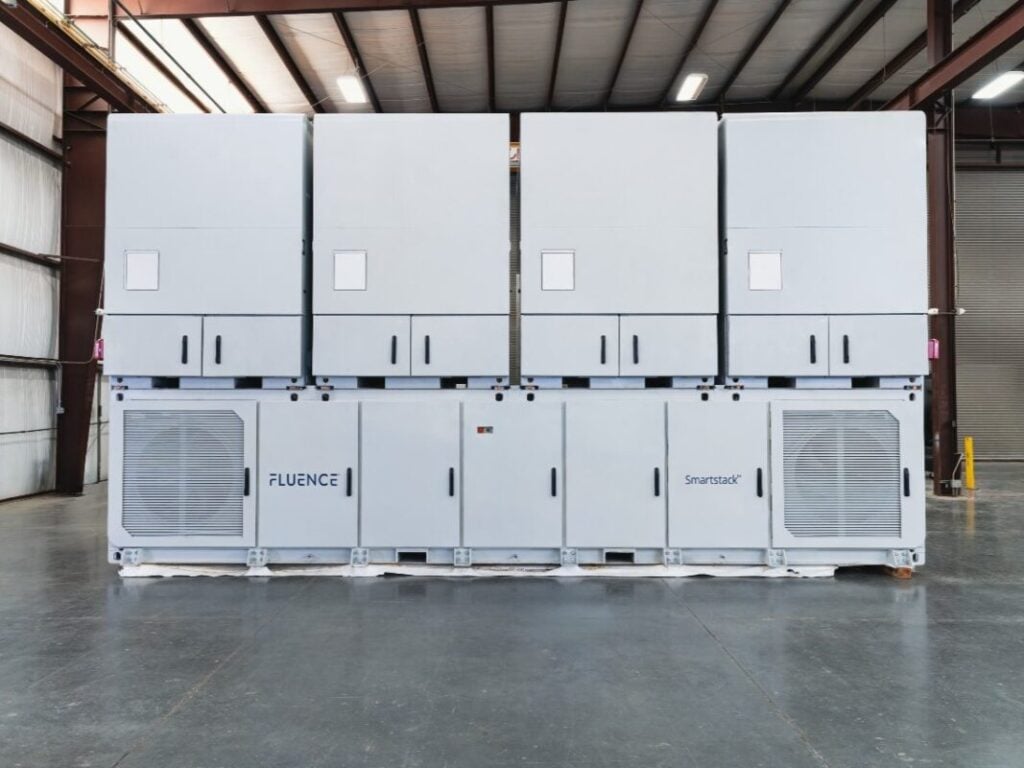
Often loosely described by industry watchers as a battery storage system integrator and technology provider, Fluence has, in the past couple of years, moved more towards an in-house manufacturing business model for almost everything but the cells that go into its grid-scale BESS solutions, including its newest product, the 7.5MWh Smartstack.
Active in at least 17 global markets, with around half of its business coming from customers in North America, the company has branched out into digital services for renewable energy and storage asset management and optimisation over the past few years. Its manufacturing operations, meanwhile, are based in the US to provide domestic content to that market and in Vietnam for the majority of its overseas orders.
Fluence banked a company record US$1.4 billion in orders in its Q4 2025, which ended 30 September 2025, and issued guidance for US$3.2 billion to US$3.6 billion revenues for its 2026 financial year. Its next financial results release is due in early February.
Try Premium for just $1
- Full premium access for the first month at only $1
- Converts to an annual rate after 30 days unless cancelled
- Cancel anytime during the trial period
Premium Benefits
- Expert industry analysis and interviews
- Digital access to PV Tech Power journal
- Exclusive event discounts
Or get the full Premium subscription right away
Or continue reading this article for free
As with other players across the energy storage space, the company sees data centre growth as a serious opportunity, claiming a 30GWh opportunity pipeline as of Q4 2025, while it signed agreements for Europe’s single largest project deal in November, for a 1GW/4GWh project with German utility company LEAG.
What did 2025 mean for the energy storage industry from your company’s perspective and the bigger picture?
From our perspective, 2025 was the year energy storage clearly moved from being important to being essential. In many markets, it was no longer viewed as a supporting technology, but instead planned as a core part of how the grid meets peak demand, integrates renewables, and maintains reliability as electricity demand continues to grow.
That evolution also shifted the dialogue with customers and system operators. The question is no longer whether storage can do the job, but how consistently, safely, and cost-effectively it can perform at scale over the long term. Expectations around delivery, availability, and asset life have risen, and for good reason.
At the same time, broader trends, particularly the rapid growth of data centres and electrification, have made system flexibility more valuable than ever. As a result, storage is increasingly seen not as a niche solution, but as foundational infrastructure for a stable and resilient grid.
What do you think 2026 will hold, in terms of both things to look forward to and in terms of challenges ahead?
We expect 2026 to be defined by continued growth and increasing scale, with storage projects becoming larger, more complex, and more central to grid operations. A clear example of this trend is our work with LEAG in Germany on the GigaBattery Jänschwalde1000, a 1GW/4GWh system that will be the largest battery energy storage project in Europe.
At the same time, this growth will come with higher expectations and a more demanding environment. Storage systems will be required to perform in increasingly complex market structures and play a greater role in reliability and flexibility, which raises the bar for safety, cybersecurity, and long-term performance. Competition will remain intense, and customers, financiers, and regulators will be more selective, placing greater emphasis on proven delivery and operational track record.
Fluence continued to add customer orders in a combination of established and emerging markets in 2025. What are your customers’ chief priorities today, and how might they differ from one market to another?
Priorities do vary by market, which is why local expertise remains so important. Regulatory frameworks, grid needs, and revenue models can look very different from one region to another, and solutions have to be designed with that context in mind.
That said, some common themes are emerging globally. More and more, customers are looking for a long-term partner with deep, proven experience. They want confidence that their provider has already operated systems at scale, understands real-world grid conditions, and can stand behind performance, safety, cybersecurity, and availability over the full asset life. Many suppliers claim they can deliver large, complex projects, but what matters most is having already done it, in challenging conditions, with experienced project and services teams on the ground.
Safety and cybersecurity have also moved much higher on the list, as storage assets take on more critical grid roles and become more tightly integrated with digital controls. Ultimately, customers want solutions that combine deep local understanding with the confidence that comes from global operating experience and data-backed performance.
The global market has become fiercely competitive. How will Fluence differentiate itself in an increasingly crowded field?
The reality is that many companies can sell a battery system that looks good on paper. The harder part, and where Fluence differentiates, is proving that the system will deliver value, day in and day out, for 20 years or more.
We compete on price—we have to—but we win on value and on our proven ability to execute. We bring one of the largest operating datasets in the industry and a track record of successfully delivering and operating projects in diverse and challenging markets, supported by experienced project and services teams on the ground. This allows us to stand behind our systems with leading guarantees and performance commitments that go beyond nameplate capacity. Offerings like our Dispatchable Energy Guarantee are built on that real-world experience and give customers the confidence to participate in increasingly complex markets without worrying about underperformance.
While some competitors lead primarily with the lowest upfront cost, we focus on total cost of ownership. By tightly integrating hardware, software, and services, with safety and cybersecurity at the forefront, and continuously improving them based on operating data, we are positioned to support customers from commissioning through decades of operation. Over the life of an asset, that difference in value becomes very tangible.
The US market’s shift toward increased domestic content picked up pace this year. What do you think are the keys to supply chain resilience and manufacturing strategy for Fluence, both in the US and in international markets?
Supply chain resilience starts with diversification and intentional design. Over the past several years, we have made deliberate choices to build a global manufacturing footprint that allows us to scale while meeting local content requirements where they matter most.
In the US, domestic content has become an important factor for customers, not just from an incentives perspective, but also for delivery certainty and quality control. For Fluence, that means aligning our supplier base, manufacturing strategy, and product platforms so domestic content can be delivered without compromising performance or reliability.
Internationally, the same principles apply: proximity to customers, strong supplier relationships, and rigorous qualification and testing. The goal is not just to reduce cost, but to ensure consistent quality, predictable timelines, and the ability to support projects over decades.
What should the industry’s priorities be in 2026 and beyond?
The industry has proven that storage works. The priority now is to prove that it can be deployed at scale in a way that is reliable, safe, and economical over the long term. This means consistently delivering projects that perform as designed and building confidence among regulators, grid operators, financiers, and communities. Demonstrating tangible benefits in cost, reliability, and resilience, year after year, will be essential to earning trust and sustaining growth. If the industry stays focused on long-term performance and credibility, the opportunity ahead will be immense.
Energy-Storage.news publisher Solar Media is hosting the Energy Storage Summit EU 2026 in London, UK, on 24-25 February 2026 at the InterContinental London – The O2. See the official website for more details, including agenda and speaker lists.