
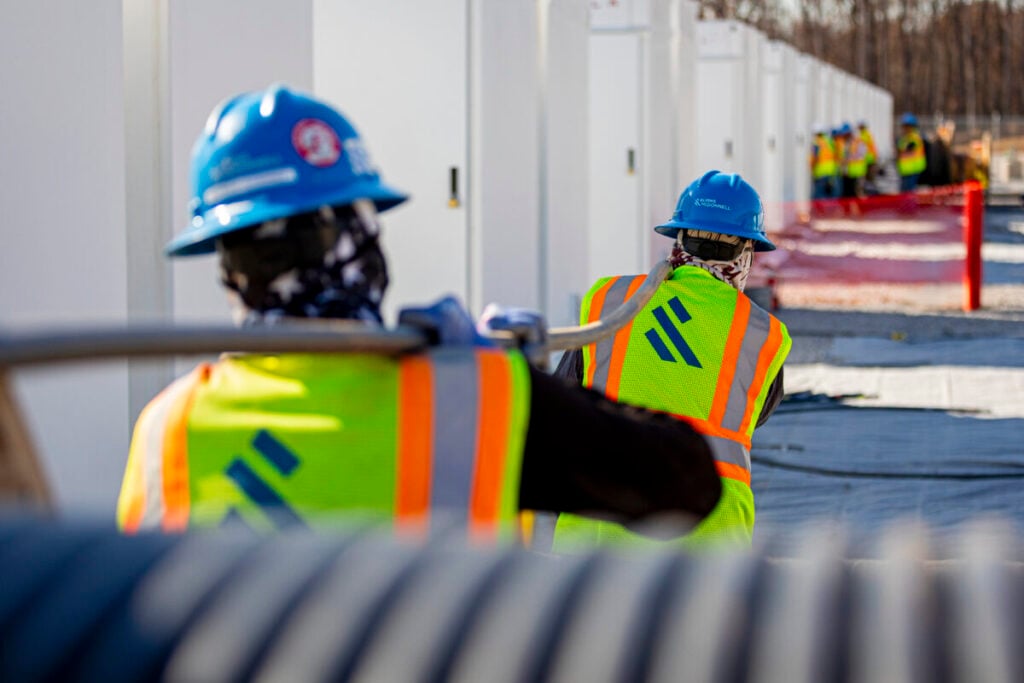
The renewables and energy storage teams at US EPC firm Burns & McDonnell tackle our annual Year in Review Q&A series.
Burns & McDonnell has delivered more than 6.5GWh of battery energy storage system (BESS) construction projects to date, working across a range of technologies and technology combinations.
The EPC has become a regular contributor to this annual series. You can read their thoughts from 2024-2025 here and their 2023-2024 reflections and predictions here.
Taking part this year from Burns & McDonnell are Ben Kuisle, director of energy storage pre-construction, Chris Ruckman, VP of energy storage, Julian Hoover, construction department manager for energy storage, Ben Echeverria, energy storage regulations and compliance, Matt Domeier, energy storage business line director and Adam Bernardi, director for renewables.
Try Premium for just $1
- Full premium access for the first month at only $1
- Converts to an annual rate after 30 days unless cancelled
- Cancel anytime during the trial period
Premium Benefits
- Expert industry analysis and interviews
- Digital access to PV Tech Power journal
- Exclusive event discounts
Or get the full Premium subscription right away
Or continue reading this article for free
What did 2025 mean for the energy storage industry from your company’s perspective and the bigger picture?
A major catalyst is the emergence of a whole new market sector: data centres. As we look at the challenges with the load profile for data centres, speed to market is one of the most critical factors for success.
Right now, solar and storage remain the fastest-deployable energy assets available, especially when compared to traditional gas generation. The ability to deploy reliable power quickly is a huge driver for what storage can bring, not just to traditional utility projects, but to this entire new market sector.
I think we really started to see standardisation of OEM equipment become more solidified in 2025. This standardisation helps drive cost-effectiveness and gives clients confidence in delivery, because there are fewer surprises.
- Ben Kuisle, director of energy storage pre-construction, Burns & McDonnell
What do you think 2026 will hold, in terms of both things to look forward to and in terms of challenges ahead?
I think we will start to see more of the ‘Bring Your Own Batteries’ (‘BYOB’) concept, where commercial and industrial loads are deploying their own batteries to solve specific issues. This is expected to sustain market growth, even if utility-scale projects dip. Below are few key use-cases we foresee growing in 2026:
- Data Centres: Especially facilities with large and frequent load swings. Batteries can help with load smoothing, grid services and demand response, rapid power deployment and renewable integration.
- Manufacturing: For on-site load management and improving power quality.
- Emerging Use Case: Pairing batteries with transmission lines or generating plants to manage output and arbitrage energy over time.
Additionally, a flattening of EV sales in 2025 created a surplus ofglobal battery manufacturing capacity. This spare capacity is beneficial for the energy storage industry, helping to keep prices low.
On the challenges, the ‘Foreign Entity of Concern’ (FEOC) rule is certainly something to monitor. Starting in 2026, an increasing percentage of battery components must come from non-FEOC countries (China, Russia, Iran, North Korea).
- Chris Ruckman, VP of energy storage, Burns & McDonnell
How have energy storage technologies and installation best practices evolved in the past year, and how should our readers think about keeping up with, or ahead of them?
Battery energy storage has undergone dramatic evolution over the past decade, driven primarily by advances in lithium-ion technology developed for electric vehicles (EVs).
Modern lithium-ion batteries have 2- 3x the energy density of early systems, resulting in dramatically smaller footprints for equivalent storage capacity. This makes previously impractical installations feasible within constrained data centre sites.
The concept of “integration” has evolved significantly. Early systems were just cells and HVAC in a box. Today’s systems are sophisticated, factory-integrated packages that include the power conversion system (PCS), controls, and even fire detection and auxiliary power equipment.
The market now offers a growing number of AC-coupled energy storage systems (like the Tesla Megapack and SunGrow PowerTitan), where the battery and PCS are in one unit. This contrasts with the traditional DC-coupled approach, where the battery blocks are paired with separate central inverters. So owners must determine the trade-offs between AC-Coupled and DC-Coupled solutions.
As the industry matures, it’s allowed integrated EPCs to get more creative with engineering technology and construction equipment to help streamline operations in the field. We’ve invested in tools and resources that help make the work safer for our craft and faster to install.
- Julian Hoover, construction department manager for energy storage, Burns & McDonnell
Two of the biggest topics in the industry last year, fire safety and community engagement, can be seen as quite closely connected. How do you advise your clients to handle this side of project execution?
We couldn’t agree more that these are two of the most important topics in the industry. It is critical to initiate dialogue with local fire marshals and building code departments at the earliest possible stage of the project.
These Authorities Having Jurisdiction (AHJs) are responsible for reviewing and approving project plans against all applicable fire, electrical and building codes. One thing we’ve seen is that local mandates may include requirements that differ from or add to national standards.

Because the interpretation and adoption of codes can vary significantly by location, these early discussions provide an invaluable roadmap for navigating the permitting and inspection process.
The BESS industry has made great strides in safety over the past few years. Battery technology has made significant improvements. The data produced from established testing standards, particularly UL 9540A and CSA-800, serves as the technical backbone for a project’s entire hazard mitigation plan. The results from these large-scale fire and explosion tests are fundamental to designing a safe site layout and are a prerequisite for getting a project approved.
This empirical data is not just for checking a compliance box; it is the primary evidence that Authorities Having Jurisdiction (AHJs) use to validate the safety and effectiveness of your design.
Ultimately, the AHJ sets the final requirements and will expect to see that the project adheres to all applicable codes before construction starts. Because there is often a compressed timeline between initial conversations with the AHJ and when equipment procurement decisions must be made, having detailed fire test data ready is the best way to de-risk the approval process.
Earlier this year, we wrote a two-part series on Energy-Storage.news on our 10 tips for effective project delivery in today’s ever-evolving battery energy storage environment (you can read Part 1 of that blog here, and Part 2 here).
- Ben Echeverria, energy storage regulations and compliance, Burns & McDonnell
Supply chain management is likely to continue being a talking point in 2026, especially with new domestic content rules around tax credits and higher tariffs. How do you view supply chain management and procurement going into next year?
Supply chain management and procurement will require a more strategic and forward-looking approach in 2026. The combination of domestic content requirements for tax credits and fluctuating tariffs means that simply sourcing the lowest-cost components is no longer a viable strategy. It is now critical to balance cost with supply chain resilience and regulatory compliance.
One major trend influencing procurement is the growing competitiveness of lithium iron phosphate (LFP) batteries compared to nickel manganese cobalt (NMC) chemistries. While LFPs once had lower energy density, their cost per kilowatt-hour has fallen dramatically, making them economically attractive for large-scale battery energy storage systems (BESS). From a supply chain perspective, LFPs avoid cobalt, which has significant cost volatility and ethical sourcing concerns. This shift toward LFP is a direct response to the need for a more predictable, safer and resilient supply chain.
The FEOC restrictions within the Inflation Reduction Act will become a focus. While the US is building domestic battery manufacturing capacity, the industry still relies heavily on China for processing critical minerals. The FEOC rules will begin impacting procurement decisions for companies that want to secure federal tax credits.
We do not see this as an immediate crisis for projects in 2026, but it is a challenge that requires active management. The true test will come closer to 2029 as the domestic content percentages become stricter, but the groundwork for diversifying supply chains must be laid now.
- Matt Domeier, energy storage business line director, Burns & McDonnell
What should the industry’s priorities be in 2026 and beyond?
In no particular order, several priorities stand out as we look ahead to 2026 and beyond. Strengthening fire safety practices and aligning standards across the industry remains essential, especially as technologies continue to evolve rapidly, often outpacing the ability of local AHJs to track the nuances of each system.
Domestic supply chain development presents another area of opportunity. With tariff strategies in flux and continued pressure for speed to market, building a more resilient, local supply base could offer both stability and efficiency.
And as solar and data centre demand adds gigawatts to the grid year over year, the need for long-duration storage is poised to grow in parallel. The industry’s ability to meet this demand will be crucial to maintaining reliability and unlocking greater flexibility across energy infrastructure.
- Adam Bernardi, director for renewables, Burns & McDonnell
This article has been amended from its original form to reflect up-to-date figures for Burns & McDonnell’s delivered portfolio of projects.