
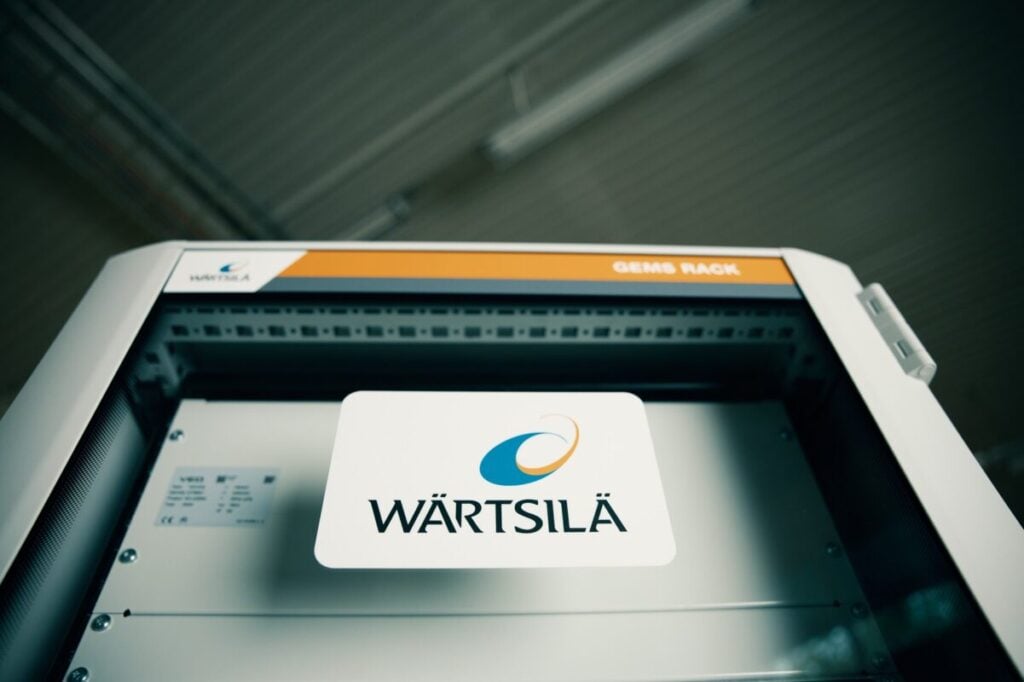
Luke Witmer, VP of software engineering at Wärtsilä Energy Storage, explains why 2025 was an “awkward” year, but one that saw the industry grow taller than ever.
One of the big players in global battery energy storage system (BESS) integration with over 18GWh of projects deployed or contracted for customers at more than 130 sites worldwide, Wärtsilä has always emphasised its track record in software as core to the company’s offerings.
While it manufactures the GridSolv Quantum series of large-scale BESS hardware, releasing multiple iterations over the past few years and touting its performance and safety track records, the energy storage arm of the Finnish marine and engine power plant technology company’s GEMS digital energy management platform and power plant controller (PPC) have consistently been given detailed mention in pretty much all of its news announcements.
Luke Witmer, who has held various software-focused roles since before Wärtsilä’s 2017 acquisition of Silicon Valley energy storage pioneer Greensmith Energy brought GEMS into the portfolio and marked Wärtsilä’s entrance into the energy storage space, discusses some of the industry’s big-picture topics from a digital technology perspective.
Try Premium for just $1
- Full premium access for the first month at only $1
- Converts to an annual rate after 30 days unless cancelled
- Cancel anytime during the trial period
Premium Benefits
- Expert industry analysis and interviews
- Digital access to PV Tech Power journal
- Exclusive event discounts
Or get the full Premium subscription right away
Or continue reading this article for free
What did 2025 mean for the energy storage industry from your company’s perspective and the bigger picture?
It was a tumultuous year for the energy storage industry as a whole. It felt a lot like puberty—an intense period of transformation across every dimension of the market.
The combination of cognitive dissonance, policy whiplash, mixed global sales performance, and the technical complexity introduced by AI data centre customers, all while the industry delivered the largest-ever volumes of megawatt-hours. It’s very much like being a teenager capable of incredible things, achieving milestones they’ve never seen before, and yet still working through the growing pains as the sector scales and matures.
But here’s what I think is really starting to click: the industry is finally embracing what we at Wärtsilä Energy Storage have believed all along—that software is a core enabler of the energy transition. When you’re trying to run a reliable electric grid with high penetrations of renewable energy, you need sophisticated software at each site to intelligently manage a diverse array of energy assets. As the generation mix continues to transform, getting more efficient amid demand growth, we’re all increasingly dependent on software to maintain the delicate balance between supply and demand to keep energy flowing.
That’s why our focus has been on continuously evolving GEMS, our controls and optimisation platform. We’re using real-time and historic data to intelligently manage and dispatch energy assets, provide predictive analytics for battery power plants, and enable our customers to get the most out of every megawatt. The goal is systems that support grid reliability and stability, reduce fuel consumption and emissions, participate in complex global markets, and actually deliver returns.
So, while 2025 brought its share of industry-wide awkwardness, just like puberty, those growing pains signal progress toward a more capable, resilient, and intelligent energy ecosystem.
What do you think 2026 will hold, in terms of both things to look forward to and in terms of challenges ahead?
2026 is shaping up to be a pivotal year – and honestly, it’s going to be interesting to play a part in how it all unfolds.
The AI race is definitely on, but here’s the thing: we can’t win it with a legacy grid mindset. In 2025, we proved that storage is the key to grid stability. Now in 2026, the focus shifts to resiliency at the edge. For data centres, especially, this means intelligent energy systems that can seamlessly shift from grid-connected to islanded minigrids.
We’ll also see real progress on the technical side. By pairing grid-forming BESS with advanced software like GEMS, we’re enabling facilities to ‘ride through’ grid stress and smooth out those volatile AI load spikes. And here’s what’s exciting – this transforms what could’ve been a massive power demand into a stabilising asset for the grid. We’ll likely see supercapacitors on the DC load buses working alongside AC BESS at the medium-voltage (MV) level to tackle the problem from both ends.
Regionally, Europe will be pushing hard to get products in ahead of the 2027 Battery Passport deadline. Australia will keep showing steady growth thanks to their meticulous grid interconnection process and continuing investment in the transition to cheaper renewables. The US will likely feel the effects of policy whiplash from 2025, which will continue to create some uncertainty.
And frankly, there’s a maturation curve we’re all navigating – not all BESS solutions work at the gigawatt-hour scale, and customers are still learning what works and what doesn’t. The vendors who can provide techno-commercial offerings backed by detailed simulations and real assurances will be the ones who help projects move forward with confidence.
We have seen software move progressively into the mainstream. Of course, it has always been crucial, but there’s more emphasis on software in recent industry conversations. What have been the most significant steps forward in the adoption of software solutions to address energy storage industry challenges?
The most significant steps forward in adoption have resulted from real operational challenges and lessons learned in the field. Early deployments revealed critical gaps: some battery power plant controllers (PPCs) focused solely on control without appropriate operator interfaces or integrated data collection capabilities. Many off-the-shelf solutions struggled with the scale of today’s GWh-sized plants and also couldn’t meet stringent response time requirements—particularly when handling the data throughput demands of large installations.
Forward-thinking providers recognised these challenges early and developed solutions capable of handling multi-GWh-scale operations while maintaining high-resolution cell-level data collection necessary for performance analytics, anomaly detection, and remote operations and maintenance. The industry is now recognising that software quality directly correlates with operational reliability and long-term value.
Having watched systems like GEMS evolve from 1MWh pilots to controlling 1GWh+ sites globally, I’ve observed three fundamental shifts over the last few years.
First, we’ve moved from basic control to predictive intelligence. Software is no longer just a dashboard—it’s an optimisation engine. Many operators today leave up to 20% of their battery capacity unused as a ‘safety buffer’ due to a lack of data confidence. With machine learning tools that identify anomalies at the cell level, operators can reclaim that capacity. On a 100MW system, that represents approximately US$20 million in recovered value through better analytics.
As large lithium iron phosphate (LFP) battery assets enter their second and third years of operation, we’re seeing challenges that are effectively mitigated by advanced software. Features like sophisticated cell balancing, real-time anomaly detection, and energy capacity estimation provide significant operational value. Additionally, ultra-fast controls now enable battery systems to absorb rapid load fluctuations—such as the synchronised GPU cluster ramps in AI data centres—before they impact grid equipment, leveraging batteries as stabilising grid assets.
Perhaps most significantly, we’ve reached the frontier of grid-forming software. For a century, grid stability relied on the physical inertia of spinning turbines in fossil plants. We’ve now proven we can replicate that inertia digitally, allowing batteries to form the grid voltage rather than simply following it. This capability is essential as traditional power plants retire. We just completed the delivery of our second massive grid-forming battery in the UK, at 600MWh, which I think is the world’s largest grid-forming battery. This technology is mature and ready, but you need the right partners to ensure your success.
Finally, as energy and ancillary service markets fluctuate between scarcity and saturation, automated bidding solutions leveraging probabilistic electricity price forecasts—informed by live grid situational awareness, including local congestion data—enable optimised battery plant operations across varying market and renewable energy conditions. Customers are adopting these solutions because they address expensive operational problems at a fraction of the cost.
Wärtsilä launched its own battery analytics software platform this year. What can you tell us about that and the reasoning behind developing a solution in-house?
From the founding of the GEMS platform, we recognised that battery cell-level data would be operationally critical for these power plants. My first work as a data scientist on the platform—over 10 years ago now—focused on simulation pipelines to analyse how field usage patterns would impact degradation. By that year’s end, we released a new generation of GEMS, which included a complete overhaul of data collection and storage technologies—from the plant controller through to cloud streaming.
That platform and its subsequent generations provided the visibility needed to service and operate customer fleets with exceptional performance. However, as plant scale has grown exponentially over the last two years, we encountered bottlenecks in our data collection capabilities. This prompted us to embark on another fundamental overhaul of our data infrastructure.
The result is GEMS Pulse, launched in October 2025—our cloud-based battery analytics platform featuring new database technology, streaming architecture, and analytics engines designed around the GEMS Data Schema. This represents a significant milestone because it moved analytics from a third-party ‘add-on’ to a core, integrated component of the energy storage ecosystem. It was a deliberate move to close the loop between data and action.
GEMS Pulse enables analytics at previously impossible scales and at a fraction of the cost. We’re creating an operational environment where every site visit addresses active issues while also performing predictive maintenance on components expected to fail soon. Anomalies are automatically flagged without manually sifting through gigabytes of data. Insurance companies can offer reduced premiums due to demonstrably lower fire risk, and commissioning teams reach commercial operating deadlines ahead of schedule with tools that pinpoint critical issues efficiently.
The reasoning also centred on data confidence. Having managed over 19 GWh of capacity and billions of hours of operational data, bringing this science in-house has allowed us to significantly reduce state of charge (SoC) error and cell imbalance. Reducing that error means reducing the ‘uncertainty buffer’—helping customers reclaim the hidden 20% of capacity previously left unused as a safety margin.
Third-party solutions would have added complexity and cost without addressing the fundamental data scale challenges we faced. With comprehensive data access, our data scientists work closely with our lifecycle team of battery experts—who collectively bring decades of field experience—to automate processes and train models that optimise plant operations.
More mature markets such as ERCOT, CAISO and the UK have seen some intense competition. What are the optimisation strategies or technologies that are needed to ensure success in mature markets?
In markets like ERCOT, CAISO, and the UK, the easy money is gone. Success in 2026 isn’t about how many megawatts you deploy—it’s about algorithmic agility and cost-effectiveness across capex, opex, and revenue capture. Many developers have historically focused too heavily on upfront capital costs. However, selecting the right software—while potentially appearing expensive initially—pays off quickly when the alternative means an asset that can’t qualify for new markets, consistently misses high-price events, or achieves only 90% availability compared to the 98% possible with appropriate software and lifecycle agreements.
Market dynamics have fundamentally changed. In ERCOT, the new RTC+B rules (effective December 2025) mean optimal battery decisions now change every five minutes. Operators still relying on manual bidding or static day-ahead strategies are leaving 20-30% of revenue unrealised. Competition has compressed profit margins significantly—operators can no longer afford to hold back 20% of energy capacity as a “safety buffer” due to SoC uncertainty. In many cases, that 20% represents the entire profit margin for smaller utilities.
From project conception through delivery and into commercial operation, many elements require optimisation to compete successfully. Critical areas we focus on include sizing methodologies during the proposal stage, financial modelling informed by real-world lifecycle scenarios, delivery optimisation spanning shipping logistics through rapid market qualification, and operational intelligence through our GEMS IntelliBidder and Dispatcher products.
These increasingly leverage probabilistic optimisation techniques with forecast error awareness. The right approach combines all these elements with experienced partners who understand each domain.
What should the industry’s priorities be in 2026 and beyond?
The industry’s priority in 2026 and beyond is maturity, and maturity translates directly into trust and bankability. When I walk the expo floor at major industry events today, I’m not finding fundamentally new technologies like I did two or three years ago, and that’s actually a good thing. We now know the rules of the game and are familiar with the field we’re playing on.
Now it comes down to who can execute best. As projects move closer to communities, technical specifications such as noise attenuation and UL9540A fire safety aren’t just checkboxes; they directly affect project economics. Systems engineered to be quiet, safe, and cybersecure will clear the permitting processes faster and will secure financing more easily.
The maturation process will include consolidations and bankruptcies as the market separates strong performers from weak ones, hardware supply chains outside of China will begin to flow at scale, and smart companies will standardise on proven holistic software platforms like GEMS rather than creating operational nightmares with dozens of different systems.
The most competitive systems in 2026 won’t just be the ones with the best battery specifications—they’ll be the ones that communities, utilities, and banks all trust to perform reliably.
Energy-Storage.news publisher Solar Media is hosting the Energy Storage Summit EU 2026 in London, UK, on 24-25 February 2026 at the InterContinental London – The O2. ESN Premium subscribers can get exclusive discounts on ticket prices. See the official website for more details, including agenda and speaker lists.