
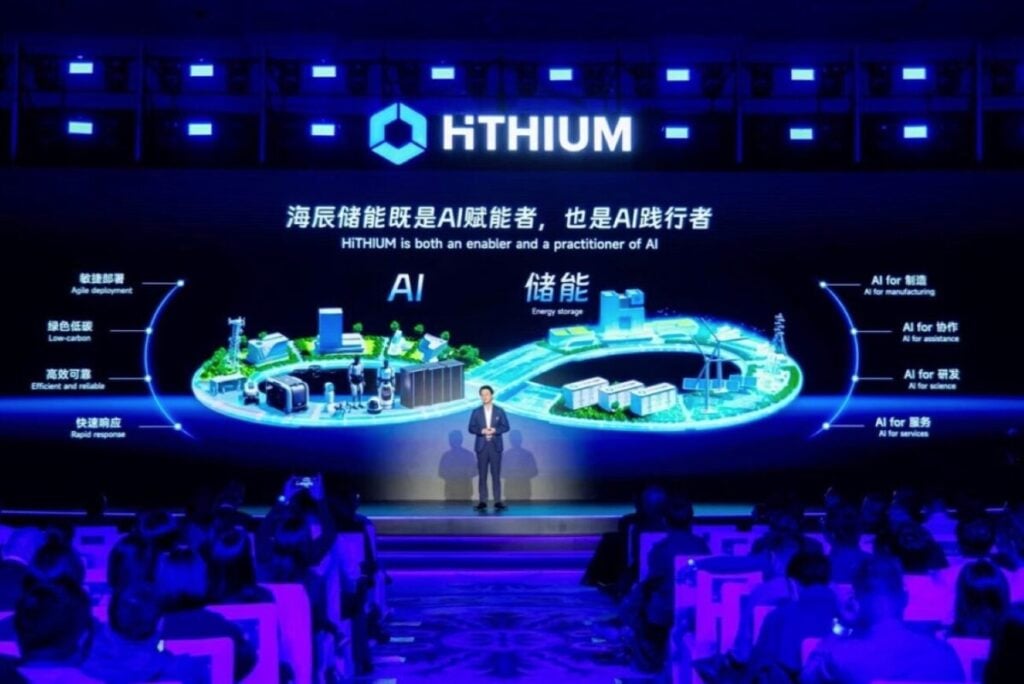
With the global AI data centre boom already here and growing rapidly, HiTHIUM brings products and strategies to help solve its significant energy challenges.
The International Energy Agency’s World Energy Outlook 2025 report reveals that “global investment in data centres will overtake that in crude oil supply for the first time in 2025,” indicating a rapid shift in the core driver of global economic growth from crude oil to electricity.
The report further notes that electricity demand is growing much faster than overall energy demand, with demand for data centres and artificial intelligence (AI) growing increasingly prominent.
UBS Securities’ latest analysis also indicates that the rapid advancement of AI and the exponential growth in machine learning are driving fundamental changes in power supply and distribution systems. It forecasts that the potential market size of global AI data centre (AIDC) power supply systems will hit US$24 billion by 2028.
Try Premium for just $1
- Full premium access for the first month at only $1
- Converts to an annual rate after 30 days unless cancelled
- Cancel anytime during the trial period
Premium Benefits
- Expert industry analysis and interviews
- Digital access to PV Tech Power journal
- Exclusive event discounts
Or get the full Premium subscription right away
Or continue reading this article for free
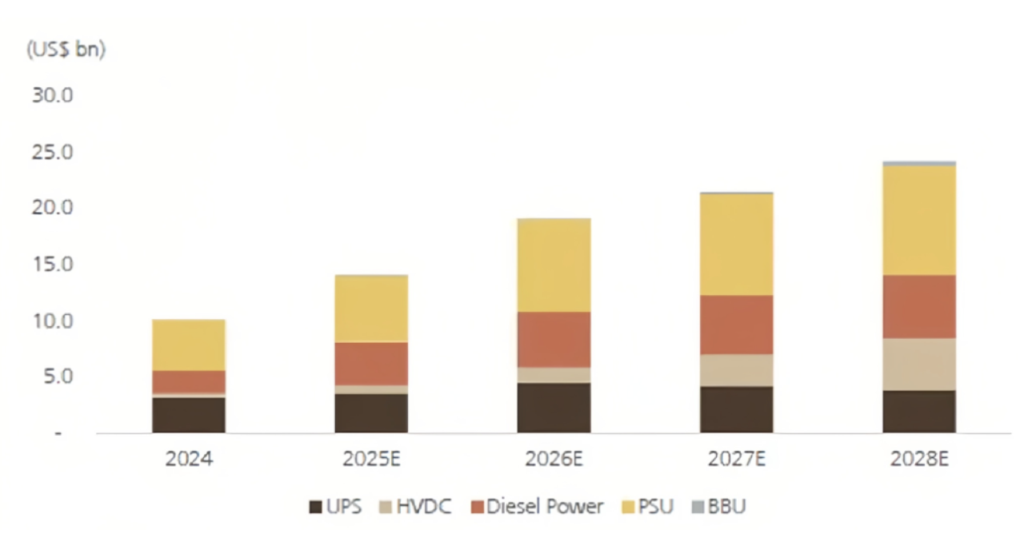
Note: AIDC power supply systems include diesel generators, uninterruptible power supply (UPS), high-voltage direct current (HVDC) power suppliers, server power supplies (PSU) and battery backup units (BBU).
Amidst explosive growth in AI computing power demand, artificial intelligence data centres, dubbed ‘super power consumers,’ have made energy supply stability, sustainability, and cost efficiency the core bottlenecks hindering industry development.
To capitalise on this new market opportunity, HiTHIUM has officially rolled out a lithium-sodium collaborative energy storage solution tailored for full-duration AIDC applications—a targeted response to the core challenges hindering AIDC development.
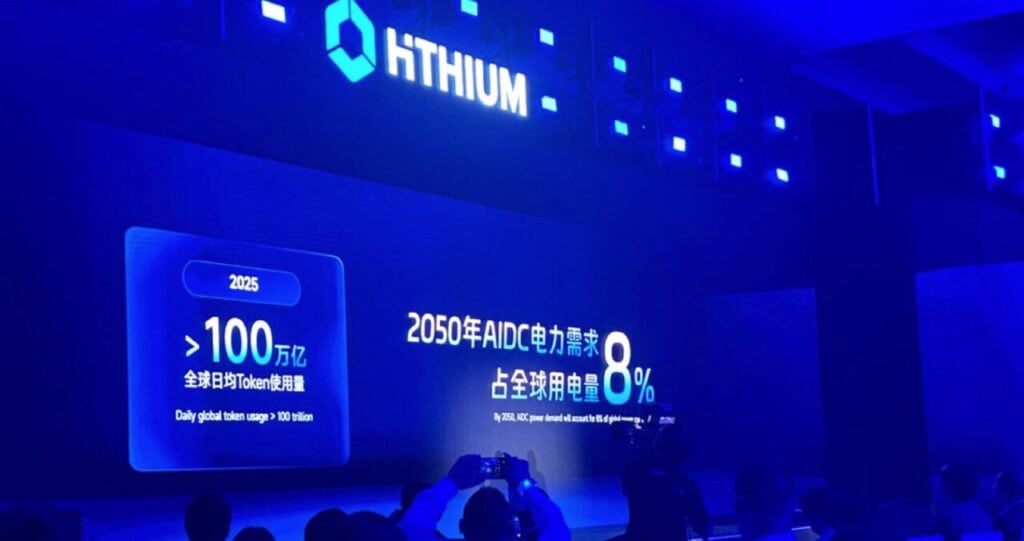
Jeff Wu, founder and chairman of HiTHIUM, stated plainly: “By 2050, global electricity consumption is projected to exceed 60 trillion kWh, of which AI data centres are expected to account for 8% of the total. This will generate a colossal demand for energy storage deployments of over 150TWh, paving the way for a mega-sized industry valued at over RMB100 trillion (US$14.3 trillion) for lithium-ion and sodium-ion battery energy storage technologies.
When the combined cost of wind and solar power generation, transmission, and energy storage is lower than that of grid electricity from traditional energy sources, global demand for energy storage will surge exponentially, with AIDC emerging as the core growth driver in this expansion.”
Driven by the projection of surging future energy storage demand, HiTHIUM has launched a series of strategic initiatives to evolve from a ‘long-duration lithium battery energy storage pioneer’ to an ‘industrial ecosystem value co-creator,’ with its AIDC-focused solution serving as a crucial part of this transformation.
AIDC energy storage market is experiencing robust growth: energy transformation fuelled by 300GWh demand surge
David Luo, HiTHIUM Senior Director of Products, shares the company’s insights: “AIDC represents an unprecedented load type—one that drives not only innovations in the energy storage sector but also a full-scale restructuring of the entire power system architecture.”
He further elaborates on the core energy storage requirements for AIDC. First, it addresses the fundamental challenge of power availability. Grids across the US and Europe are existing infrastructure with a 30- to 50-year service life, and their capacity and stability fall short of meeting surging demand. Expanding traditional energy capacity takes over five years—a timeline that fails to address the urgent needs of AI computing power.
Energy storage has thus emerged as the key to resolving the ‘computing power waiting for electricity’ predicament.
Secondly, it mitigates power balance challenges stemming from AIDC’s highly variable load profiles. As power supply system upgrades to the 800-volt high-voltage direct current (HVDC) standard, energy storage must fulfil the dual roles of energy supply support and power capacity support. Functioning as an ‘energy buffer,’ it ensures the stable operation of the entire system.
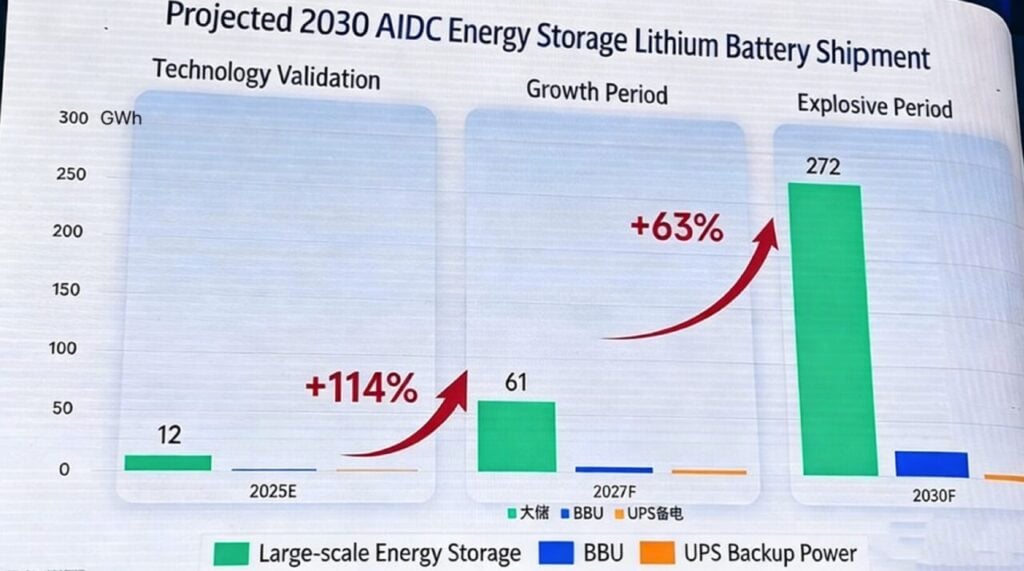
A December 2025 report from GGII (High-Tech Industry Research Institute) underscores the market’s enormous potential: The AIDC energy storage lithium-ion battery market will undergo a three-phase evolution-technology validation, growth, and explosive expansion.
By 2030, global shipments of AIDC energy storage lithium-ion batteries are projected to exceed 300GWh, reflecting robust long-term growth momentum.
The report specifies that 2025 marks the technology validation phase, with AIDC energy storage lithium-ion battery shipments projected at 12GWh; by 2027, the market will enter the growth phase, with shipments surging to 61GWh (a year-on-year increase of 114%); and 2030 will witness the explosive expansion phase, with shipments expected to hit 272GWh-representing a 63% growth rate from 2027 to 2030. In terms of technical routes, large-scale energy storage systems maintain an absolute dominant position across all phases.
David Luo emphasises: “From our perspective, 2025 is the inaugural year of AIDC energy storage market expansion. A substantial number of projects are already underway, but due to the extended construction cycle of data centres, there is a certain lag between project shipments and actual installations.”
Long-duration energy storage ensures reliable green power, lithium-sodium combination mitigates AIDC ‘impact load’
From Luo’s perspective, AIDC’s energy storage requirements boil down to three core imperatives: “full-duration supply, high reliability and cost efficiency”.
Specifically, it needs long-duration energy storage to absorb surplus green power and secure base load supply; to handle instantaneous peak loads and maintain a 99.9%+ availability; and to optimise energy costs to enhance operational efficiency.
Traditional single-path energy storage technologies struggle to meet all these requirements. Against this backdrop, HiTHIUM pioneered the world’s first lithium-sodium collaborative full-duration energy storage solution tailored for AIDC.
As detailed, the solution comprises four key product lines: ∞Power 6.25MWh 4-hour, ∞Power 6.9MWh 8-hour, ∞Power N2.28MWh 1-hour and ∞Power 6.25MWh 2-hour. Together, they form a “source-grid-load” integrated energy security system that fulfils AIDCs’ core needs for sustainability, responsiveness, stability, and cost-effectiveness.
“8-hour long-duration energy storage (LDES) is emerging as a core trend,” Luo notes. He explains that HiTHIUM’s AIDC solution, through the efficient coupling and intelligent management of long-duration energy storage systems with renewable energy sources, has drastically shortened the construction cycle of power infrastructure, from the traditional five to 10 years, to just one to two years.
This fundamentally resolves the ‘computing power waiting for electricity’ predicament. Particularly in scenarios where green power penetration requirements exceed 80%, the 8-hour long-duration energy storage system can significantly lower the cost of green energy, regulate grid frequency, and ensure the reliability of backup power supply.
“The collaborative lithium-sodium energy storage is the golden pairing of power and energy storage. Lithium-ion batteries focus on long-duration energy storage, acting as long-term backup power for data centres and delivering stable, durable base load support for AIDC.
High-rate sodium-ion batteries, by contrast, specialise in instantaneous peak load response. Our 162Ah sodium-ion battery boasts a cycle life exceeding 20,000 times and achieves millisecond-level response speeds, perfectly matching the pulsating power demands arising from AIDC computing power fluctuations.”
This innovative layout aligns with the evolutionary trend of AIDC energy architectures. Luo points out: “In the future, AIDC power supply systems will upgrade to an 800V high-voltage direct current (HVDC) architecture, with the technical path gradually shifting from UPS to energy routers. Our solution not only adapts to the current 240V and 400V voltage but also pre-empts the energy storage needs of the 800V architecture. It achieves full coverage on power supply side above 10 kilovolts and serves as the core hub of the AIDC energy system.”
Synchronised solar and storage lifecycles, with low LCOS and localised strategies for international markets
“Competition in the AIDC energy storage market will ultimately come down to both technological strength and cost competitiveness,” Jeff Wu stated.
HiTHIUM’s core strategy moving forward is to drive the Levelized Cost of Storage (LCOS) down to the 0.1 yuan era within five years through technological breakthroughs in four key areas, achieving the goal of “matching the lifespan and cost of wind and solar energy”.
“The economic viability of energy storage is the key to its full commercialisation,” according to Jeff Wu.
“Currently, the LCOS of new energy storage systems remains above 0.3 yuan, though some high-quality domestic projects have already brought this figure below 0.3 yuan. We must pursue continuous technological innovation to not only match the lifespan of wind and solar energy but also achieve cost parity with them.”
To achieve the goal of matching wind and solar in lifespan and cost, HiTHIUM is devoting all resources to developing ultra-large cells, decoupling power and energy based on first principles to strike a balance between safety and cost. Simultaneously, it is advancing extreme intelligent manufacturing, building highly integrated systems, and rolling out integrated solutions through a multi-pronged approach.
Beyond the domestic market, HiTHIUM’s management aims to expand into international markets simultaneously. David Luo notes: “Driven by the urgent demand for reliable power to support AIDC construction, the markets can still deliver solid returns with a payback period of two to three years—even amid high current investment costs for PV and energy storage systems. Looking ahead, as our LCOS drops to the 0.1 yuan/kWh level, the energy costs for AIDC will be further reduced.”
Targeting the core US AIDC market, HiTHIUM has adopted a dual-driver strategy of “local manufacturing plus localised services”. David Luo notes, “We adhere to a ‘Local For Local’ philosophy, and our US layout has already yielded initial outcomes. Our HiTHIUM Texas System Factory in Mesquite, Texas, commenced initial production in August 2025—marking our official entry into large-scale localised production in North America—with a designed annual capacity of 10GWh for battery modules and energy storage systems.
We have now achieved localised supply of US-made products. Simultaneously, we have established service hubs across key regions, built a professional team of over 100 members, set up regional warehousing facilities and a 72-hour on-site response mechanism, and recruited international talent to closely align with the needs of overseas AIDC clients.”
To further integrate into the global market, HiTHIUM is proactively working to meet diverse international standards. It passed the energy storage fire safety certification TM-2 of the New York City Fire Department (FDNY) and completed the open-door combustion test, laying the foundation for local market access. Building on these milestones, HiTHIUM signed a strategic cooperation agreement with Microgrid Networks LLC (MGN) to provide a complete solution of 55MW/290MWh for 10 energy storage projects in New York.
Looking ahead, Luo says: “Over the next three to five years, long-duration, high-power, liquid-cooled energy storage systems will become mainstream for AIDC. Leveraging our full-chain layout spanning batteries, energy storage systems, manufacturing, and supply chains—including our global R&D, production, sales, and service network-HiTHIUM will aggressively expand in the AIDC energy storage market. We are committed to powering global computing infrastructure with energy that is stable, green, and affordable.”