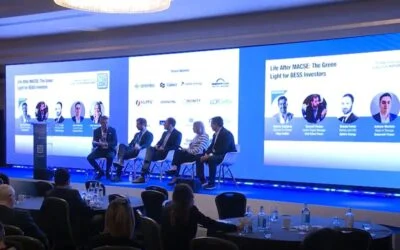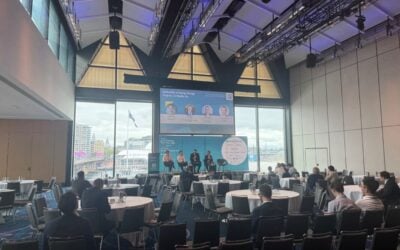
What are the merchant opportunities for in Germany, where there are almost no capacity schemes or subsidies for energy storage? A panel of expert speakers discussed the opportunities in Europe’s largest energy market on the panel at the Energy Storage Summit 2026 in London in February.
See a full video of ‘The Money Maker: Assessing Germany’s Unique Merchant Opportunities’ panel discussion below with the following panellists:
- Eva Zimmerman, Senior Research Associate, Aurora Energy (moderator)
- Florian Mayr, Partner, Strategy&
- Leandra Boes, Director Commercial Asset Management, Green Flexibility
- Amin Akherati, Head of Origination – Infrastructure & Energy, Berenberg
- Loic Cerulus, Director, Investments, CVC DIF
The summit is the flagship event in our publisher Solar Media’s now 16-strong series of energy storage events globally, which you can see here. Yesterday we published an Italy-focused session, and will be posting more of the conference’s session recordings on Energy-Storage.news in the coming days and weeks.
Try Premium for just $1
- Full premium access for the first month at only $1
- Converts to an annual rate after 30 days unless cancelled
- Cancel anytime during the trial period
Premium Benefits
- Expert industry analysis and interviews
- Digital access to PV Tech Power journal
- Exclusive event discounts
Or get the full Premium subscription right away
Or continue reading this article for free
See the full video discussion below.
A big topic was tolling, particularly important in the absence of a capacity market (CM) or other state-led capacity procurement mechanism. This later led into a discussion on broader project financing in Germany and also the potential of storage to help the renewables sector’s ability to mitigate falling PPA prices.
Grid fees for charging and discharging, and the expiry in August 2029 of an exemption from these for storage, was also a key theme, alongside general grid access.
Challenges around optimisation and transparency were also discussed. Comparing performance across projects and optimisers is easier (though still not ‘easy’) in the UK, for example. How well optimisers can adapt to rapidly-changing electricity markets and the regulatory environment are really key, perhaps more than how good your algorithms are, one speaker said. Market saturation, another way to compare the UK and Germany, also came up.