
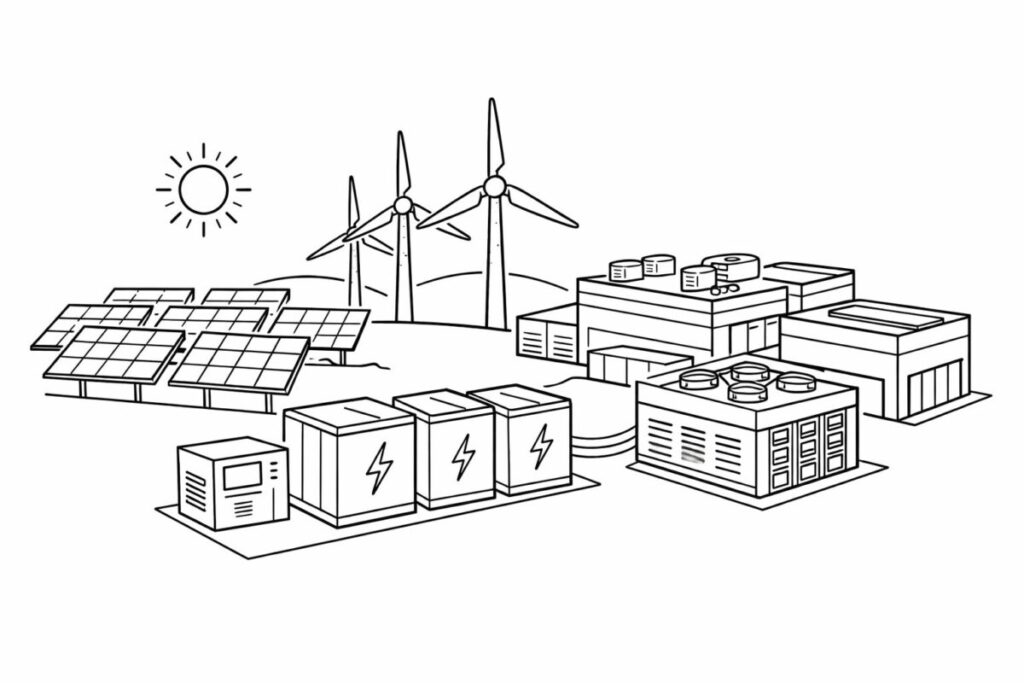
Renewables and battery storage are quick and cheap to deploy for satisfying data centre power demand, writes Jason Kaminsky of kWh Analytics.
Electricity availability is fast becoming the limiting factor for technology sector growth. If supply cannot keep pace, power becomes a strategic bottleneck.
Renewable energy combined with storage is the only option that can scale quickly enough to respond: nuclear projects face long development timelines, gas turbines are limited by supply constraints, and coal plant extensions offer only incremental relief. Faster to deploy and often more cost-effective than expanding coal capacity, renewables will play a central role in meeting record-breaking demand driven largely by AI and data centre expansion.
Here’s what we can expect in the year ahead.
Try Premium for just $1
- Full premium access for the first month at only $1
- Converts to an annual rate after 30 days unless cancelled
- Cancel anytime during the trial period
Premium Benefits
- Expert industry analysis and interviews
- Digital access to PV Tech Power journal
- Exclusive event discounts
Or get the full Premium subscription right away
Or continue reading this article for free
Data Centers developers are building their own power sources to minimise impact of their increasing demand
Increased pressure from regulators and utility companies looking to minimise strain on ageing electrical grids and protect consumers from higher electricity bills is causing many data centres to seek ways to supply their own power, often behind-the-meter (BTM).
Recent Cleanview data shows that about 56GW of planned data centre capacity, nearly one-third of the pipeline, is now designed to source part or all of its electricity from on-site generation rather than the broader grid. This marks a dramatic shift from late 2024, when less than 2GW of proposed capacity relied on on-site power. That said, this trend doesn’t imply widespread fully islanded operations. Most facilities are still expected to maintain some level of grid connection to ensure reliability, redundancy or market access.
Although the majority of buildout is powered by natural gas today, there are notable exceptions and significant commitments by data centres to increase reliance on renewable capacity, driven not only by operational needs but also by concerns over mitigating reputational impact.
Siting, permitting and interconnection among the headwinds renewables and BESS developers face
Energy demand from data centres is rising remarkably fast at roughly 5% per year. Recent analysis from Grid Strategies projects that data centre-driven load could reach 90GW by 2030. And importantly, data centres account for only about one-third of total expected demand growth, which also includes manufacturing expansion, transportation electrification, and broader industrial activity, underscoring just how substantial the overall capacity need will be.
Speed and cost make renewable energy and BESS a compelling option for powering data centres. However, these projects face headwinds ramping up quickly enough to keep pace with data centre demand, particularly as regulators favour alternatives such as oil and gas.
The biggest hurdles are siting and permitting. While the technologies are proven and readily available, whether projects can actually get approval to move forward remains uncertain.
Interconnection bottlenecks are another hindrance. Ageing grid infrastructure in need of costly upgrades, limited grid operator resources, and a highly complex review process for thousands of new projects applying at the same time means an overloaded interconnection queue that can take years to get through in some regions.
Supply chain and manufacturing delays are also a factor, particularly when multiple large projects are seeking approvals at the same time.
Regulatory constraints will shape tactics, not stop development
While cost competitiveness and deployment speed of renewables are expected to drive exponential growth in the face of rising demand, we’ll likely continue to see a push by this administration to support oil and gas buildout.
However, the reality is that gas turbines will remain in short supply until well into the 2030s, and new nuclear capacity continues to face significant development obstacles. As a result, renewable energy paired with battery storage is the only viable, scalable solution in the short term to meet accelerating demand.
Federal policy that would overhaul the current structure is unlikely in the near term. The Investment Tax Credit (ITC) is expected to remain in place, though we can expect clarification around its implementation, particularly around Foreign Entities of Concern (FEOC) requirements. Developers are already adjusting to key milestones such as the 4 July 2026 begun-construction requirement.
While some projects may choose to avoid FEOC complexity by foregoing tax credits altogether, others are employing creative strategies such as purchasing custom transformers or taking early construction actions to ensure eligibility.
Domestic manufacturing, particularly in battery storage, is expanding, with some EV manufacturers converting facilities to produce grid-scale systems. In short, tactics are shifting to ensure development continues.
Data centers will increasingly rely on renewables and BESS to meet fluctuating demand
Renewables paired with battery storage work well in helping to smooth the peaks and troughs of fluctuating data centre loads throughout the day. Short-duration batteries can cushion sudden spikes in demand, while longer-duration systems can help stabilise overall load. And because renewables and storage can be deployed on-site, operators can manage reliability and demand internally, reducing strain on the broader grid.
The bottom line
Renewables and battery storage hold the key to optimising data centres’ power needs and alleviating reputational concerns. Operationally, renewable generation combined with battery storage will become central to how data centres manage peak demand, load shifting, and interconnection reliability across both short and extended time horizons.
Strategically, deeper integration of renewables strengthens their sustainability profile, helping mitigate scrutiny around energy use and environmental footprint.
About the Author
Jason Kaminsky is the CEO of kWh Analytics, a US-based Climate Insurance provider that underwrites property insurance and revenue-firming products for renewable energy assets. Its proprietary database of 300,000+ zero-carbon projects and US$100 billion in loss data fuels advanced modelling and insights, enabling precise underwriting decisions. Just prior to joining kWh Analytics, Jason spent more than three years as a Vice President of Environmental Finance at Wells Fargo Bank. In March 2026, speciality insurer Beazley reached an agreement to acquire kWh Analytics.
The Energy Storage Summit USA 2026 will be held from 24-25 March 2026, in Dallas, TX. It features keynote speeches and panel discussions on topics like FEOC challenges, power demand forecasting, and managing the BESS supply chain. ESN Premium subscribers can get an exclusive discount on ticket prices. For complete information, visit the Energy Storage Summit USA website.