
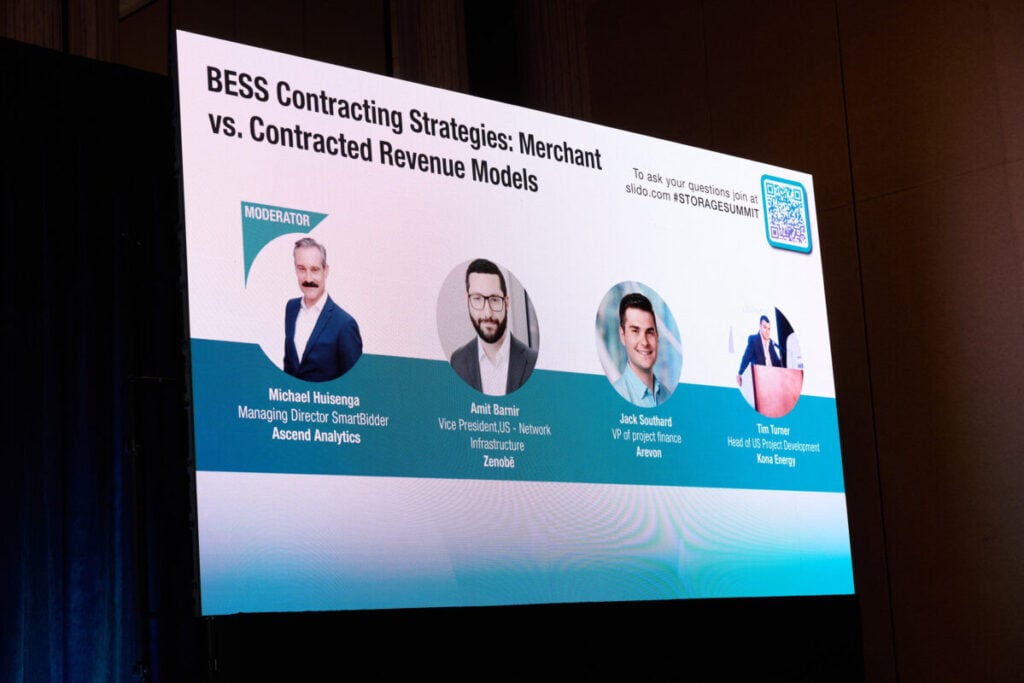
A panel at the 2026 US Energy Storage Summit in Dallas, Texas, discussed the “creative, innovative structures” developers are having to embrace to secure long-term revenues for energy storage projects.
The panel discussion, titled “BESS Contracting Strategies: Merchant vs. Contracted Revenue Models”, was moderated by Michael Huisenga, Managing Director SmartBidder at Ascend Analytics, Tim Turner, Head of US Project Development at Kona Energy, Jack Southard, VP of Project Finance at Arevon, and Amit Barnir, Vice President, US Network Infrastructure at Zenobē Energy.
Ascend Analytics is a market intelligence consultancy using AI forecasts and bid agents to boost battery energy storage system (BESS) profitability in day-ahead and real-time markets. Kona Energy is a UK-based renewable project developer. Arevon is a US renewable projects developer-operator. Zenobē Energy, headquartered in the UK, provides BESS and EV solutions and acts as a developer-investor in the BESS space.
The discussion highlighted various strategies that developers in the US market are employing regarding the progress of energy storage development.
Try Premium for just $1
- Full premium access for the first month at only $1
- Converts to an annual rate after 30 days unless cancelled
- Cancel anytime during the trial period
Premium Benefits
- Expert industry analysis and interviews
- Digital access to PV Tech Power journal
- Exclusive event discounts
Or get the full Premium subscription right away
Or continue reading this article for free
The US market is experiencing short-term instability driven by regulatory uncertainties and reduced merchant revenues, though the specific drivers and reasons vary across ISOs and state programmes.
The current market indicates a growing shift towards long-term contracts and a decline in reliance on purely merchant business models. At the same time, grid connection queues remain a common challenge across markets nationwide.
UK precedent
Turner added context from the UK energy storage market, describing a dramatic revenue collapse. “2024 was a very, very low year for revenues. I think 70% or so of batteries in the UK were making US$40k/MW/year, that year.”
He continued, “There was a lot of concern around the revenue stack and what that would mean for projects getting financed going forward, and a lot of the floors that had been agreed previously were underperforming and out of money.”
This situation led to creative responses from the market, “such as ratcheted fee structures to enable off-takers and developers to share some of the risk. But also, there have been more innovative balancing floor structures that have allowed off-takers and underwriters the ability to claw back some revenues in the good years to compensate for years where they may have been out of the money on floors previously.”
State programmes in the Northeast
Barnir provided insights into emerging Northeast markets where state-backed programmes are creating new opportunities. He described the fundamental driver: “What we’re seeing in the Northeast is really a response to rising ratepayer costs, with states recognising that they need to step in and incentivise new generation.”
New York has implemented the Index Storage Credit (ISC), Maryland has a residential and commercial energy storage programme, and New Jersey has legislation seeking to increase energy storage deployments.
Together with more aggressive decarbonisation policies, this has generated a distinct market dynamic. Barnir clarified the financing challenge these programmes tackle:
“Historically, there wasn’t enough merchant volatility to make an energy storage project pencil, and the existing markets aren’t sending a long enough signal to get these financed. They recognise that they need to provide a certain level of contracted revenue to these projects in order for financing to become available to them, and you’re seeing 15-20 year off-take contracts backed by some of the most bankable counterparties in the country, which are the states themselves.”
He continued, “In a very small geographic region, we can compete in very different markets while still being very close to home. My team is based in New York City, and within two hours, we can actually access three different markets where previously you needed to be doing projects in CAISO, ERCOT, and SPP in order to get that same level of exposure.”
Barnir highlighted his team’s strength in programmes involving merchant exposure, explaining that Zenobē is not “handing over the keys” to these systems, as in a tolling agreement, where someone else optimises them. Instead, the company prioritises being highly “capable and smart” about where it can maximise value.
Differences across markets and states also highlight the importance of site selection when developing a project.
Site selection
The discussion uncovered varying priorities across markets. Southard described California’s stance, “Who’s going to care about the site the most is going to be who’s operating the battery. So if it’s a tolling agreement, they’re focused on nodal congestion, grid reliability. So they’re going to be a lot more focused on site location.”
Turner emphasised the importance of location within ERCOT: “There is a premium for assets that are located in the right parts of the grid, and that can be quite a significant premium.” He described Kona’s strategy of targeting “majorly constrained corridors where there’s chronic congestion that’s very difficult for the system operator to alleviate, which can create that protected volatility.” Turner stressed that “having a really high-quality site in the right part of the grid is going to be critical for making sure that you can secure the off-take that you need to actually get your project off the ground.”
Barnir further highlighted Northeast challenges with a blunt assessment: “Permitting on the East Coast is quite a nightmare and very fragmented in a lot of cases.” He emphasised that beyond technical considerations, “state programmes want projects that the local community will support, and can you provide benefits at the local level that bolster up the way these projects look? We think a lot about qualitative factors, not just price and headroom on the system.”
The panel discussed new opportunities in data centres, though the market is still early-stage. Barnir pointed out that “we’re seeing a lot of activity with data centres, but it’s not necessarily from a pure contracting standpoint. It’s maybe integrating a solution behind the meter as a bridge to power with other generation as well.” He elaborated that for independent power producers, the emphasis is on “contracting around the implications of what those data centres are doing,” such as increasing capacity prices in PJM due to growing data centre load.
Turner suggested an approach for ERCOT, “I expect to see more developers splitting large projects into smaller units. For example, you could have a floor or toll for a part of the asset, possibly negotiate a direct PPA with a data centre for another part, and keep some exposure to the merchant market as well.”
This structure would “allow lenders to apportion more debt to the contracted revenues, but then allow you to have some exposure to the upside for when there’s scarcity events,” Turner said.
Southard added that “data centres are probably the most concerned with speed to power. They are probably less focused on the type of generation from an environmental standpoint, but what they are focused on is how quickly something can get built and online.”
Huisenga ended on a hopeful note: “It does seem like there’s a lot of appetite for opportunities by the utilities, by CCAs, by data centres perhaps, to be counterparty on projects to move good projects forward. Maybe it’s more work, but it definitely seems like there’s a pathway for good projects to get done.”