The UK’s National Energy System Operator (NESO) will offer grid connection offers up to 2035 to 283GW of projects following a reform of the process.
The system operator published the initial results from its reformed grid connection process yesterday (8 December).
Before the new methodology for connections, the queue of projects awaiting an offer had reached around 722GW, about four times as much capacity as is required to meet government renewable energy targets.
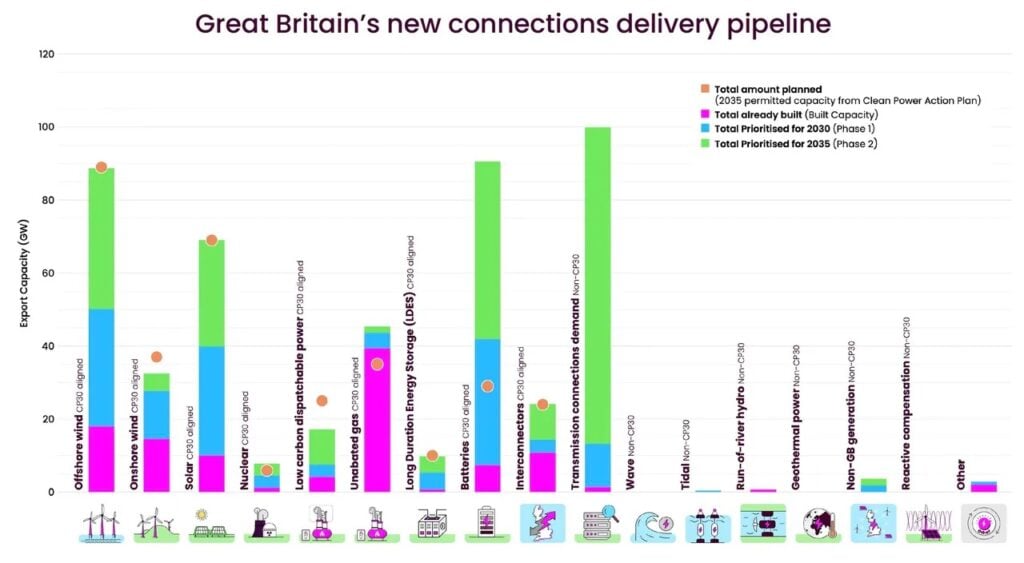
Developers that put projects forward for a grid connection will receive either a Gate 1 or Gate 2 offer – Gate 2 projects, which will receive a connection date up to 2035 are split into Phase 1 and Phase 2, with Phase 1 projects receiving connection offers pre-2030.
Try Premium for just $1
- Full premium access for the first month at only $1
- Converts to an annual rate after 30 days unless cancelled
- Cancel anytime during the trial period
Premium Benefits
- Expert industry analysis and interviews
- Digital access to PV Tech Power journal
- Exclusive event discounts
Or get the full Premium subscription right away
Or continue reading this article for free
A total 132GW is due a connection before 2030 (Gate 2 Phase 1), which is when the government is targeting the UK to have an energy system powered almost 100% by renewables, with gas primarily functioning to provide stability, per Clean Power 2030 plans.
Post-2030, 151GW will receive offers up to 2035 (Gate 2 Phase 2) and 216GW will receive Gate 1 offers, essentially putting projects aside unless Gate 2 capacity opens due to projects withdrawing.
The methodology by which NESO assigned projects to a connection date was the subject of scrutiny, and many developers said the process was rushed, while it was generally known that there would necessarily be ‘winners and losers’ in the process.
Trade body for the solar and energy storage sector, Solar Energy UK, described the reforms as “painful but necessary”.
Only BESS projects with ‘protected’ status will receive offers
That disappointment may be felt most keenly by battery energy storage developers, with 83GW issued Gate 2 offers and an oversupply of 62GW by 2035. Of those with Gate 2 offers, 33GW will connect in Phase 1, pre-2030.
Due to the high volume of prospective battery energy storage systems (BESS) entered for grid connections, only those with ‘protected’ status (i.e., those that had already significantly progressed before the connection queue reshuffle and thus will retain their previously issued connection dates) will receive offers.
Because only protected BESS projects will be issued connection offers, 153GW of projects were not ‘prioritised’, receiving Gate 1 offers or removed completely. It is unlikely that there will be capacity for new BESS projects to connect between now and 2035. Further, some protected projects will have been moved to a later date, but will still be considered prioritised.
Long-duration energy storage (LDES) projects are at full capacity up to 2035, with offers issued partially based on when applications were made – the earlier ones took priority, and 5.6GW was not prioritised.
The next window for Gate 2 connections is due to open no earlier than Q2 next year.
Developers have a 90-day window to respond to transmission connections offers, and possibly less to respond to connection offers at the distribution level, issued by distribution network operators in the next few days.
Developers were also urged to challenge results as soon as possible, but only with evidence-based data or if they believe a process error occurred.
To read the full version of this story, visit Solar Power Portal, where it first appeared.
Energy-Storage.news publisher Solar Media is hosting the Energy Storage Summit EU 2026 in London, UK, on 24-25 February 2026 at the InterContinental London – The O2. See the official website for more details, including agenda and speaker lists.