The government of Turkey, currently processing applications for large-scale energy storage facilities at renewable energy plants, will raise import duties for lithium iron phosphate (LFP) battery products.
Shortly before the end of 2023, Turkey’s Energy Markets Regulatory Authority (EMRA) said that it had given pre-licensing status to 493 project applications representing 25,630MW of energy storage planned for deployment at wind or solar PV plants in the country.
As reported by Energy-Storage.news in April last year, about 20GW of licences are expected to be issued over a period of three years. At that time, the government had already received nearly 4,400 applications totalling 221,000MW and pre-licensed an initial 744MW across 12 projects.
Developers and their investors were invited to apply to install energy storage facilities on a one-to-one ratio per megawatt of wind or solar and Korkut Öztürkmen, board member at major domestic power producer Aksa Enerji said it marked the beginning of a “very promising market” for energy storage.
Try Premium for just $1
- Full premium access for the first month at only $1
- Converts to an annual rate after 30 days unless cancelled
- Cancel anytime during the trial period
Premium Benefits
- Expert industry analysis and interviews
- Digital access to PV Tech Power journal
- Exclusive event discounts
Or get the full Premium subscription right away
Or continue reading this article for free
It would also support a stalled large-scale renewables sector in Turkey, with investors shying away from falling feed-in tariff (FiT) rates.
EMRA president Mustafa Yilmaz said on 29 December 2023 that in total, the regulator received 5,968 applications, for proposed transmission-connected projects with installed power exceeding 260GW, for delivery in the 2023-2028 timeframe. This demonstrated a “satisfactory” investment appetite, the president said.
The 25.6GW of pre-licences granted, meanwhile, represent an investment value of around US$35 billion should they all be built, the president said.
Pre-licences were split across solar PV and wind technologies as follows: 193 pre-licences granted for wind projects totalling 13,529MW and 300 solar PV projects of 12,101MW combined generation capacity.
Tariffs, trade association among drivers to create ‘industry ecosystem’ in Turkey
The same day EMRA published Yimaz’s announcement, renewable energy companies Partner EGS and Polat Enerji said they planned to deploy a battery energy storage system (BESS) at Soma RES, one of Turkey’s largest wind power plants.
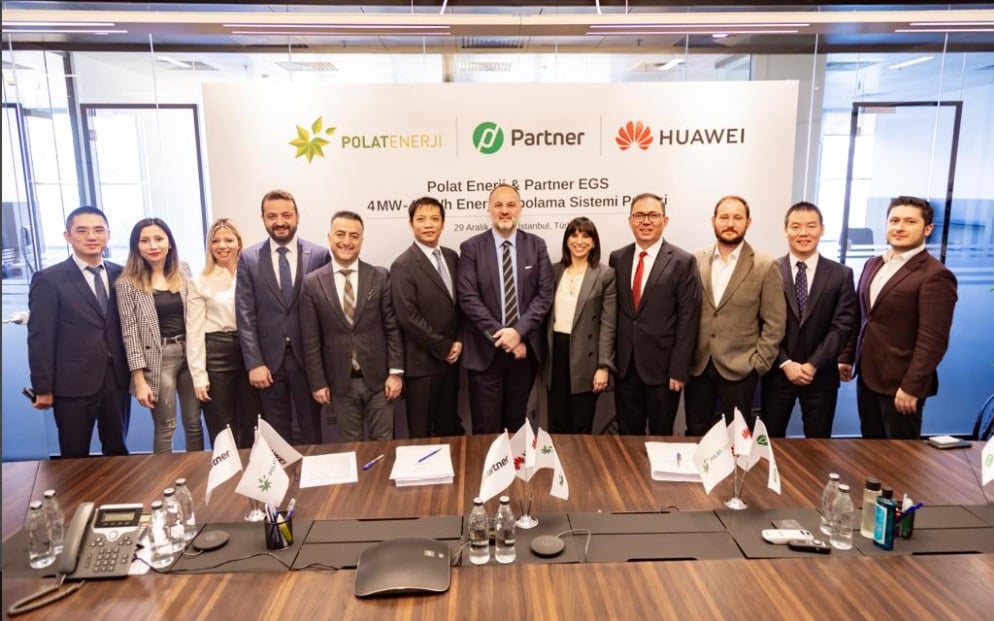
The two companies said a 4MW/4MWh BESS will be sited at the 328.9MW wind farm, helping contribute to grid flexibility and reducing network imbalance costs. A signing ceremony was held 29 December (pictured above) between the two companies. Chinese technology provider Huawei will be supplying the BESS technology, extending an existing relationship with Partner EGS.
In somewhat related news, local media in Turkey and across Asia was widely reporting that another major Chinese maker, battery manufacturer EVE Energy, is partnering with Aksa Power Generation, part of the same group as Aksa Enerji, forming a joint venture (JV) to take on the Turkish BESS market.
Speaking with Energy-Storage.news yesterday, Can Tokcan, managing partner at Turkish energy storage system integrator and manufacturer iNOVAT, said the developments were “very positive for the industry,” although it remains to be seen “how much of that [near 30GW] will be realised and in what time span”.
“Everybody has an expectation, but we will see how it’s actually realised,” Tokcan said.
Tokcan said that iNOVAT and a number of other companies across the energy storage value chain have formed a new trade association a few months ago. Participants include software developers, storage system manufacturers, battery management system (BMS) companies and others, seeking to develop an industry ecosystem in Turkey.
Part of this is with regard to targeting the Turkish market, but also with a view to export opportunities: iNOVAT recently made what is thought to be the first delivery of containerised BESS solutions abroad, to a customer in Hungary, while battery manufacturer Kontrolmatik is currently building one of the first lithium iron phosphate (LFP) battery cell factories on US soil, in South Carolina.
At the same time, Tokcan said that perhaps equally, or of even more immediate relevance to the market’s early stage development is the government’s recent announcement that it will levy duties onto imported LFP battery products.
The 30% tariffs will apply to not only cells, but also battery modules and complete systems. In an interview to be published early next week on Energy-Storage.news Premium, Tokcan said that he believed local industry capabilities “will be improved by this additional tax, I think, because there will be more local companies working on manufacturing cells”.