New company Allye Energy has raised £900k (US$1.1 million) to scale up production of its mobile battery energy storage system (BESS) using second life EV batteries.
UK-based Allye, which came out of stealth recently, has raised the capital primarily from Elbow Beach Capital (with £650k), with support from Alpha Future Funds.
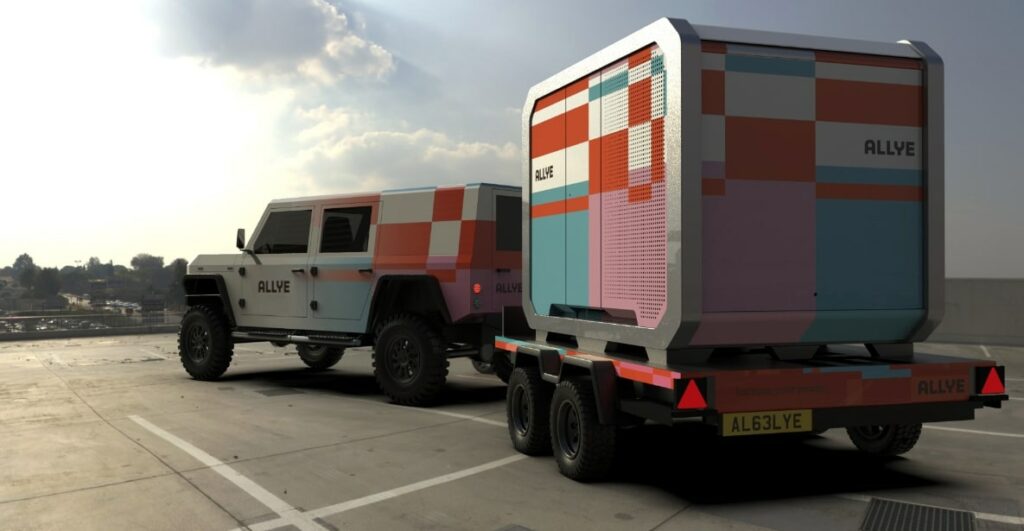
The money will go towards scaling up production of its Max solution, a mobile BESS unit which Allye claimed is the “world’s first mobile energy storage system to repurpose healthy battery packs from electric vehicles (EV)”.
Repurposing of used EV batteries into BESS units, or second life energy storage, has been covered extensively by Energy-Storage.news.
Try Premium for just $1
- Full premium access for the first month at only $1
- Converts to an annual rate after 30 days unless cancelled
- Cancel anytime during the trial period
Premium Benefits
- Expert industry analysis and interviews
- Digital access to PV Tech Power journal
- Exclusive event discounts
Or get the full Premium subscription right away
Or continue reading this article for free
Max is a 300kWh unit that Allye is aiming to deploy as a replacement for diesel generators, which are often used in construction sites but also by the UK’s grid operator National Grid and smaller distribution network operators (DNOs) to maintain regional networks.
It expects to provide its first systems for industrial users in Q3 this year, and is targeting 10,000 Max units by 2030 with an installed capacity of 3GWh. From that year onwards, it wants to install 5,000 units annually. Target revenues for 2024 are £8.5 million with £45 million in 2025.
Allye CEO Jonathan Carrier said in a statement: “Elbow Beach Capital and Alpha Future Funds
share a commitment beyond the financial. They believe smart energy storage can accelerate
the decarbonisation of the electricity grid and help businesses and households access
cleaner, cheaper energy. This investment will provide us with the platform for future success.”
The company also wants to develop solutions for commercial and residential markets.
Allye’s claim of its product being a world-first may be true of a proprietary mobile BESS solution developed in-house by a company, but it is unlikely to be the first time that EV batteries have been configured into such a unit.
Norwegian firm Evyon last year told Energy-Storage.news for Vol.33 of PV Tech Power, Solar Media’s quarterly technical journal for the downstream solar industry, that it was selling its second life BESS solution to companies building charging solutions for construction sites, which would presumably be ‘mobile’ to some extent.
Allye’s founding team of Jonathan Carrier, Jack Levy and Lorenzo Bergamaschi bring automotive industry experience from Arrival, McLaren and Jaguar Land Rover.
Mobile BESS solutions hold much promise thanks to being greener and quieter than diesel generators. US company Moxion recently saw California Governor Gavin Newsom visit its factory in the state which, once operational, promises to have an annual production capacity of 7GWh. Tech giant Amazon recently ordered its products for film and TV production sites.