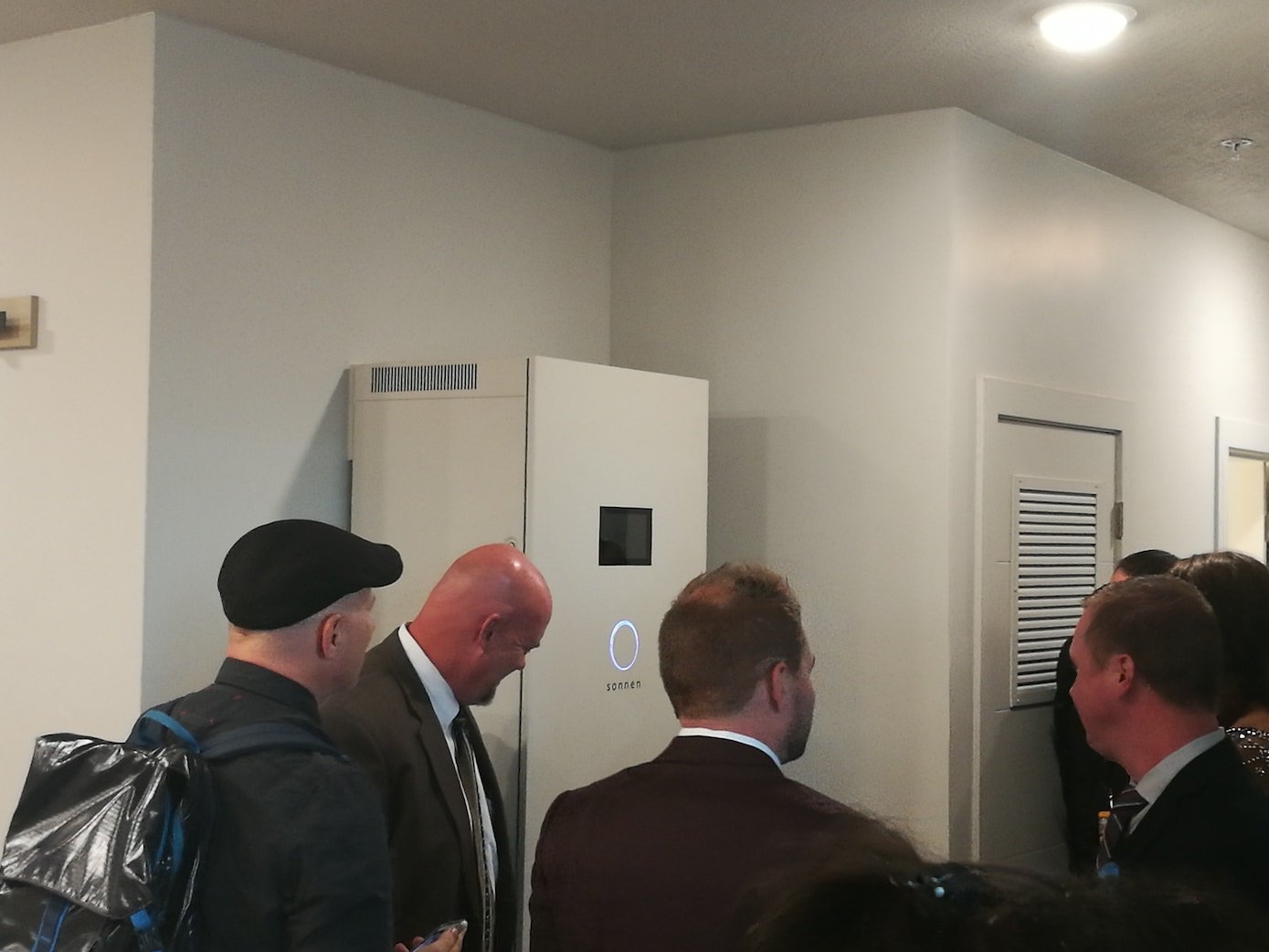
Blockchain technology and a digital trading platform is enabling sonnen’s latest virtual power plant (VPP) project in northeast Germany to store wind energy that would otherwise be curtailed and ‘lost’.
The company’s head of e-services, Jean-Baptiste Cornefert, told Energy-Storage.news that the VPP, which allows wind power generated locally to be stored and then used in sonnen’s residential battery energy storage systems, proves that the concept can work “under real life conditions”.
With the sonnen battery systems acting together as one large-scale energy storage system, the regional distribution system operator (DSO) is able to dispatch wind energy into them, preventing the local power grid from becoming overloaded or congested.
“For now, the project is running very well. Basically the need for grid services like network congestion [mitigation] is quite large. Proofing the technology under real life conditions – and not in a lab – is the first step to participate in this market,” Jean-Baptiste Cornefert said.
Try Premium for just $1
- Full premium access for the first month at only $1
- Converts to an annual rate after 30 days unless cancelled
- Cancel anytime during the trial period
Premium Benefits
- Expert industry analysis and interviews
- Digital access to PV Tech Power journal
- Exclusive event discounts
Or get the full Premium subscription right away
Or continue reading this article for free
So far, just a “double digit number” of battery systems are connected to the VPP. While perhaps being less ambitious in numbers of units connected than some other recent projects of its type, the project helps to prove that automated actions by the DSO and the VPP can be done using a flexibility platform and registered and logged using blockchain.
In this instance, that platform is the Energy Web Foundation’s (EWF) Energy Web Chain, an open-source decentralised blockchain platform. EWF has a digital exchange, called ‘EW Origin’, on which any surplus of wind energy can be registered and then matched to available capacity in sonnen battery systems.
Sonnen’s customers can sign up to SonnenFlat, the company’s subscription service to participate: in exchange for making their battery system available for grid services, they pay a flat rate for electricity on a monthly basis.
‘Blockchain as a technology still has room to grow’
“Currently, the only tools DSOs have to fight local network congestion is curtailing generation,” Zoltán Maric, sonnen’s team leader in blockchain development said.
“Physically, what could also help is incentivising an increase in demand in the local network where there is excess generation. This is what this project does and shows.”
However, some barriers exist to widespread adoption of solutions of this type, Maric said, with current regulation and incentive structures in Germany only allowing DSOs to pay renewable energy generators to stop generating energy rather than using their network fees – which are levied from all users – to increasing demand for renewable energy to be utilised.
Those grid network fees account for as much as 20% of energy prices in Germany. These could be lowered in those locations where this type of congestion happens, the sonnen representative suggested.
On a technical level, the lack of common blockchain protocols for energy trading and sharing is another barrier, Zoltán Maric said, with open-source libraries for blockchain communication not yet widely available or actively developed across all computer programming languages.
“It is noticeable how blockchain as a technology still has room to grow. Integrating the interfaces of our VPP with smart contracts on the Energy Web Chain is significantly more tedious than integrating with established API technologies like REST,” Maric said.
Sonnen e-services head Jean-Baptiste Cornefert in fact wrote a feature article about a previous trial sonnen participated in on a national level with transmission operator TenneT for this site a couple of years back, also using blockchain to help balance and integrate wind energy via household battery systems. His colleague Maric clarified that while this project is similar, it works on a local scale instead, and is more advanced in that it utilises the EW Origin software as a “flexibility marketplace” that “enables transparency in the bid selection process” used by distribution and transmission network operators.
“In other words, anyone can check that bids are picked in a fair way,” Zoltán Maric said.