A busy week of grid-scale BESS project news from Germany, with numerous development, project, optimisation and tolling partnerships announced.
The announcements show various companies either entering Germany for the first time (such as Masdar, Zenobe and RP Global), scaling up their ambitions (like Enlight), or offering solutions to those wishing to do so.
Enlight buys majority stake in 150MW solar, 2GWh BESS project
Israel-headquartered IPP Enlight has signed an agreement to acquire a stake in Project Jupiter, a large-scale co-located solar and energy storage project in Germany, in partnership with investment manager Prime Capital.
The project has a 500MW grid connection and is targeting ready-to-build (RTB) status in late 2026.
Try Premium for just $1
- Full premium access for the first month at only $1
- Converts to an annual rate after 30 days unless cancelled
- Cancel anytime during the trial period
Premium Benefits
- Expert industry analysis and interviews
- Digital access to PV Tech Power journal
- Exclusive event discounts
Or get the full Premium subscription right away
Or continue reading this article for free
Enlight is expected to acquire 51% to 60% of the shares in the project with Prime Capital, via its fund PGEIF II, holding the remaining shares.
Jupiter will require €470-500 million (US$560-600 million) of investment, with average revenue during the first five years of approximately €85-90 million and EBITDA of €70-80 million.
It would be among the largest battery energy storage system (BESS) projects in Germany.
RWE and Masdar partner on Germany battery projects
Power firm RWE has partnered with UAE state-owned investor Masdar for BESS investments in Germany.
The two companies will explore the creation of a joint venture (JV) targeting 1GW of capacity by 2035.
Mohamed Jameel Al Ramahi, CEO of Masdar, said: “Germany is an important market for Masdar as we progress toward our target of 100 gigawatts of capacity worldwide by 2030 and we look forward to building on our already powerful partnership with RWE to support energy transformation in Germany and across Europe.”
The partnership was announced alongside one between RWE and the Abu Dhabi National Oil Company (ADNOC), another UAE state-owned enterprise, concerning liquified natural gas (LNG) exports to Europe.
Note that RWE is already a major player in the German BESS industry. It is among the leading owner-operators by operational capacity in the country, and this year and last year started building separate 400MW systems, among the largest to reach that stage.
Zenobē announces German market entry
UK-based BESS owner-operator Zenobē has announced its intention to acquire transmission-level BESS projects in Germany.
The company is actively hiring a German team to support its growth ambitions, and wants to acquire at least 1GW/4GWh of BESS projects in Germany by 2030. It is actively engaged with offtakers for its projects, it added.
Zenobē pointed to its deep experience in the UK market, with 1.3GW/2.5GWh either in operation or under construction. Most of that is at transmission-level, and much of it is providing advance grid-forming services to the National Energy System Operator (NESO).
Germany’s four transmission system operators (TSOs) recently launched procurements for such services.
Co-founder and director James Basden said: “This is a fantastic opportunity for Zenobē to bring its deep technical expertise and proven track record of developing and operating transmission-scale BESS to Germany to solve the challenges of achieving a zero carbon grid.”
RP Global and MaxSolar forge investment-EPC partnership
Investor RP Global has entered into a memorandum of understanding (MOU) with MaxSolar, an EPC provider and IPP, to develop and implement solar and storage projects in Germany.
The partnership focuses on the joint development, financing, construction and operation of the ground-mounted projects.
RP Global will be project investor and long-term owner while MaxSolar will deliver the projects on a turnkey EPC and long-term O&M basis.
The firms are targeting 100MW of projects a year. They are already working together on Harbke, a 49.5MW solar PV project, while another PV project will start construction in the first half of this year, under the new MOU. The projects under the MOU will have a big emphasis on including energy storage, the companies said.
The Mobility House Energy and Electrohold Group offer tolling in Germany
Vehicle-to-grid (V2G) and optimisation firm The Mobility House (TMH) has partnered with Bulgaria-based Electrohold Group to offer BESS tolling solutions in Germany.
Electrohold Groups is the energy trading arm of IPP and transmission & distribution network owner Eurohold Bulgaria, and the pair have partnered on BESS optimisation in the latter’s home market.
Together, they are now offering Germany BESS project owners and investors tolling solutions. That means they will provide those owners with some level of fixed revenues in return for the control and profits from optimising the BESS projects. Tolls can cover the full or partial capacity of a project.
TMH will bring its experience of optimisation while Electrohold can use its big backing to support bankability, including a security bond structure covered by A-rated reinsurers, it said.
Germany is consistently rated as one of Europe’s most attractive markets, but many commentators say there is currently a relatively shallow pool of such offtakers for BESS projects.
Leandra Boes, director of asset management for owner-operator Green Flexibility recently told Energy-Storage.news: “The majority of projects in Germany are still reaching Final Investment Decision (FID) without securing tolling or other fixed revenue arrangements. While numerous market participants are actively exploring fixed revenue structures, only a limited number proceed to execution, largely because tolling off-takers apply steep risk discounts.”
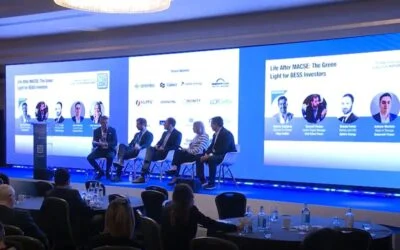
Boes will be a speaker at the upcoming Energy Storage Summit 2026 in London, taking place 24-25 February at InterContinental London – The O2. Use the discount code ESN20 for a 20% discount, while ESN Premium users can get 30% off.