In this news roundup, Unigrid, Inlyte Energy, CIUDEN, and Sunamp are advancing non-lithium energy storage technologies worldwide.
Unigrid’s sodium-ion battery looks to match solar panel lifecycle
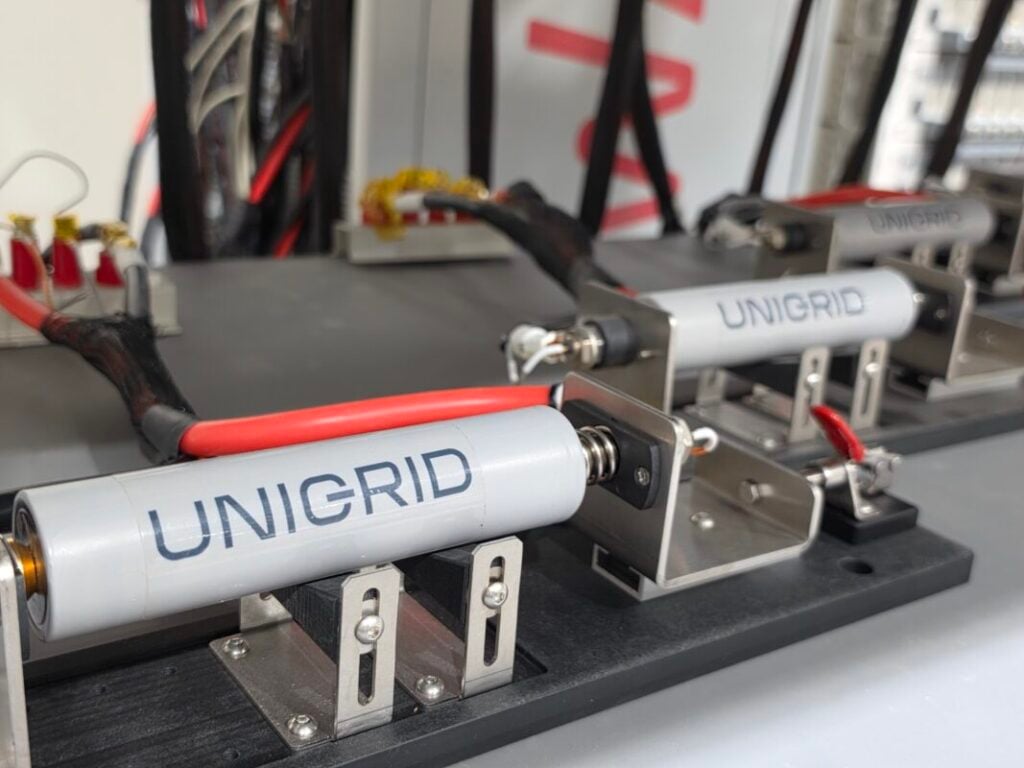
US sodium-ion (Na-ion) battery technology company Unigrid announced its proprietary sodium cobalt oxide (NCO) chemistry achieved 5,000 full-depth cycles, 100% depth of discharge, with greater than 95% capacity retention in commercial-grade cells.
The company claims the milestone translates to an expected cycle life of 20,000 and operational life of up to 25 years.
Lithium iron phosphate (LFP) batteries have a cycle life of up to about 12,000 cycles, which is higher than that of many other lithium-ion (Li-ion) batteries.
Try Premium for just $1
- Full premium access for the first month at only $1
- Converts to an annual rate after 30 days unless cancelled
- Cancel anytime during the trial period
Premium Benefits
- Expert industry analysis and interviews
- Digital access to PV Tech Power journal
- Exclusive event discounts
Or get the full Premium subscription right away
Or continue reading this article for free
The claimed operational life of Unigrid’s battery, up to 25 years, would align with the typical lifespan of solar PV panels, reducing costly battery replacements.
Darren H. S. Tan, CEO of Unigrid, stated, “Instead of planning for costly battery replacements halfway through a project, operators can now align storage with the full life of their solar assets. That opens the door to more predictable financing models like Battery-as-a-Service and long-term energy leasing, while reducing risk and lowering lifetime costs across the grid.”
In January, Unigrid began international shipments of its NCO cathode cells at commercial volume. At that time, the company claimed to be the first battery company outside of China to export Na-ion cells at scale. It also stated it would begin fulfilling off-take agreements later in the year.
Unigrid uses a fab-less, foundry-subscription model, partnering with manufacturers to expand its proprietary NCO cell chemistry instead of building expensive gigafactories. This enables quick global expansion, delivering Grade A cells in 40-foot containers.
After certifying its Na-ion cells with UN38.3 for safe transport last year, Unigrid moved from pilot to full-scale exports by 2025. These shipments marked the first Na-ion exports at several ports, which had to adapt procedures for this battery chemistry. Transporting cells safely is complex; the US National Fire Protection Association (NFPA) is developing NFPA 800, a standard that addresses all aspects of battery transport and storage.
Inlyte Energy partners with Ervin Industries to expand domestic supply chain
US-based iron-sodium battery manufacturer Inlyte Energy has announced an agreement with metal abrasives manufacturer Ervin Industries to engineer iron powder formulas to optimise Inlyte’s battery performance and expand its domestic supplier base.
Inlyte’s system uses sodium metal chloride (SMC) battery technology, also known as ZEBRA batteries, which have been in use for over 40 years.
Previously speaking with Energy-Storage.news, CEO Antonio Baclig said, “Inlyte Energy’s technology is an iron-sodium battery, which falls under the category of SMC batteries, also known as ZEBRA batteries, which have a 40+ year history. This technology utilises the conversion chemistry of iron and sodium chloride, with solid beta-alumina as the electrolyte and molten NaAlCl4 as a catholyte.”
Inlyte asserts that using domestically available materials like iron provides a way to advance energy storage by utilising existing American industrial infrastructure.
Ervin provides engineered iron materials for various industrial sectors such as surface preparation, metalworking, and advanced manufacturing. The company uses recycled metals to produce these materials, ensuring a sustainable and affordable base for battery manufacturing. Collaborating with Inlyte, Ervin aims to refine specifications, enhance production methods, and improve material characteristics to support large-scale battery deployment.
Inlyte says it is making further progress toward establishing manufacturing and commercialisation in the US, with plans to select a site for its first domestic production facility in 2026. In collaboration with HORIEN Salt Battery Solutions, Inlyte aims to introduce sodium battery systems manufactured in the country, with commercial deliveries scheduled for 2027.
CIUDEN completes operational testing of VRFB-equipped energy storage facility
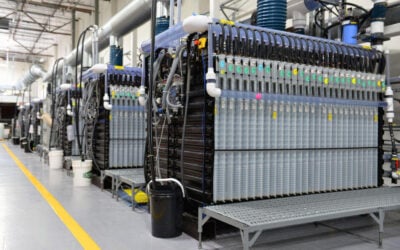
La Fundación Ciudad de la Energía (CIUDEN), which reports to Spain’s government Ministry for Ecological Transition and the Demographic Challenge (MITECO), has completed operational testing of an energy storage facility using vanadium redox flow battery (VRFB) technology.
This 1MW/8MWh ESS features a 100kW/800kWh experimental module for various R&D tests. The €6,4 million (US$7.3 million) contract was awarded to Spanish company CYMI and includes South Korean company H2 Inc.’s technology. This technology relies on the vanadium redox reaction across four oxidation states, stored in multiple electrolyte tanks. It offers a lifespan of over 20 years and supports power-energy decoupling.
The ESS is a component of CIUDEN’s project focused on producing green hydrogen, sustainable synthetic fuels, and energy storage. It is financed by the European Union’s Recovery, Transformation and Resilience Plan (RTRP) and Next Generation EU. The goal is to gather technical data to support the industrial-scale development of various technologies, enabling the determination of their optimal operating conditions and helping to promote industry decarbonisation.
Along with the flow batteries, the project hosts sodium-sulfur (NaS) battery systems, which have a capacity of 1MW/5.8MWh, and Li-ion systems with 600kW/1.3MWh, installed during 2025 at the Cubillos del Sil Technology Development Centre, CIUDEN will have an overall energy storage capacity of approximately 15MWh
In 2024, H2, Inc deployed a 1.1MW/8.8MWh VRFB in a project CIUDEN, as part of a programme funded by MITECO. The programme sought to deploy a long-duration energy storage (LDES) solution capable of providing maximum power for eight hours, and H2 won the bid in collaboration with local Spanish firms.
In the same year, Enel Green Power launched what was then believed to be the largest VRFB in Mallorca, Spain. This 1.1MW/5.5MWh system was installed at Enel Green Power España’s 3.34MWp Son Orlandis solar PV plant, located in the Palma municipality. Largo Clean Energy supplied the VRFB.
Sunamp launches thermal energy system for commercial, industrial, and manufacturing sectors
Sunamp, a Scotland-headquartered manufacturer of thermal energy storage technology, has launched Central Bank Mini, its first dedicated product for the commercial, industrial, and manufacturing sectors.
Sunamp explains that Central Bank Mini is engineered to effectively capture and utilise the complete potential of waste heat and low-carbon energy sources. It is a thermal energy storage system that stores and releases heat across a wide range of industrial temperatures.
Using Sunamp’s proprietary Plentigrade phase change material (PCM) technology allows the system to absorb heat during charging and release it when needed. This helps businesses recover waste heat, stabilise energy loads, cut fuel use, and lower carbon emissions.
Plentigrade is a non-toxic PCM developed in partnership with the University of Edinburgh. It is engineered to store heat much more effectively than water and can serve as a replacement or supplement to traditional heating systems such as boilers in both homes and businesses.
The company claims that the product integrates with the various heat sources present across modern industrial sites and heat networks, and can harvest energy from numerous sources, including chiller heat rejection, process cooling and heat exchange, air and flue gas heat recovery, and air compressor cooling. It covers charge temperatures from 50°C to 120°C and discharge temperatures from 33°C to 85°C.
This previously lost energy can be redeployed into valuable plant services such as process heating, space heating, HVAC, steam preheat, hot water generation, and cooling through absorption chillers.
Sunamp explains, “For food and beverage manufacturers, for example, this could mean significantly lower electricity or gas or oil use for warming, pre‑heat and essential ancillary processes and smoother, more reliable heat supply across batch operations and fluctuating boiler loads.”
The company also highlighted that in Kitakyushu City, Japan, IHI Corporation used Sunamp’s Central Bank Mini P58 to capture surplus boiler heat from a soap plant and deliver it to a neighbouring factory through an underground pipe.
Using Sunamp’s Plentigrade PCM technology, “the system stored up to 80kWh of heat with minimal losses and supplied stable, hygienic, controllable heat on demand. The results were immediate operational savings and long-term resilience with a 30% reduction in system costs and CO₂ payback in under one year.”