Sports car company Porsche has deployed a 10MWh BESS at its factory in Germany using batteries from its Taycan vehicle line.
The company has deployed 4,400 modules from preseries, works and research & development (R&D) Taycan vehicles into the second life BESS project to help power its factory in Leipzig, Germany.
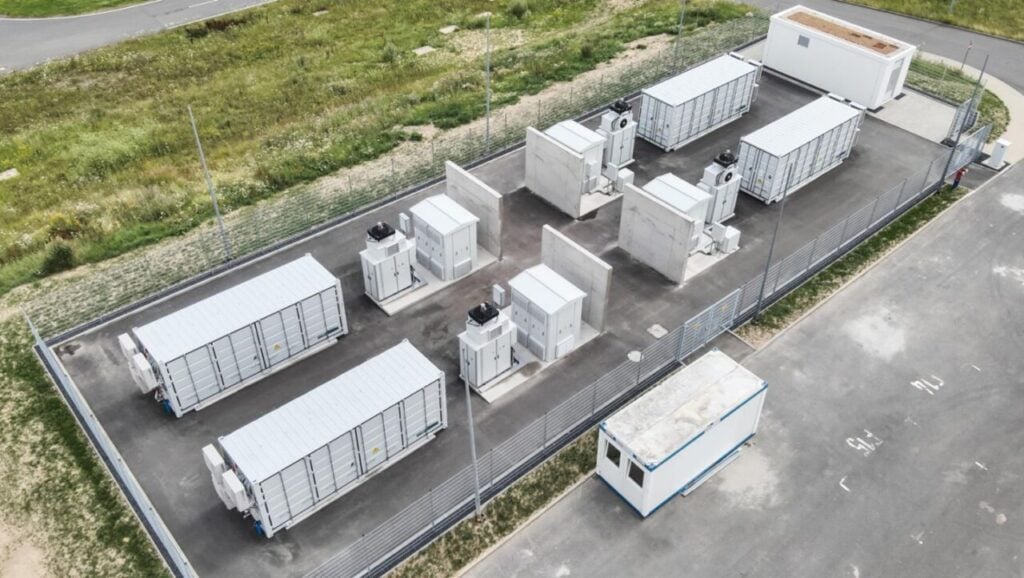
The project has a power output of 5MW and an energy storage capacity of 10MWh and can be operated at up to 20% overload for short periods. The 4,400 modules are divided into four BESS containers, pictured above.
The four BESS strings are each connected to an inverter and a medium-voltage transformer, and the entire project has a useful life of over ten years. The BESS is partly powered by the plants solar array which totals 9.4MW, and has numerous use cases.
Try Premium for just $1
- Full premium access for the first month at only $1
- Converts to an annual rate after 30 days unless cancelled
- Cancel anytime during the trial period
Premium Benefits
- Expert industry analysis and interviews
- Digital access to PV Tech Power journal
- Exclusive event discounts
Or get the full Premium subscription right away
Or continue reading this article for free
Alwin Schmid, head of electrical engineering at Porsche, said the project was both about the environmental aspect of reusing batteries but also ‘stacking’ revenues and use cases of the BESS in an innovative way.
“Of course, this is about environmental aspects and the core issue of the energy supply. But it was also important to us to take a pioneering role with the storage system.”
“In this unprecedented model project, we were able to combine a number of different goals, including peak load capping, optimisation of self-consumption and simultaneous participation in the energy market.”
It will be fully integrated into the energy market ‘in very marketable form’ by the end of the year, Porsche added.
The company want to make the Leipzig plant more economical and increase its self-sufficiency, said Jonathan Dietrich, overall project manager for battery storage at Porsche.
“We hope to gain insights from the project in order to be able to equip other Porsche locations with similar systems and capabilities in the future. At the same time, we can utilise batteries from test cars that are no longer suitable for demanding use in the vehicle for a second useful deployment before their final recycling,” he said.
Project is one of the larger second life BESS around
The project is one of the larger BESS projects around deployed using repurposed EV batteries. The largest Energy-Storage.news is aware of are 12MWh and 28MWh systems in California, both deployed by firm B2U.
In Germany, three totalling 25MWh will be built by ABO Wind and Tricera while a 25MW system commissioned two years ago was partially made up of second life batteries.
Second life BESS technology holds promise and will continue to be deployed as the stock of used EV batteries grows, but rapid price falls of new batteries and BESS has reduced the economic benefits of doing it (Premium access article).
One electric vehicle (EV) company executive working on energy storage recently told Energy-Storage.news that the firm had looked at second life BESS in great detail but that the maths behind it no longer added up.