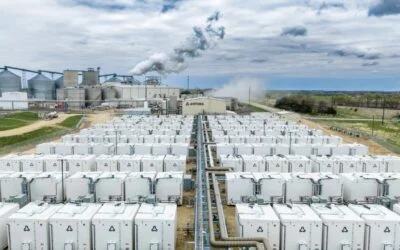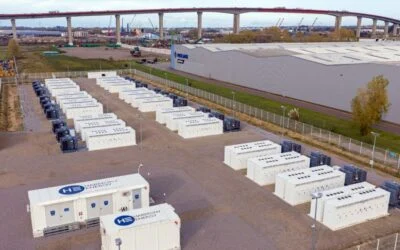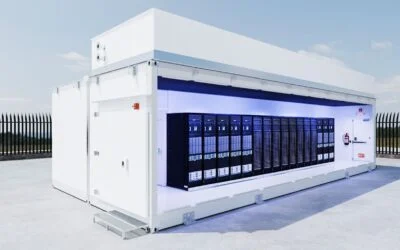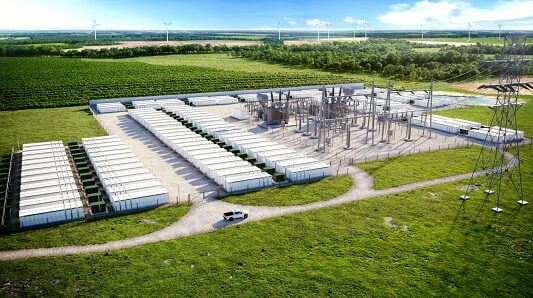
Ontario’s electricity system will be able to handle rising demand over the next year and a half, thanks in part to new battery energy storage systems (BESS).
That’s according to an assessment by the Ontario Independent Electricity System Operator (IESO), which is responsible for operating the Canadian province’s bulk electricity system and electricity market.
The IESO has just published its Q1 2025 Reliability Outlook (PDF download), covering the 18-month period spanning April 2025 to September 2026.
As has been previously reported by Energy-Storage.news back in mid-2023, as the IESO prepared to launch a major energy storage procurement, Ontario is now facing significant growth in electricity demand for the first time since 2005.
Try Premium for just $1
- Full premium access for the first month at only $1
- Converts to an annual rate after 30 days unless cancelled
- Cancel anytime during the trial period
Premium Benefits
- Expert industry analysis and interviews
- Digital access to PV Tech Power journal
- Exclusive event discounts
Or get the full Premium subscription right away
Or continue reading this article for free
Load growth drivers include electric vehicle (EV) manufacturing facilities, data centre developments and heavy industry including electric arc furnaces. Meanwhile, Ontario’s population increased by about 3.2% in 2023 and again in 2024.
Along with new renewable energy generation and energy storage including long-duration energy storage (LDES), the province is banking on nuclear, some gas and demand-side resources.
Peak demand is projected to increase by 1,000MW between Summer 2025 and Summer 2026 and the IESO said it would need to work closely with market participants to coordinate outages as it expects conditions to be ‘tight’ in the summer of next year.
The impact of the sudden frostiness in US-Canada relations may also have an as-yet-unknown bearing on the outlook, with Ontario currently importing some power from New York State, although it has a larger Capacity Sharing Agreement with Quebec.
Procurements account for nearly 3GW of energy storage output
Beyond the immediate term, the IESO expects a ‘considerable amount’ of energy storage to connect to the Ontario grid, it said in the report.
Among these is the ‘flagship’ Oneida BESS, a 250MW/1,000MWh project which achieved financial close in 2023. Oneida is owned by a consortium comprising independent power producer (IPP) Northland Power, electrical works contractor Aecon and a joint venture (JV) between the First Nations community Six Nations of the Grand River—on whose land it will be built—and developer NRStor.
While the CA$800 million (US$558.57 million) project has received some financial backing from government schemes, NRStor chief development officer Jason Rioux told ESN Premium in a May 2023 interview that the BESS will generate revenues from a mix of long-term contracting and merchant markets (Premium access).
Around 60% of the revenue stack will comprise payments from its 20-year contract with the IESO, which will have the right to charge and dispatch the asset to help meet peak demand. The remainder will come from wholesale market participation, including the delivery of ancillary services.
The IESO also looks forward to the start of commercial operation at BESS assets awarded contracts through its 2023 Expedited Long-Term 1 (LT1) request for proposals (RfP).
Expedited LT1, launched in 2022, saw the award of contracts to resources in two tranches, with 739MW announced in May 2023 and a further 142MW of projects selected for contracts with the system operator in June of that year, for a total of 881MW.
Energy-Storage.news has reported on several of those projects, both collectively and individually. That included the late 2024 financial close on Canada’s biggest committed BESS project to date, the 300MW/1,200MWh Hagersville Battery Energy Storage Park by Boralex and Six Nations of the Grand River Development Corporation.
Ontario IESO has also held a second RfP, Long-Term 1 (LT1 RFP). Results were announced in May 2024, with 1,748.22MW of battery storage selected alongside 410.69MW of non-storage biogas and natural gas resources for a total of 2,194.91MW.
At the time of the announcement, Ontario energy minister Todd Smith said the average price of winning bids in LT-1, at CA$672.32/MW, was 24% lower than the CA$881.09/MW average price of winning bids in ELT-1.
Through the two RfPs, Ontario IESO had anticipated the procurement of between 1,500MW and 2,500MW of storage of a total 4,000MW new capacity, but factoring in LT-1, ELT-1 and the Oneida project, the province secured 2,915MW of storage resources. LT-1 projects will start coming online in 2027.