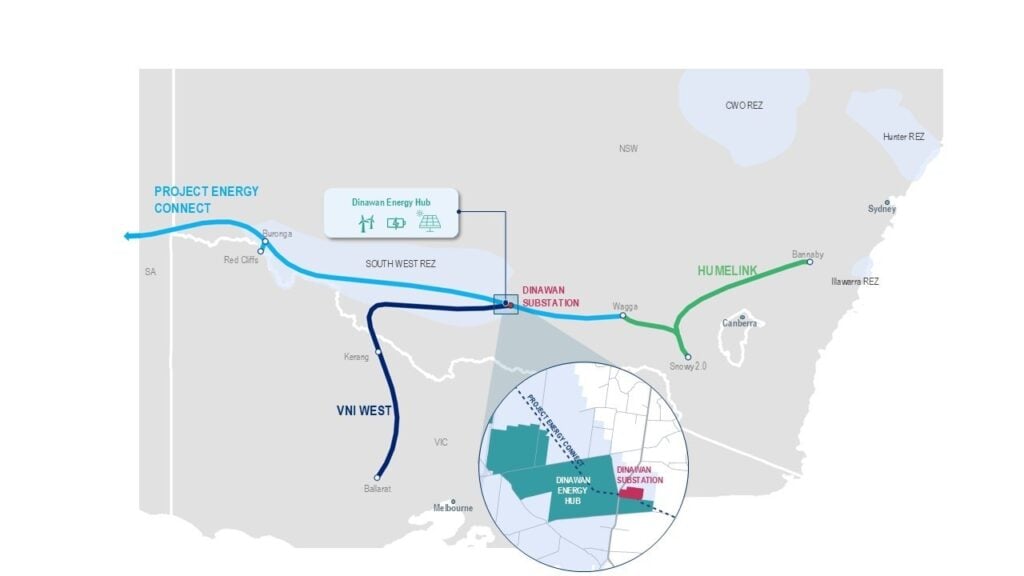
The New South Wales (NSW) Independent Planning Commission (IPC) has approved Spark Renewables’ Dinawan Solar Farm, an 800MW solar project paired with a 356MW/1,574MWh battery energy storage system (BESS).
The approval follows an assessment process that included a two-member IPC panel conducting site inspections, receiving 43 written submissions, and holding community stakeholder meetings with 13 community members.
The application was referred to the IPC for determination after more than 50 public objections were lodged with the Department of Planning, Housing and Infrastructure during its assessment period.
Located approximately 30km south of Coleambally and 30km north of Jerilderie within the Murrumbidgee Local Government Area, the project forms the solar component of the broader Dinawan Energy Hub, being developed by Dinawan Energy Hub Trust, a wholly owned subsidiary of Spark Renewables.
Try Premium for just $1
- Full premium access for the first month at only $1
- Converts to an annual rate after 30 days unless cancelled
- Cancel anytime during the trial period
Premium Benefits
- Expert industry analysis and interviews
- Digital access to PV Tech Power journal
- Exclusive event discounts
Or get the full Premium subscription right away
Or continue reading this article for free
The approved development includes associated infrastructure such as substations, a temporary accommodation camp and temporary construction compounds.
In its Statement of Reasons for Decision, the Commission found that the project would assist in “improving grid stability and energy security” and aligns with NSW government commitments to transition to renewable energy.
The Dinawan Solar Farm’s approval represents a critical component of the larger Dinawan Energy Hub, a proposed 2GW hybrid wind, solar and storage project situated on the traditional lands of the Wiradjuri people and several smaller nations of the Murrumbidgee plains.
Last year, the project was among those awarded the right to connect to the South West Renewable Energy Zone (REZ), with a capacity of 1,007MW across solar, wind and battery storage, and was the only project in that round to incorporate solar PV.
The solar-plus-storage project’s location positions it on the route of the EnergyConnect interconnector, which will run between Robertstown, South Australia and Wagga Wagga, New South Wales.
Transmission operators ElectraNet and Transgrid are developing the 900km EnergyConnect interconnector, which will enhance the capacity and flow of renewable energy between the two states.
Dinawan is also positioned to support the proposed HumeLink and VNI West interconnectors, enhancing its role in facilitating renewable energy transmission across the National Electricity Market.
Earlier this year, the Dinawan solar and wind components were both included in the list of fast-track approvals for projects as part of the formation of the Investment Delivery Authority.
As reported by Energy-Storage.news last month, the newly established organisation endorsed 16 projects worth a collective AU$34.4 billion (US$22.1 billion) with the energy portfolio spanning pumped hydro storage, battery storage systems, wind farms, solar PV power plants, and gas infrastructure, distributed across multiple REZs, including the South West REZ and Central West Orana REZ.
Addressing community concerns through conditions
The IPC panel, comprising Suellen Fitzgerald as Chair and Simon Smith, considered a range of concerns raised by local stakeholders regarding cumulative impacts, traffic and roads, noise, contamination, social impacts, emergency planning, local infrastructure, and insurance.
The Commission has imposed conditions of consent to minimise the project’s adverse impacts, though the specific details of these conditions were not elaborated in the determination announcement.
Community submissions revealed particular concerns from neighbouring landholders about the cumulative impact of multiple renewable energy developments in the region, including the approved Pottinger Wind Farm, the proposed Bullawah Wind Farm, and the approved Yanco Delta Wind Farm.
The Bundure District Landholder Group raised issues about baseline environmental testing, chemical residue management, fire risk, and the adequacy of regulatory oversight during construction and operation.
Spark Renewables has committed to a benefits, upskilling, and industry program that includes over 30 commitments supporting the clean energy transition through a community fund for local initiatives, advancing First Nations’ access to workforce participation, and next-generation training and education opportunities.
The company also confirmed it will provide direct community funding via a Voluntary Planning Agreement with Murrumbidgee Council, contributing AU$1,050 per megawatt from the wind farm and AU$850 per megawatt from the solar PV power plant annually once construction of each stage commences.
Interested in Australia? Read Energy-Storage.news’ Energy Storage Summit Australia coverage and related content.