
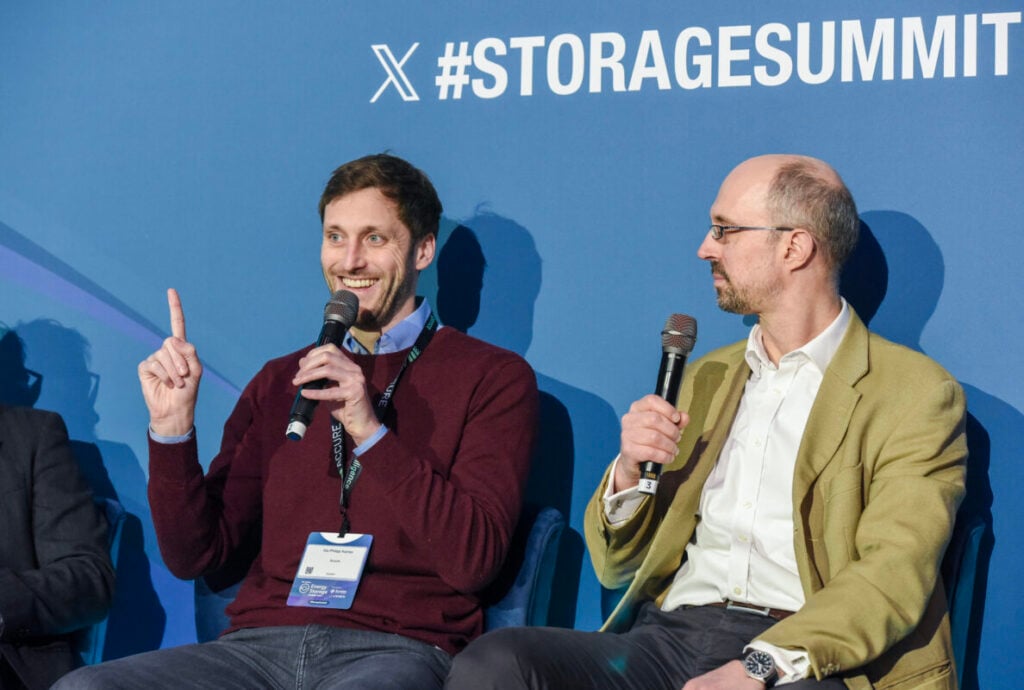
Energy-Storage.news speaks to Dr. Kai-Philipp Kairies, CEO and co-founder of ACCURE Battery Intelligence, ahead of the upcoming Energy Storage Summit USA 2026.
ACCURE Battery Intelligence is a predictive battery analytics platform that manages safety, health, and performance for energy storage systems (ESS) worldwide.
Kairies will be giving a presentation on ‘Turning SOC accuracy into 5%+ more trading revenue in ERCOT’ at ESS USA 2026, focusing on state of charge (SOC) misalignment, dispatch data, and validated financial results.
Energy-Storage.news: What do you think is driving the most demand for data analytics solutions from companies such as ACCURE right now, and where do you see the biggest growth opportunity over the next two to three years?
Try Premium for just $1
- Full premium access for the first month at only $1
- Converts to an annual rate after 30 days unless cancelled
- Cancel anytime during the trial period
Premium Benefits
- Expert industry analysis and interviews
- Digital access to PV Tech Power journal
- Exclusive event discounts
Or get the full Premium subscription right away
Or continue reading this article for free
Dr. Kai-Philipp Kairies: I think the energy storage industry is in this really interesting phase of growing maturity. We’ve got real money flooding in. Funds have their first couple of years of experience with limited portfolios, and now everyone’s scaling up. As you scale up in a maturing industry, operational excellence becomes so much more important.
On the first couple of assets, market conditions were really good, and so you didn’t even have to capture all of the potential value to have a really successful year. In those early years, even if you just caught 90% of that, you were doing well. But now, as more and more players flood the market, margins are compressed, and portfolios grow larger, small changes in your efficiency can yield tens of millions of dollars across these portfolios. These are numbers that are worth looking into.
What we provide is visibility into where revenue erosion occurs and what they can do to fix it. We just had a beautiful case study in ERCOT where we showed that a very experienced owner-operator left 5% of revenue on the table because of inefficiencies they weren’t even aware of. I think that’s really why we exist.
What do you think is the biggest problem battery analytics can solve for battery operators that they can’t solve for themselves?
I think there are two dimensions in which we support the industry. One dimension is risk reduction and quality assurance—making sure you get what you pay for and that your financial model isn’t disrupted by rare but highly impactful events, like a fire or hardware failure. As in all other industries, these quality assurance topics are handled by independent third parties for many reasons.
We have a very broad view into the market, and so we know what will go wrong in the field, and we can apply that knowledge to the individual portfolio. Internal teams always need to look after these things, but they have limited experience and exposure, so our breadth of knowledge just really augments their capabilities. Also, we work with insurance groups that are more comfortable when an independent third party takes a look at the asset and when best practices are really put into practice. So that’s on one hand.
And then the other side is really the performance optimisation. How can I squeeze out a little more lifetime value or a little more revenue from the asset? And what we bring to the table is analytics, including predictive analytics, with a depth of physical detail. It’s just not feasible to have 15 or 20 PhDs in one owner-operator company. I mean, they’re hard to hire, expensive, and inefficient.
For some of the really specialised tools that we provide, it just doesn’t make sense to build those capabilities in-house, but it’s definitely worth applying them. Thinking about those 5% more revenue—that’s definitely something everyone should implement as market conditions get more challenging and portfolios increase in size. But I wouldn’t advise anyone to hire 20 PhDs. I can sometimes tell you how to work with them.
What feedback are you receiving from your customers? Are they reporting increased revenue and growth from using ACCURE, or do they mainly focus on the detailed analytics breakdown?
This is something we have to learn over time. It depends on who you talk to. The operational teams, engineers who are responsible for keeping the lights on, what they most like is that we make their life easier and that they have a sparring partner to discuss a couple of edge cases with. Typically, those people are extremely overworked. Those departments are always understaffed, and then management adds new sites, which just adds more responsibility for the same number of people.
When we come in and provide customers with tools that reduce the number of tedious, small tasks they need to do, they can focus on the high-value things and spend an hour more with their family every day. That is the best return on investment for them.
But then, of course, in order to justify the expenses, the chief financial officer might say, “Hey, I love that my team gets more sleep, but it doesn’t pay the bills. How do you show return on investment?” For those folks, the revenue uplift or savings on insurance premiums—it’s very easy. We can just say, “Hey, because the insurance recognises us as a risk-reducing measure, you get better terms.” And the simpler the better. When you talk to a CFO, they don’t have a lot of time. Show them three numbers, and if they add up, that’s good.
On the procurement side, they have to buy equipment worth a billion dollars, sometimes a couple of hundred million. And the way this is happening right now in the storage industry is that the system integrators and the battery companies draft the contracts, and they’re like, “Hey, here’s a standard contract, dear lawyer, please sign on the dotted line.” Then we come in and say, “Look, we have seen these clauses in the contract break in real life because they don’t address some of the most pertinent problems. So please add language that you’re protected against these known issues.” That has been a big part of what we’re doing with our customers. We want to catch issues when they happen and fix them as quickly as possible. But if you set the stage right from the very beginning by drafting the contracts well, you can spare yourself a lot of headaches.
So, three departments, three completely different views on what we do, but it all connects into this operational excellence, or however you want to call it.
How does ACCURE’s experience enable it to identify opportunities?
All startups have some of their founders’ DNA. It just happens inevitably. I’ve been working in the battery space since 2008, so I’m going on 20 years, and since 2012 with an almost exclusive focus on stationary battery systems. ACCURE and the core of our analytical knowledge and the way we think about stationary systems is based on over a decade of experience.
We were very lucky and privileged to have gotten some very large customers early on. We have analysed over 20GWh of battery storage over the years, across all manufacturers, geographies, use cases, etc. And of course, if you already have great algorithms, then you can feed all that data into those algorithms, and they get even stronger.
We’ve created a unique database and algorithm quality that is probably impossible to replicate, and we make it easy for customers to work with it. They don’t have to build a whole framework. They don’t have to hire all these people.
We want to make analytics simple because, in the end, no one really cares about analytics. They care about outcomes. And if my outcome is, “Hey, 5% more revenue, and I just hire ACCURE, and they look after it”—great. If the outcome is good relative to the investment, and we make sure it is, I think there is a long-term position. We see some of the same things in wind and solar for independent companies that focus only on the technical equipment.
The Energy Storage Summit USA 2026 will be held from 24-25 March 2026, in Dallas, TX. It features keynote speeches and panel discussions on topics like FEOC challenges, power demand forecasting, and managing the BESS supply chain. ESN Premium subscribers can get an exclusive discount on ticket prices. For complete information, visit the Energy Storage Summit USA website.